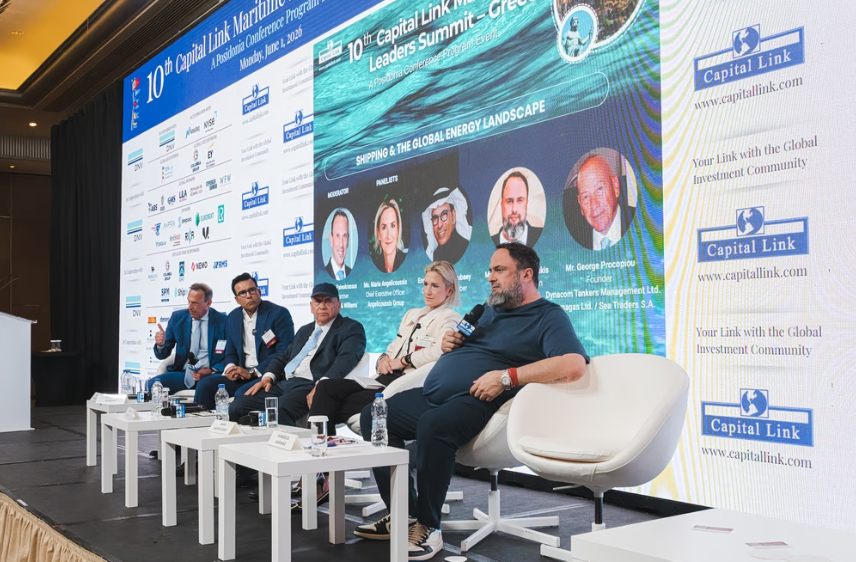
With the participation of more than 1,500 representatives from Greek and international shipping, the 10th Capital Link Maritime Leaders Summit – Greece was held in Athens on the first day of Posidonia 2026. The event was organized with particular success by Capital Link and its president and CEO Nicolas Bornozis. Special interest was drawn to the panel titled “Shipping & the Global Energy Landscape,” which featured leading personalities from shipping and energy, including Evangelos Marinakis, founder of Capital Maritime & Trading, Angelicoussis Group CEO Maria Angelicoussis, founder of Dynacom, Dynagas and Sea Traders George Prokopiou, and Bahri Group CEO Ahmed Ali Alsubaey. The discussion was moderated by George Paleokrassas, Senior Partner at Watson Farley & Williams.
Evangelos Marinakis: shipping must create strategic partnerships
Evangelos Marinakis outlined the strategic landscape of global shipping: from the crisis in the Strait of Hormuz to the shadow fleet and the real impact of Western sanctions.
He appeared optimistic about the outcome of the Middle East war: “I’m quite optimistic that if we wait a few more weeks or months, a solution will be found. And there will be great demand for cargo, to rebuild the stocks that have been depleted.” He noted that “energy stability and energy adequacy are very important — not only for the region, but for states around the world,” emphasizing “that this is something shipping can provide, and we see it’s more important than ever.” He clarified that “ahead of us lies a unique opportunity for shipowners who have a number of vessels in the energy sector, tankers, LPG and LNG, so we can create strategic partnerships with states and ensure that whenever needed and whenever geopolitical issues arise, there will be a reliable partner by their side – not opportunistically, but with a long-term perspective.” He added “that we observe an increasingly growing trend toward such partnerships and agreements, which help our industry continue to develop.”
On the shadow fleet issue, Mr. Marinakis was clear and direct: “First of all, we’ve seen that the governments that should have been very concerned about the shadow fleet, should have acted immediately and banned the activity of these ships. It depends on them to stop it, if they want to. But that didn’t happen. And of course they’re taking a huge environmental risk, especially in the Mediterranean, which is also very important not only for cargo transportation, but also for tourism, for the peoples of Greece, Italy, Spain, France…”
His proposal is specific: “to allow them to withdraw the ships and give them a 60 or 90-day deadline, or even longer, so they can withdraw the shadow fleet. This is the only way we can reduce it. If after the end of the wars the shadow fleet remains, because it offers charterers much cheaper prices, they will use it. This means that all of us, who have invested in technology for new ships and operate according to regulations, will feel that all our investments will be in great danger. Therefore, I believe everyone should pressure the European Union and also the United States to allow and set a deadline for the process to begin.”
Concluding, Mr. Marinakis addressed the sensitive issue of sanctions, noting that his critical position does not contradict compliance: “I said I completely disagree with the sanctions, because, in my opinion, they make no sense. And the only ones punished by the sanctions were European consumers. European countries were not allowed to buy oil from Russia. And we had India buying oil at huge discounts, China buying oil at huge discounts. Even Saudi Arabia was buying oil at huge discounts. And then we had the European Union buying oil products from refineries at exorbitantly high prices. And ultimately, Russia collected more money than before, even with the discount it gave to China, India and Saudi Arabia. The war continues. So where is the impact of the sanctions? When we said this for the first time, everyone started saying: ‘No, you don’t respect the sanctions.’ We respect the sanctions. And because we respect the sanctions, we can express our opinion and say what the real impact of these sanctions is.”
The discussion focused on geopolitical developments, energy security, maritime energy transportation and shipping’s decisive role in maintaining the global supply chain during a period of increased uncertainty.
Maria Angelicoussis: global economy showed remarkable resilience
Opening the discussion, Maria Angelicoussis characterized the conflict with Iran and the closure of the Strait of Hormuz as one of the most serious disruptions to the global energy supply chain in recent decades. Despite the major disruptions, Mrs. Angelicoussis noted that the global economy showed remarkable resilience. Oil prices increased by 50%-60%, while LNG prices in Asia nearly doubled, without reaching the extreme levels many expected. As she explained, this is due to the shift toward alternative fuels, declining demand in certain regions, and the unprecedented release of strategic reserves by the International Energy Agency.
She made special reference to Qatar’s and Das Island’s LNG facilities, which represent about 20% of global LNG exports. Although some units suffered damage, she appeared optimistic about the rapid restoration of flows once safe passage through the Strait of Hormuz is permitted. The head of the Angelicoussis Group also noted that the United States has emerged as a critical pillar of energy security for Europe and Asia, as it continuously increases LNG exports, covering part of the gap created by Middle East disruptions.
Ahmed Ali Alsubaey: warm thanks to Greek shipping
For his part, Ahmed Ali Alsubaey chose to begin his remarks with warm thanks to Greek shipping. As he mentioned, during the first days of the crisis many withdrew from the region, however Greek shipowners continued to operate in the particularly dangerous waters of the Gulf, demonstrating professionalism, knowledge of the region and a sense of responsibility toward the global supply chain.
“It was truly moving to see people who had the courage and continued to operate with us under these conditions,” he said characteristically, paying tribute to Greece’s shipping community for its support during the crisis.
Evangelos Marinakis shared a recent experience that shows the critical role Greece played in the region. War broke out and soon Iran began hitting targets in Qatar, the United Arab Emirates, Saudi Arabia, even Oman and Fujairah. One morning, with the shipping industry waiting for cargo from Saudi Arabia’s Yanbu, the worst news came: missiles had hit the pipeline. “And of course, it would have been a disaster, because all of us were waiting for cargo from Yanbu. And an hour later, we learn that Greek missiles protected the area. In the end, the damage wasn’t great. This was something that happened thanks to Greece. It was very useful for our shipping activity. And at that time, it was critical, in my opinion,” said Evangelos Marinakis.
George Prokopiou: freedom of navigation is a non-negotiable principle
George Prokopiou intervened with particularly sharp words, emphasizing that freedom of navigation is a non-negotiable principle of the international economy and that no state or power can impose tolls or restrictions on the planet’s strategic sea passages. He also sent a message with many recipients, noting that shipping is here to serve the world. “And Greece has a long tradition of breaking blockades, since antiquity. Later, in modern times, Greek shipowners earned money and supported the Greek Revolution. They had no other way to invest or utilize it, and essentially took advantage of opportunities created by the Napoleonic Wars, penetrating the blockade imposed by the British fleet. I don’t want to elaborate further on the details, but I believe the hints are sufficient for you to understand what I mean.”
Mr. Prokopiou directly connected energy consumption with societies’ living standards, estimating that the world is still in a period of “adding energy sources” rather than true energy transition. He argued that the global economy still needs oil, natural gas, LNG and coal, while warning that high energy costs threaten European industry’s competitiveness.