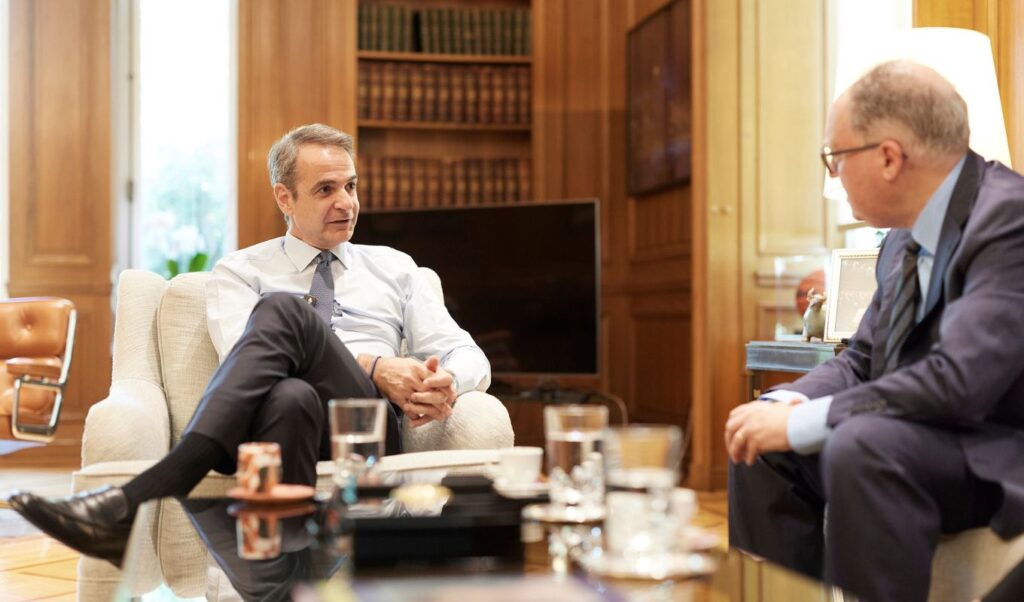
Prime Minister Kyriakos Mitsotakis and Financial Times columnist Gideon Rachman discussed in an extensive interview current geopolitical developments and the global economy. Among the key topics they analyzed were the implications of a potential blockade of the Strait of Hormuz, as well as the impact of such a crisis on energy supply, with emphasis on Greece’s role as a significant maritime power.
In parallel, they addressed Greece’s fiscal recovery after the debt crisis, as well as the policies required to maintain economic growth in the future.

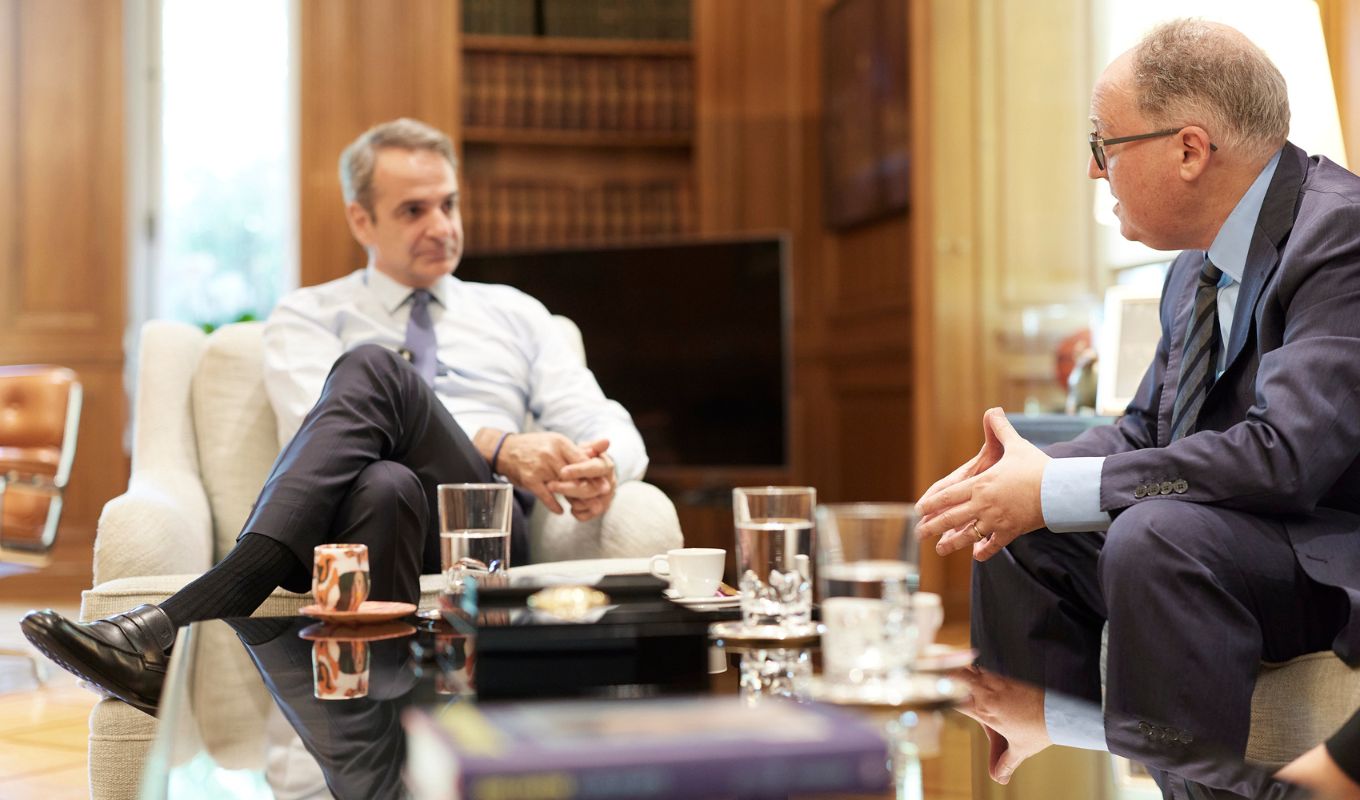

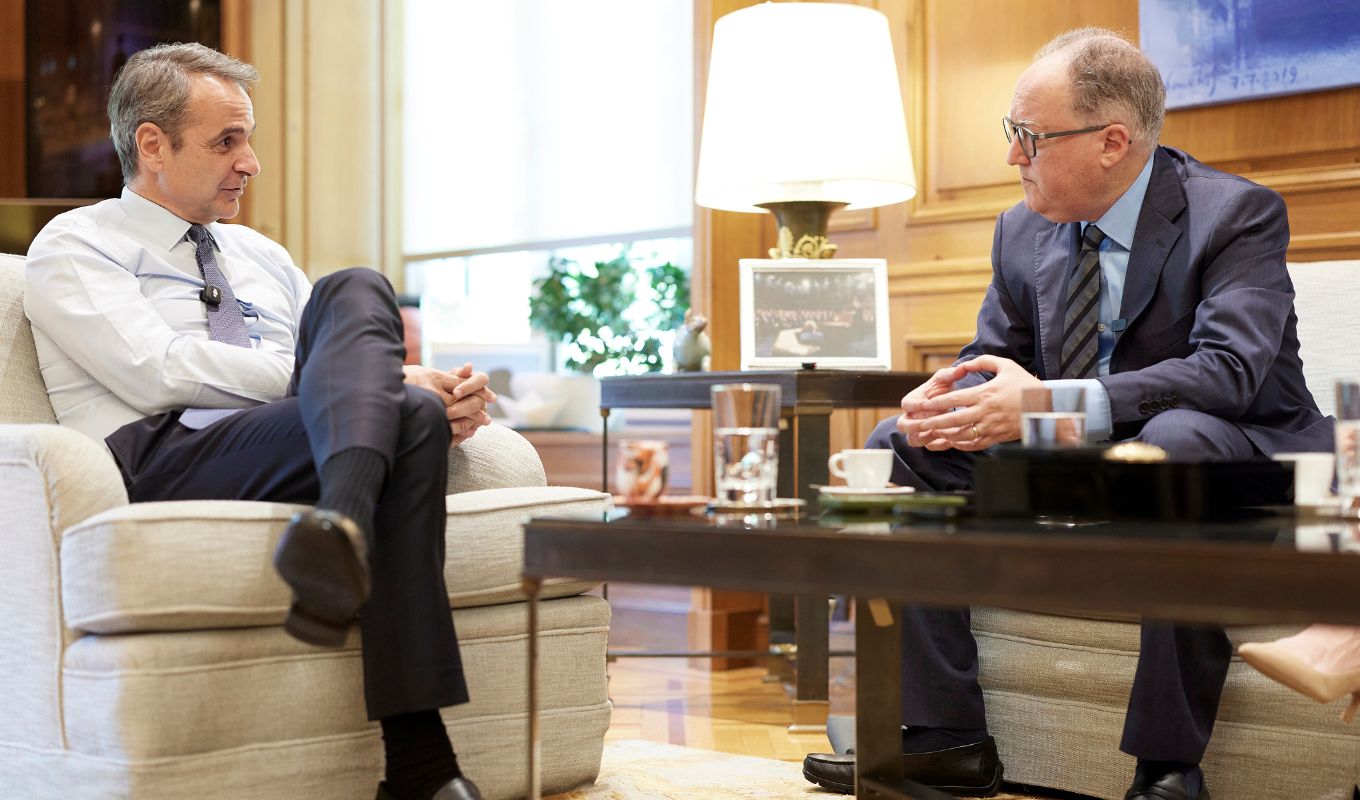
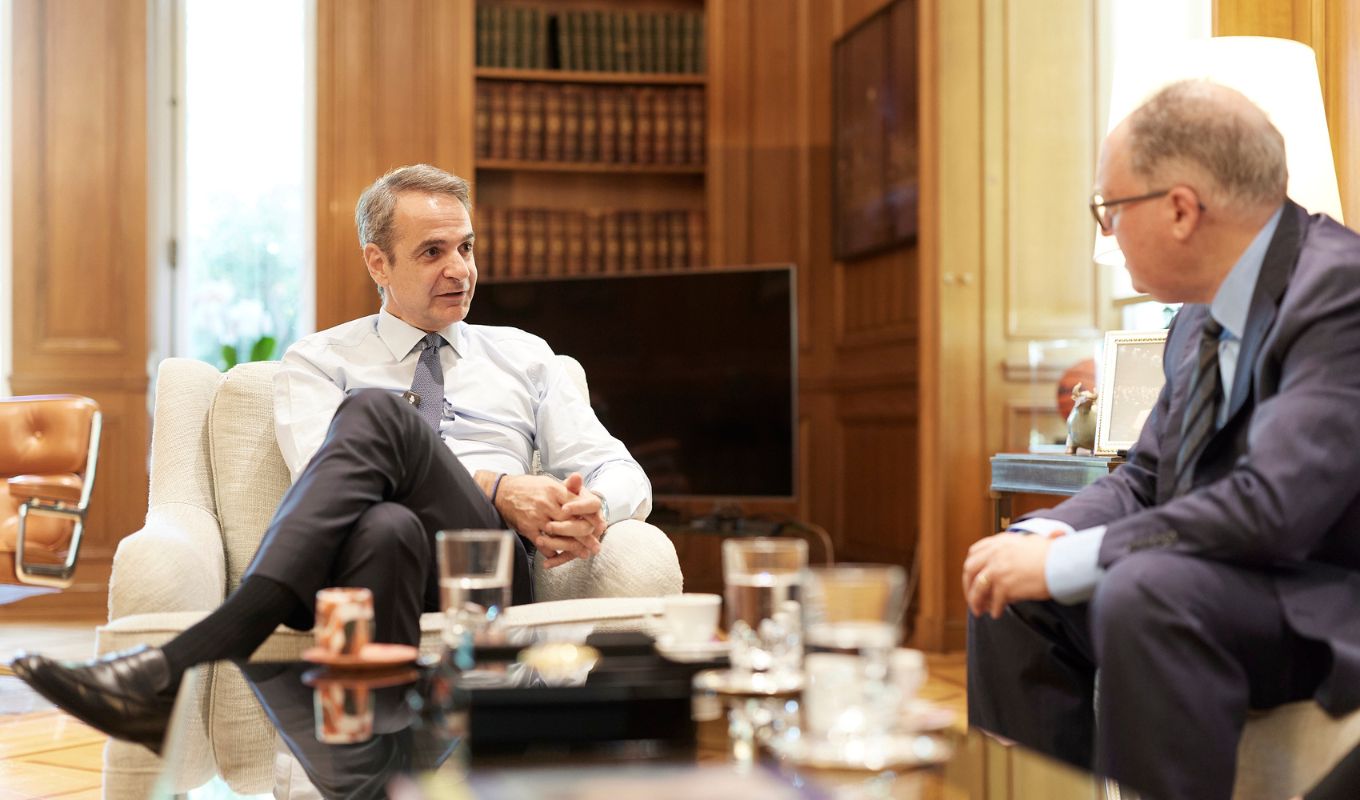
Full interview with the Greek Prime Minister:
Gideon Rachman: Regarding the Iranian crisis, I have the sense that the world is beginning to believe that economic consequences are going to be felt, that prices are going to skyrocket if we don’t find a solution. I wonder, therefore, how concerned you are about the economic dimension?
Kyriakos Mitsotakis: I think we should all be quite concerned. If this crisis continues for the foreseeable future, there will be significant consequences in terms of persistently higher inflation and lower growth, and this will force us all to somehow readjust our economic planning. This is an issue I have raised at the European Council level. Although I don’t necessarily want to predict the worst-case scenario, I believe it is our obligation as Europe to prepare for a negative development. Of course…
Gideon Rachman: Do you see it already, though?
Kyriakos Mitsotakis: We see it as much higher inflation than we thought we would be facing. Certainly this is significant, because for all European governments the cost of living must be the first priority. As for Greece, we are utilizing whatever fiscal space we have. We have achieved a very impressive primary surplus for 2025, so we have additional fiscal room. We are utilizing this fiscal margin for targeted and temporary relief measures, but of course we know this won’t be enough.
Gideon Rachman: Do you have any sense of when shortages will appear, whether it’s food or fertilizers or oil?
Kyriakos Mitsotakis: For now we don’t see any shortages in petroleum products, which is important for us. For example, regarding aviation fuel, Greece is a significant exporter of aviation fuel to the rest of Europe. So I don’t expect any shortage. I think the problem will be at the price level…
Gideon Rachman: Indeed
Kyriakos Mitsotakis: And, of course, persistently high inflation, which is already worsening the cost of living crisis we had to face even before this war broke out.
Gideon Rachman: And of course the longer it continues the worse this situation becomes. As I understand, over the weekend you were at a meeting in the Peloponnese with representatives from Saudi Arabia, Bahrain, high-level Ministers, as well as some Europeans. Did you get any sense of how the issue will be resolved?
Kyriakos Mitsotakis: I think it’s difficult to make specific predictions at this moment. I think we all understand that the medium to long-term implications for the global economy will be quite serious, if this war continues. Of course, however, we are not participating in the negotiations. As Greece, we have always supported a solution through negotiations. We are particularly concerned about the issue of freedom of navigation, we were concerned before this war even began. This is, historically, a major priority for Greece, as a leading maritime power…
Gideon Rachman: You represent about 25% of global shipping.
Kyriakos Mitsotakis: We represent 25% of global shipping, which is why we have a presence in the Red Sea as well. Operation ASPIDES, a European operation aimed at ensuring freedom of navigation in the Red Sea, under Greek leadership. Unfortunately, very few European countries decided to participate in this operation. So when we argue in the European Council that Europe must be more active in the Gulf, at a time when it is imperative for Europe to build a strategic partnership with Gulf countries, we must also…
Gideon Rachman: But what mission does this operation have? For those who don’t know it.
Kyriakos Mitsotakis: It’s an operation for escorting commercial ships when required.
Gideon Rachman: But not yet through Hormuz?
Kyriakos Mitsotakis: Not for passages through Hormuz. It’s an operation in the Red Sea and off the Horn of Africa. Its main goal was protecting commercial ships from Houthi attacks. Our ships, for example, have been engaged and managed to shoot down Houthi drones, using Greek-made anti-drone systems. So it’s a successful operation…
Gideon Rachman: And it’s a possible model for…
Kyriakos Mitsotakis: It could constitute an operational model. One of the issues that could be discussed is the extension and expansion of the ASPIDES operation mandate, to include a different geographical area. However, for this to make sense, we first need a solution through negotiations. I think it’s unrealistic to expect anyone to send ships to a geographical area that is still in a state of almost military conflict.
Therefore, we need, first of all, a solution through negotiations. And after that, if a need for peacekeeping operation arises, certainly we as Greece would be willing to participate. We have the model, we’ve done it already, and I would encourage other European countries to seriously consider sending naval forces to the region.
Gideon Rachman: You said, then, that freedom of navigation is an extremely important principle for Greece. The Iranians have made it clear that they want to impose fees for passage through the Strait of Hormuz, and some energy sector executives I’ve spoken with have said “maybe we should just pay, it would amount to roughly 1 dollar per barrel of oil, and everything would start flowing smoothly again.” What do you think?
Kyriakos Mitsotakis: Absolutely not. Categorically no. We would be setting an extremely dangerous precedent. I think it would be completely unacceptable, not only for Greece but for almost every other country that benefits from free trade. It’s pure blackmail. We cannot accept it. Europe cannot accept it.
Gideon Rachman: Indeed. And do you think this would set a precedent? Obviously Hormuz is extremely important in itself, but would it create a precedent for undermining freedom of navigation worldwide?
Kyriakos Mitsotakis: We are, as I mentioned, a country at the forefront of global shipping, that believes in free trade. We must not forget that 90% of global trade is conducted through ships. Therefore, any additional cost for maritime transport, or even the possibility that freedom of navigation would be used as a means to achieve geopolitical goals, would essentially destroy what we have achieved for many decades, ensuring that freedom of navigation is a concept that should never be questioned.
Gideon Rachman: I mentioned the energy company executives, who have essentially circulated this idea. Do you think there are governments that would be tempted to adopt it?
Kyriakos Mitsotakis: No. Honestly, I haven’t seen any government show interest in this idea, including the US, which has made it absolutely clear that we must return to the previous regime.
Gideon Rachman: Although President Trump at some point had said something like “maybe we could share the revenue,” however he seems to have abandoned this idea.
Kyriakos Mitsotakis: No, I think every recent statement by the President makes it absolutely clear that no fee, no additional burden, no payment regarding the Strait of Hormuz can be accepted.
Gideon Rachman: But if that’s the case, how will you force the Iranians to open them?
Kyriakos Mitsotakis: That’s part of the negotiations being conducted between the US and Iran. There are two fundamental principles that, in my opinion, are non-negotiable: Iran can never acquire nuclear weapons, and we must return to the status quo ante regarding the Strait of Hormuz. But, I repeat, we don’t participate in the negotiations, and I imagine those who are talking with the Iranians would know more.
Gideon Rachman: Yes, I mean, in my own country there were some politicians who openly condemned the decision to start the war in the first place, saying it was wrong. It’s probably too late to talk about that, but what’s your view? I mean previously things worked more or less, at least in Hormuz.
Kyriakos Mitsotakis: In retrospect one could draw many conclusions, but I don’t think it’s my job at this moment to comment on what should have happened three months ago. We have a situation we must address, and I prefer to simply look forward rather than dwell on decisions made in the past, which, to put it bluntly, we can no longer reverse.
Gideon Rachman: Can I ask you about Greece’s relations with Israel? Because, you know, if I think of previous decades, I always considered Greece as a country that had a rather critical stance toward Israel. However, today you seem to have quite close relations, while Israel’s actions in Gaza are particularly controversial.
Kyriakos Mitsotakis: First of all, we have a multi-year strategic partnership with Israel and I would say it’s a stable foreign policy choice adopted by previous governments as well, including left-wing governments. But precisely because we are strategic partners and have a strong partnership, we also have the ability to express our honest opinion to our Israeli friends when we think they make mistakes. We were quite critical of what happened in Gaza. We were quite critical publicly of what was happening in Lebanon, and I welcome the ceasefire and direct talks between the two countries. However, this is strategic cooperation with great depth, and never…
Gideon Rachman: And what’s the basis of this strategic cooperation? What’s the common strategic interest?
Kyriakos Mitsotakis: The common interest for a stable Eastern Mediterranean, but there are also strong economic ties, strong defense ties, cooperation between our defense industries, many Israeli investments taking place in Greece, as well as the convergence of our technological ecosystems. So it’s cooperation that’s not limited simply to geopolitical priorities.
I must emphasize, however, that we simultaneously maintain excellent relations with all other regional players. Greece stood by our Gulf partners in times of need. We honored our strategic cooperation with the United Arab Emirates. We have strong cooperation with Saudi Arabia and Qatar. We were present in Lebanon, supporting the Lebanese Armed Forces. We have very strong ties with Egypt. We have demarcated our maritime zones with Egypt and are at the forefront of strengthening relations between the European Union and Egypt.
Therefore, our relationship with Israel does not burden our strong cooperation