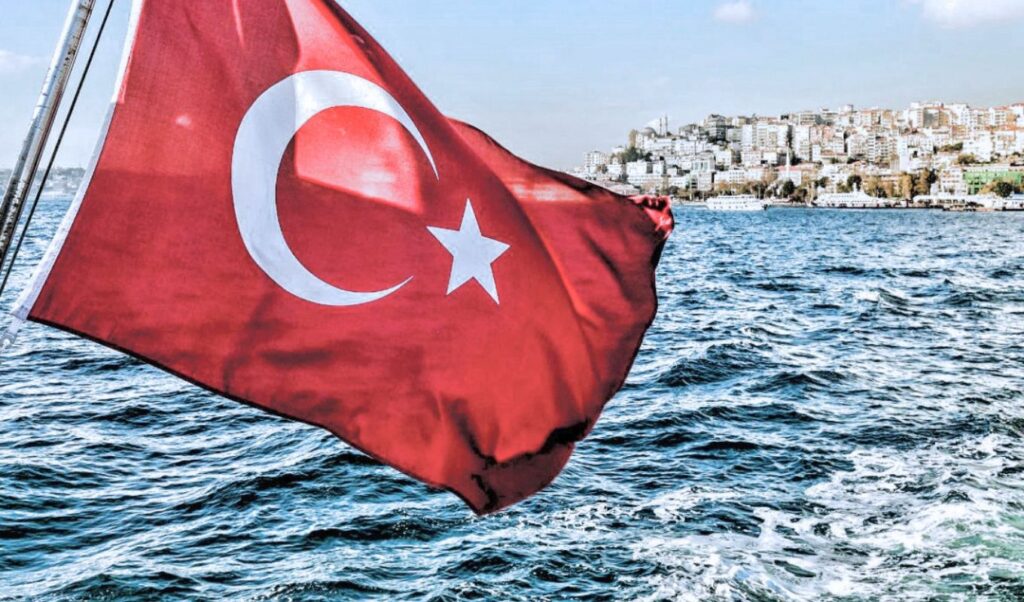
A new strategy is being developed by Turkey against Greece. Aiming to legally fortify the “Blue Homeland” doctrine, it is bringing a bill to the Turkish National Assembly, attempting to officially establish its strategic objectives for the continental shelf and Maritime Zones in disputed areas. Forty-four years after the last relevant legislation of 1982 concerning territorial waters, Ankara is attempting to codify its claims in the Aegean and Eastern Mediterranean, sending a clear message to Athens.
Turkey: Provocative bill with claims in Aegean and Eastern Mediterranean
According to yesterday’s article by Özay Şendir, director of “Milliyet” (which brought the issue to public attention on Friday), the new law being prepared by the Turkish government will explicitly define Turkey’s territorial waters in the Black Sea and Mediterranean at 12 nautical miles, however for the Aegean Sea it maintains the 6 nautical mile limit. This choice is not coincidental as Turkey’s goal is to prevent any extension of Greek territorial waters beyond 6 nautical miles, believing that such action would dramatically restrict its access to the Aegean and interrupt its continuous maritime connection to international waters.
For this reason, according to the columnist, Ankara insists on the Turkish National Assembly’s 1995 declaration regarding casus belli. One of the most significant parameters of the new legislation is the imposition of strict control over all types of activities within areas that Turkey considers its jurisdiction. Economic, scientific and environmental activities, as well as fishing in Exclusive Economic Zones (EEZ), will now be subject to Ankara’s exclusive permission.
As the director of “Milliyet” characteristically writes in his article, “the law stipulates that all economic, scientific and environmental activities in Exclusive Economic Zones are subject to Turkey’s permission. Another significant clause gives the President the power to declare areas that Turkey has not yet declared as an Exclusive Economic Zone as ‘Seas with Special Status'”. This means that Turkey will be able to intervene in areas of the Aegean it considers disputed, presenting environmental or scientific arguments.
Additionally, Ankara considers the Aegean Sea as a semi-enclosed sea because it is shared by two countries and connects to the open sea through narrow passages. This attempts to make the Aegean a “Sui Generis” sea, a term used in international law to describe a unique and exceptional sea where the two countries must cooperate and not engage in unilateral actions. With this rationale, Ankara resorts to this new legislative initiative in order to use it as a countermeasure to Athens’ initiatives for Maritime Spatial Planning (MSP) that provides for the potential outermost limits of its jurisdiction as well as the demarcation of “Marine Parks” in the Aegean.
The draft bill includes the continental shelf agreement with the Occupied Territories, as well as the agreement for the Turkish-Libyan memorandum. However, as the director of “Milliyet” claims, the bill does not aim to make “Turkey a contracting party to the United Nations Convention on the Law of the Sea. Instead, it updates a law that was established 44 years ago that does not cover the developments and risks of recent decades.
On the contrary, it ensures the integration into laws of legal definitions that do not exist in domestic law, because Turkey is not a contracting party to this agreement”. As everything indicates, Turkey’s ultimate goal is to legitimize its positions at the negotiating table and create a legal basis to prevent initiatives from Greece’s side, (such as the extension of territorial waters to 12 nautical miles) while also ensuring that no activity on the seabed or surface of the areas it claims will be carried out without its consent.