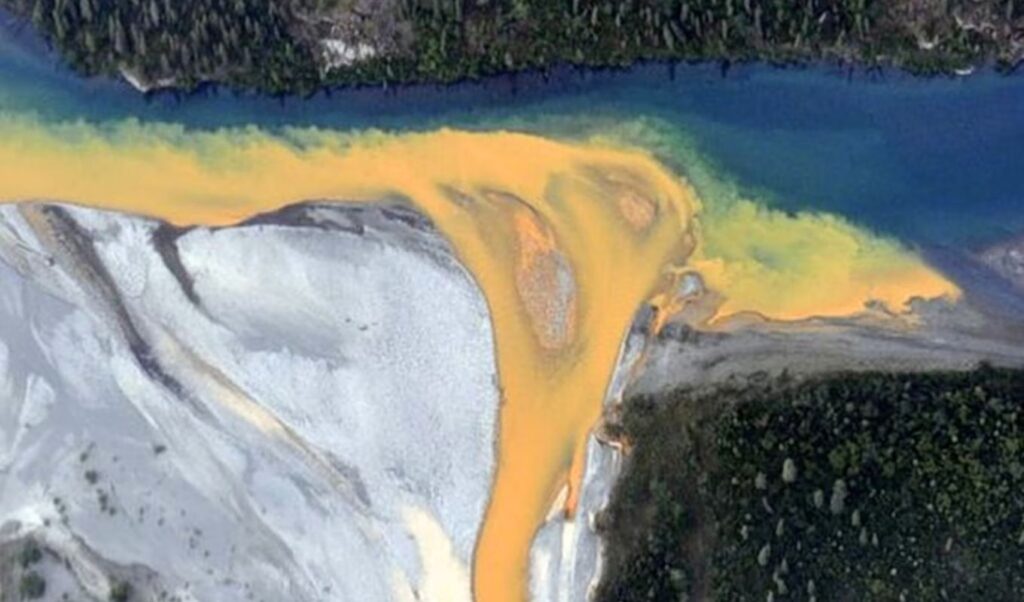
A disturbing environmental phenomenon is unfolding in the most remote corners of Alaska, where waterways that maintained their crystal-clear blue color for decades are transforming into a striking shade of orange. Researchers have been systematically monitoring this change since 2018, working to understand the causes behind this dramatic color transformation. The phenomenon is concentrated primarily in the Brooks Range, an exceptionally isolated region where no nearby mining operations exist that could explain the discoloration. A study published in the scientific journal AGU Advances suggests the most likely explanation is linked to the thawing of Arctic permafrost — permanently frozen ground that is now beginning to give way.
Rivers that look like “orange juice”
The initial observations were so unusual that researchers had to travel to extraordinarily remote locations, some of which were accessible only by helicopter. As the investigation expanded, more and more rivers and streams were found displaying the characteristic orange tint. John O’Donnell, an ecologist with the U.S. National Park Service, described some of the sites as places where the water looks “almost like a milky orange juice.” The appearance is reminiscent of acid drainage typically associated with mining areas — yet in the Brooks Range, no mining facilities exist that could serve as the source of the phenomenon.
Arctic rivers flowing through Alaska are increasingly turning orange as wildfires, thawing permafrost, and other factors contribute to an influx of heavy metals in these waterways. https://t.co/AV3wmoBVOw https://t.co/xOX8q5hI0v
— AccuWeather (@accuweather) December 20, 2025
Permafrost thaw releasing trapped metals
The team led by environmental chemist Taylor Evinger, in collaboration with Brett Poulin’s laboratory at the University of California, Davis, analyzed samples collected between 2022 and 2024 from six watersheds across the Brooks Range. The explanation proposed by scientists is directly tied to ground warming. As permanently frozen soil thaws, water penetrates layers that remained frozen for thousands of years. There, it comes into contact with trapped minerals which, upon oxidation, can release iron, aluminum, manganese, zinc, nickel, cadmium, and rare earth elements into the water. The result is a fundamental shift in the chemical composition of rivers — and their unmistakable orange appearance.
Metal concentrations up to 70 times higher than normal
The results of the analyses reveal just how dramatically a river can change without any direct human or mining activity. Some samples were more acidic and contained metal concentrations even higher than those recorded in certain mine drainage sites. Particularly alarming was the case of the Salmon River, where a single seepage event raised metal concentrations up to 70 times above normal levels. The impact of the phenomenon remained detectable approximately 97 kilometers downstream from its point of origin.
2019 appears to have been a turning point
Researchers linked one of the most significant metal release events to 2019, when Alaska recorded its hottest summer on record. That was followed by a winter with exceptionally heavy snowfall. The increased snow accumulation can act as an insulating layer, preventing the ground from refreezing with the same intensity. “We believe that water penetrated deeper into the soil due to the thaw, interacted with these minerals, and all of these watersheds were activated at around the same time,” explained Evinger. Following that period, a significant increase in sulfate and zinc levels was recorded, with concentrations gradually declining over the following years.
The phenomenon is spreading across the Arctic
Scientists estimate that the phenomenon is not confined to a handful of rivers in the Brooks Range. Since 2018, thousands of seepage events have been recorded across permafrost regions of North America, with more than 200 rivers and streams affected by acidic rock drainage. Brett Poulin emphasized that this particular process had not been anticipated in existing projections for how the Arctic would transform as temperatures rise. Similar characteristics have already been observed in rivers across northern and Arctic regions of Canada, as well as in other areas underlain by permanently frozen ground.
Concerns for fish, ecosystems, and local communities
The key question now concerns the long-term ecological and social consequences of the chemical shift in these rivers. Researchers have observed vegetation loss near some of the acidic waterways, along with a decline in fish and other aquatic organisms. The development is of particular concern because many rural and remote Arctic communities depend on these rivers for their food supply. In the Brooks Range, however, no mass fish die-offs or drinking water problems causing immediate harm to residents have been recorded so far, according to Evinger. Nevertheless, scientists warn that the changing chemistry of these rivers represents yet another alarming indicator of climate change’s impact on the Arctic.