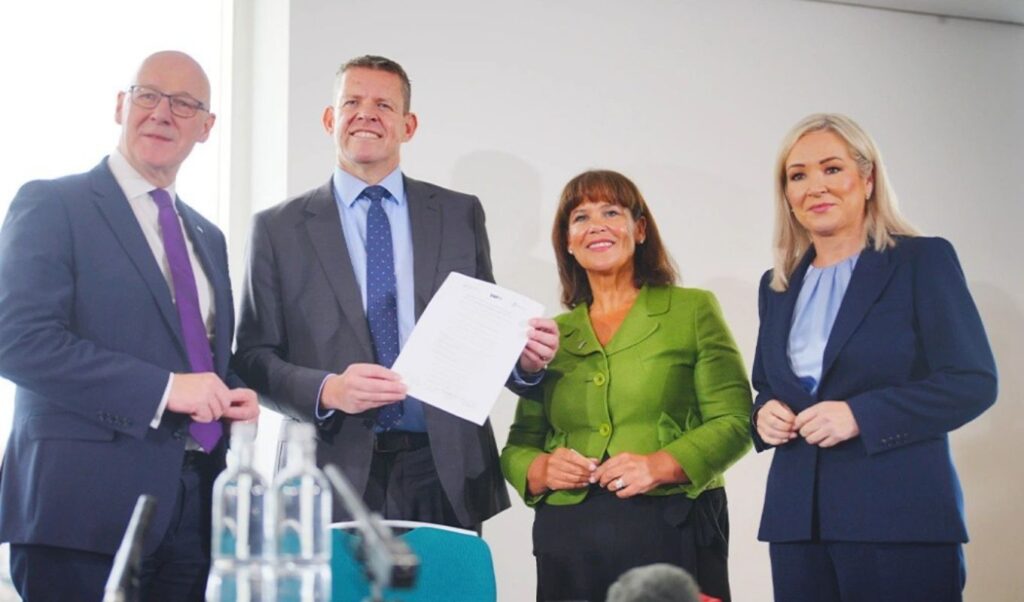
The leaders of Scotland, Wales and Northern Ireland met on Monday, September 14, in Cardiff and signed a joint declaration asserting “their right to self-determination” and stating that the future of their nations “belongs in the European Union.” This unprecedented meeting took place in the wake of surprise remarks made over the weekend by US President Donald Trump, who commented that “a union between the Republic of Ireland and Northern Ireland would be something fantastic.” Notably, Scotland, Wales and Northern Ireland are now all governed by pro-independence parties — a phenomenon unprecedented since 1999, when devolved institutions were first established for these nations.
Read also: UK: Keir Starmer steps down as MP — plans to focus on “international affairs” (Video)
Scotland, Wales and Northern Ireland form united front for self-determination
Welsh First Minister and Plaid Cymru leader Rhun ap Iorwerth welcomed Scottish First Minister and SNP leader John Swinney, Michelle O’Neill, First Minister of Northern Ireland and Sinn Féin Vice President, as well as Mary Lou McDonald, Sinn Féin President. “Our nations have the right to self-determination,” reads the agreement signed by the leaders. “We call on the British government to prepare and facilitate constitutional reform,” they added, expressing their conviction that “the future of our nations lies within the EU,” arguing that Brexit has “damaged” their economies.
🚨 NEW: The leaders of Scotland, Wales and Northern Ireland say the future of their nations “belongs in the European Union” as they call for independence from the UK pic.twitter.com/oFPZJVE5ig
— Politics UK (@PolitlcsUK) September 14, 2026
Successive British governments have opposed holding independence referendums following the 2014 Scottish vote, in which 55% of voters rejected independence. Last week, Downing Street ruled out any such possibility, stressing that Prime Minister Andy Burnham “firmly believes in the Union.” Trump, however, predicted over the weekend that Irish unification “will eventually happen.” Sinn Féin is calling for a referendum by 2030. According to Michelle O’Neill, the US president’s remarks show that “the conversation about unification is alive and people are deeply interested” — not only at a local level, but “on an international scale.”
Scotland, Wales and Northern Ireland seek independence referendums — what each nation wants
At the press conference in Cardiff, the assembled leaders stressed that their nations would each move toward self-determination at their own pace. Scottish First Minister John Swinney stated that a referendum on Scottish independence should be held within the next five years. In Wales, Rhun ap Iorwerth, upon his election in May, described independence as a “distant goal.” He set no timeline for a referendum, saying he “prefers to leave the matter in the hands of the Welsh people,” but noted that there is a “growing recognition that governance from Westminster is not working.”
The leaders of Scotland, Wales and Northern Ireland have just signed a deal pushing for independence from the UK.
“We believe the future of our nations belong in the European Union”. pic.twitter.com/KmcZrA7ewQ
— Pubity (@pubity) September 14, 2026
Current British Prime Minister Andy Burnham, who until recently served as Mayor of Greater Manchester, has made greater decentralisation a key priority. However, for Rhun ap Iorwerth, “the devolution of powers granted to a nation is quite different from that which concerns a region or city in England.” For Michael Keating, Professor of Politics at the University of Aberdeen in Scotland, the joint declaration by the three leaders is “politically significant,” given that for many years the SNP and Plaid Cymru had kept their distance from Sinn Féin, the former political wing of the IRA. In any case, however, “this is unlikely to change the British government’s position,” he noted.