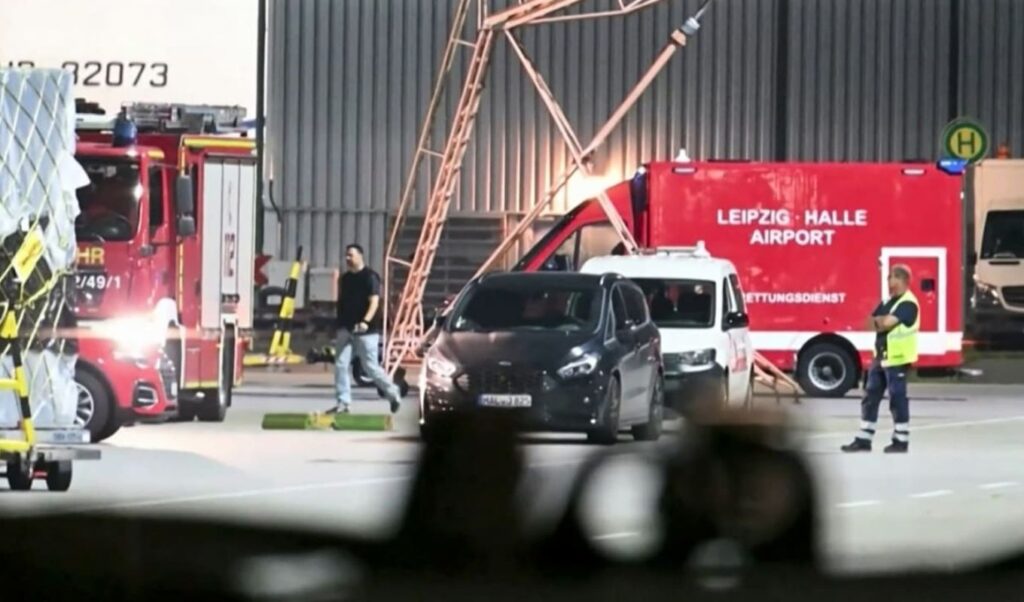
Germany and Russia are once again entering a dangerous trajectory following the attempted drone attack on Leipzig Airport in early August. Berlin directly accused Moscow of carrying out the hybrid operation, while the European Union swiftly expressed solidarity with Germany. The German government simultaneously moved to implement immediate diplomatic measures against Russia, giving the incident a pan-European dimension. Berlin called on the EU to impose new measures, including against Russia’s so-called “shadow fleet,” as well as the adoption of additional sanctions.
Germany’s EU partners rallied to its side one by one, including Greece, as well as NATO and the United Kingdom. One question that remains unanswered is whether the United States will also step forward in support of Germany. The Russian side responded promptly, with Foreign Ministry spokeswoman Maria Zakharova stating that Germany would receive an appropriate response to its decision to close the Russian House in Berlin and Russia’s General Consulate in Bonn.
Maria Zakharova: Russia will respond to all anti-Russian decisions
“Both have been irritating the ruling elite for some time. Now they have found a pretext. Well, they will receive an appropriate response,” she stated. She added that “under a completely groundless and far-fetched pretext, Berlin has once again escalated bilateral relations. As usual, no convincing or serious evidence has been presented. There simply is none, and there cannot be any!” she added.
“Meanwhile, Berlin itself is completely tainted by both its involvement in the conflict in Ukraine and its participation in terrorist attacks against civilians. They are looking for something to hold onto. Russia will respond to all anti-Russian decisions,” Zakharova said.
From the very first moment after the incident was revealed, Moscow has denied any involvement.
EU and NATO express solidarity with Germany
Germany’s decision to proceed with measures against Russia — including the closure of the Bonn consulate on September 18 and the Russian House — was welcomed by European institutions, Berlin’s allies, and NATO.
“Greece expresses its full solidarity with Germany following Russia’s hybrid attack on Leipzig. Attempts to intimidate our democracies will not succeed. We remain steadfast and will maintain a credible deterrent to protect our citizens and our security,” wrote Prime Minister Kyriakos Mitsotakis in a post on social media.
In an initial reaction to Germany’s measures, NATO Secretary General Mark Rutte welcomed them and added that “Russia’s efforts to intimidate us, undermine our unity, and our determination to support Ukraine, are futile and will fail.”
“Hybrid attacks will not go without a clear response,” said European Commission President Ursula von der Leyen, who also welcomed Berlin’s measures.
French President Emmanuel Macron stated that he “supports the adoption of new European sanctions against Russia.”
“We must be united in our support for Ukraine. France will continue to play its full role,” he wrote on X, adding that “these hybrid attacks are multiplying across Europe. They cannot go unanswered.”
Sweden echoed this stance, expressing solidarity with Germany.
“We will summon Russia’s ambassador in Stockholm to express Sweden’s strong protest over Russia’s behavior,” said Prime Minister Ulf Kristersson at a press conference.
The United Kingdom also stood by Germany, with Prime Minister Andy Burnham stating that London’s determination to deter attacks against freedom and security would not be broken.
Poland expressed full solidarity with Germany, while Finland’s Prime Minister Alexander Stubb said, “We know the Russian playbook very well.”
Russia’s hybrid attack is part of an aggressive strategy against Germany and the rest of Europe, said Ukrainian Foreign Minister Andrii Sybiha. Acts of sabotage, disinformation, and election interference are not isolated incidents but part of Russia’s deliberate policy, he added.
“We are not at war, but under hybrid attack,” says German interior minister
Earlier on Tuesday, at a press conference, German Interior Minister Alexander Dobrindt presented a series of findings indicating that Russia is responsible for the August 4 drone attack on Leipzig Airport.
He noted that the attack followed “the established pattern of Russian hybrid operations in Europe.” He further explained that German security services are recording a “high threat level” from hybrid operations targeting Germany and other European countries.
The means used in the Leipzig sabotage “are known to us from other hybrid operations carried out by Russia and from its war against Ukraine,” said Dobrindt, who provided details about the drone’s configuration, the components used, and the explosives involved.
The German government has concluded that “Russia is responsible for the hybrid attack in Leipzig.”
For Dobrindt, the Leipzig incident “is not an isolated event, but part of a broader pattern of hybrid actions,” and he expects Germany to remain a target of Russian hybrid attacks. “Let us be clear: we are not at war, but we are a daily target of hybrid warfare,” he emphasized.
Airport employees had discovered a drone near Ukrainian cargo aircraft, almost by chance.
The drone was carrying an explosive device that failed to detonate, as the detonator was faulty. German authorities also suspect that a second drone collided with a nearby cargo aircraft.