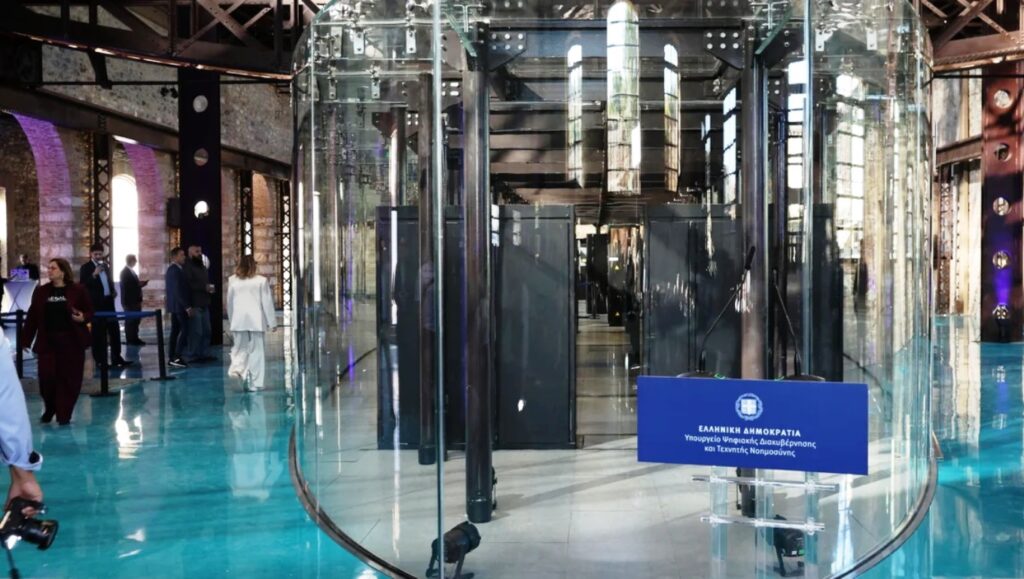
The newly inaugurated Daedalus supercomputer is set to unlock new possibilities for scientific research, technological development, and the advancement of Artificial Intelligence in Greece. This state-of-the-art High Performance Computing (HPC) infrastructure is capable of processing massive volumes of data and performing highly complex calculations at extraordinary speed. Its operation strengthens Greece’s participation in the European and international supercomputing ecosystem, providing scientists, research institutions, businesses, and public organizations with access to cutting-edge computational capabilities. The significance of this new infrastructure extends well beyond digital applications, as its power can be harnessed across sectors that directly impact everyday life — from healthcare and civil protection to energy, transportation, and industry.
The “Daedalus” supercomputer: Capabilities in healthcare and civil protection
Particularly noteworthy are the system’s applications in biomedical research and personalized medicine. Scientific teams will be able to use appropriately anonymized data to train Artificial Intelligence models, with the goal of developing tools that contribute to the early detection of diseases and the better tailoring of medical treatments to each patient’s individual needs. Equally significant are its capabilities in the field of civil protection, where the processing of large datasets can support complex climate models for understanding extreme weather events and assessing wildfire risk. Scientific simulations can provide deeper insight into environmental conditions and potential scenarios, boosting research into natural hazards and climate change.
Advanced technology and scientific applications
“DAEDALUS” is built on Hewlett Packard Enterprise architecture, uses NVIDIA GH200 accelerators, and features direct liquid cooling technology. This technological setup enables the execution of computationally demanding tasks across a wide range of scientific disciplines. Beyond medical research, the infrastructure will be utilized in computational physics and chemistry, biology, meteorology, environmental modeling, energy, transportation, and cybersecurity. It is a general-purpose supercomputer, meaning it was not designed exclusively for Artificial Intelligence, but rather for a broad spectrum of scientific and technological tasks that require exceptional computational power.
Business opportunities and applications in the Greek language
Significant opportunities are also emerging for businesses, as Greek companies will be able to run simulations of new products or production processes, reducing testing time and improving design before manufacturing begins. At the same time, the supercomputer will support generative AI and Large Language Model (LLM) applications, with capabilities specifically tailored to the Greek language, education, culture, and the promotion of cultural heritage. Access to the infrastructure will be available to universities, research centers, startups and small-to-medium enterprises, industries, and public bodies, as well as the broader European scientific community — all with the aim of developing new products, services, and advanced technological applications.