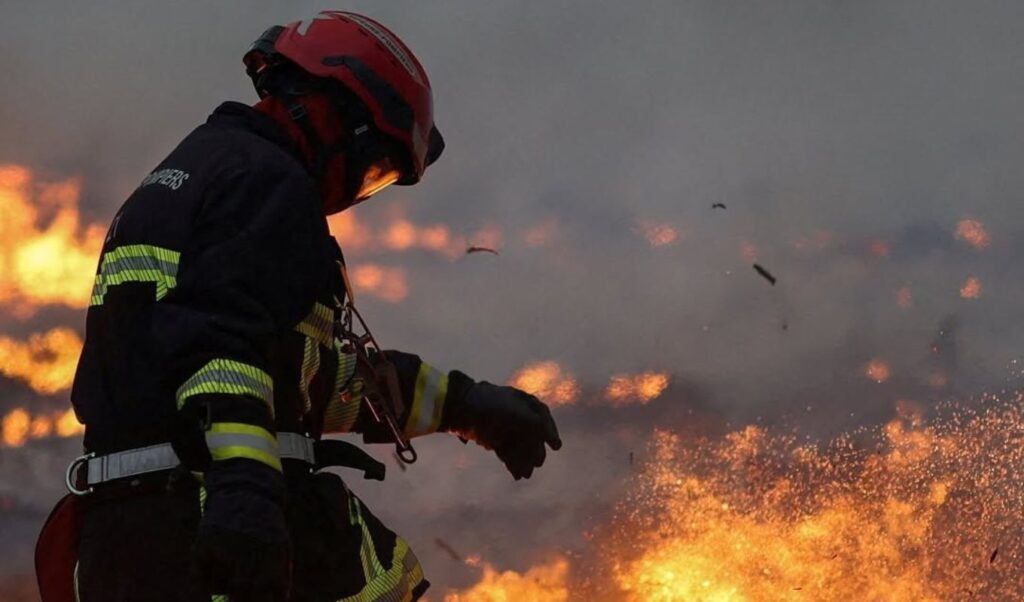
Fire has become Europe’s common enemy, and that reality is captured in a Bloomberg report documenting the devastating damage caused by wildfires sweeping across the continent — scorching forests, farmland, and entire communities. Even countries that had not traditionally faced this threat, such as Spain and France, are now deeply alarmed. The report also includes expert analysis warning that extreme weather conditions and climate change are creating a new, far more dangerous environment for wildfires to ignite and spread — leaving firefighters to operate under extraordinarily perilous conditions. In France’s Gironde region, fire commander Mathieu Jomain described the battle against the flames as unlike anything he had ever experienced. The fire shifted direction and intensity constantly, and at one point his crew became trapped in front of a wall of flames. “This is war against wildfires,” he said, adding: “I have been a firefighter for 26 years and I have never seen fires of this magnitude,” according to Bloomberg.
Read more: Wildfires rage in France and Spain: 330,000 people forced to flee their homes
Bloomberg: Nearly 420 square kilometers burned
The wildfire, which broke out on July 22, burned approximately 420 square kilometers, destroyed around 200 homes, and forced the evacuation of more than 220,000 people. Scientists noted that the fire burned with such intensity that it generated its own microclimate, even influencing local weather conditions.
During the same period, two major wildfires near Madrid merged into a single fire front, forcing tens of thousands of residents to abandon their homes. In the United Kingdom, authorities declared a major incident due to a fire near the Sizewell B nuclear power station.
Firefighters in Spain described an exceptionally unpredictable blaze, with winds shifting direction depending on altitude, flames reaching 40 to 50 meters in height, and a fire front advancing at approximately 5 kilometers per hour. They also observed pyrocumulonimbus clouds — massive storm clouds generated by the fire itself — which can further accelerate its spread.
From a small spark to an extreme event
Experts explain that a wildfire can begin from a single small ignition point, but when dry vegetation, high temperatures, and strong winds combine, it can rapidly escalate into an extreme phenomenon. Once a fire reaches the tree canopy and creates its own microclimate, the options for suppression become severely limited. Theodore Kipping, a scientist at Imperial College London, argues that in such cases the primary strategy must be to prevent the fire from spreading into populated areas, as many traditional firefighting methods simply fall short.
Scientists attribute the growing intensity of wildfires to climate change, as well as to a combination of wet winters followed by prolonged droughts, extreme heat, and rural abandonment — all of which lead to a dangerous accumulation of dry fuel. Climate researcher Raúl Cordero Carrasco emphasizes: “It’s not a matter of money. It’s not a matter of investment. It’s not a matter of how heroic the firefighters are.” He concludes: “You simply cannot stop a fire when conditions are as extreme as those we have witnessed in Europe over recent days.”
“Like a roll of the dice”
A similar view is held by Thomas Smith of the London School of Economics, who observes: “Every time a fire breaks out, there is a chance it will get out of control — it’s like a roll of the dice,” adding that “Climate change is loading the dice in favor of larger fires, so that when an ignition occurs, the odds of it becoming a catastrophic fire are much greater.”
The consequences extend far beyond environmental damage. In France, the wildfires dealt a severe blow to tourism, transportation, and local businesses. Hotels, campsites, restaurants, and small enterprises saw mass cancellations, while many families lost their primary source of income during the peak of the summer tourist season.
Insurance companies are warning that climate-related wildfires now represent a permanent shift in risk. As AXA chief executive Thomas Buberl stated: “We have to learn to live with the fact that these fires will occur more and more frequently. They are now part of our daily reality.”
Experts predict that hot and dry conditions will persist in the coming months, with the risk of large-scale wildfires spreading further north across Europe. For many regions, the challenge is no longer just about extinguishing fires — it is about adapting to a new reality being shaped by climate change.