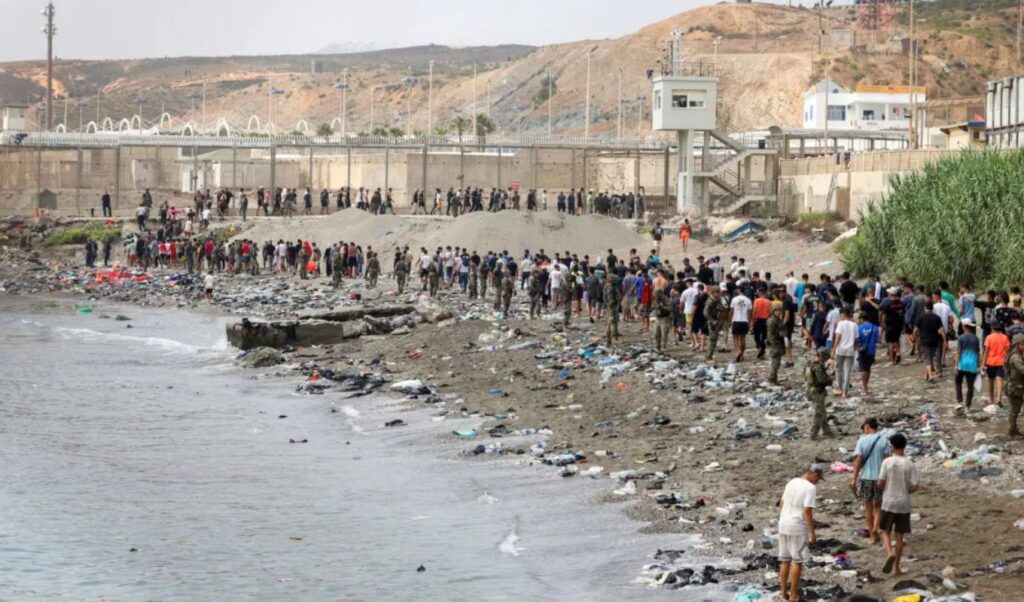
Scenes of chaos and a deepening humanitarian crisis define the situation at the Spanish-Moroccan border in Ceuta, where dramatic developments are accompanied by harrowing testimonies from people who managed to cross into the enclave — and are now urging their compatriots not to follow in their footsteps.
Read also: Ceuta: 22 leaders, including Mitsotakis, turn against Spain over its migration policy
Border militarization, floating barriers and a cry of despair: “I made a mistake — don’t come, people are dying”
At the same time, Pedro Sánchez’s government is moving swiftly to fortify Ceuta, deploying military forces and positioning massive floating barriers along the coast, as political pressure from the European Union continues to mount. Against this backdrop, Spanish newspaper El País has published the testimony of a Moroccan migrant who says he bitterly regrets his decision to cross the border, issuing a stark warning that conditions in the enclave are genuinely life-threatening.
A Moroccan migrant decided to go back to Morocco because he didn’t find Spain good enough for him:
“There’s nothing in Ceuta besides famine and repression. It feels like a prison.”
Hopefully this video goes viral among Moroccans and discourages them from leaving their country! pic.twitter.com/TQ2G6ssbsn
— Dr. Maalouf (@realMaalouf) July 31, 2026
“Honestly, I don’t know why I came. I’m going back — it’s as simple as that. What we did has nothing good or worthwhile about it. People are dying here. Please, those of you who haven’t come yet — don’t do it,” he said, as he waited to return to Morocco.
These testimonies come in the wake of the deaths of at least 67 migrants, who lost their lives either attempting to swim across the sea or in the chaos that erupted at crossing points.
Wave of voluntary returns coordinated with Moroccan authorities
The president of Ceuta, Juan Jesús Vivas, estimated that approximately 60,000 people have illegally crossed from Morocco into the Spanish enclave — a figure that represents nearly 70% of the city’s permanent population.
However, according to Spain’s Interior Ministry, around 48,000 migrants have already voluntarily returned to Morocco, with the repatriation process continuing in coordination with Moroccan authorities.
Floating barriers and military deployment at the border
The Sánchez government announced the installation of a temporary inflatable floating barrier stretching 500 metres, aimed at preventing further mass arrivals from the Moroccan coastline.
Meanwhile, army units, police, and Civil Guard forces have been deployed across the area, while on the Moroccan side of the border, authorities are clashing with groups of migrants attempting to push through into Ceuta and Melilla.
Prime Minister Pedro Sánchez described the situation as “a violation of Spain’s territorial integrity,” attributing the crisis to people-smuggling networks.
“Smugglers are deceiving thousands of young people and ultimately leading them to their deaths — whether at sea or within the city itself,” he said.