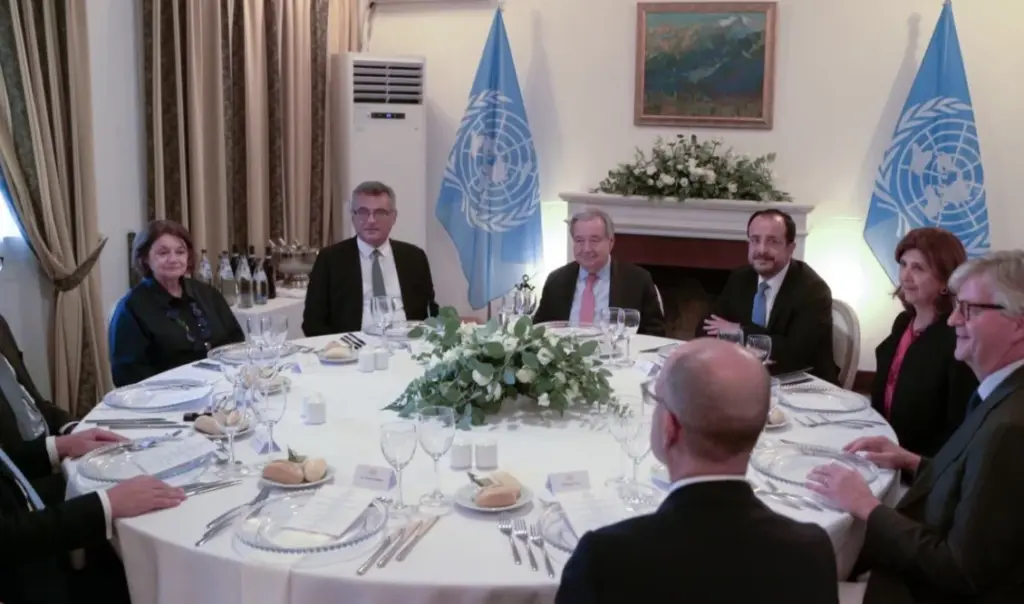
There are no concrete outcomes yet, nor any timelines — but according to the Cypriot President, “we are once again in a period of intense momentum after many, many years.” It appears that despite Turkey’s efforts to torpedo the process by swiftly rejecting the proposal for an expanded five-party meeting, the Cyprus issue is entering a new phase — one in which the European Union will play a significant role. On Friday, President Nikos Christodoulidis met with Raffaele Fitto, Executive Vice President of the European Commission, who also traveled to the occupied territories to meet with Turkish Cypriot leader Tufan Erhürman, in his capacity as the EU’s official envoy for handling this historic issue. On Monday, August 3rd, President Christodoulidis will brief political party leaders in detail at the National Council on the outcomes of his meeting with UN Secretary-General António Guterres, whose term expires in December.
‘Green light’ for development of the Cronos natural gas field in Cyprus’s EEZ
The pressures now at play also have enormous economic and energy implications. France’s TotalEnergies and Italy’s Eni recently gave the green light for the development of the Cronos natural gas field within Cyprus’s Exclusive Economic Zone (EEZ), with liquefied natural gas production set to begin in 2028. However, the Turkish Cypriot side’s unwillingness to step back from its entrenched positions continues to raise serious obstacles, giving Ankara grounds for potential unilateral action. This has always been the pattern: every time the UN intervened in a piecemeal fashion, Turkey moved to undermine the atmosphere. This is even more pronounced now, with Ankara invoking its so-called “Blue Homeland” doctrine on a daily basis — projecting an image of both military assertiveness and self-styled mediating power. Against this backdrop, Erhürman limited himself to describing Guterres’s visit as positive, while simultaneously rejecting the proposal for a 5+1 conference that would include the guarantor powers.
The Cypriot president clarified his intentions
Reading Turkey’s intentions early, the Cypriot President moved quickly to separate fact from fiction, stating that the new UN initiative does not represent a process starting from “a blank page,” but rather builds on the negotiating acquis accumulated through previous rounds of talks. He highlighted three key takeaways: first, that Guterres reaffirmed his full commitment to UN Security Council resolutions; second, that the Secretary-General considers the negotiating framework built up through the Crans-Montana talks as a given — effectively rejecting the notion of restarting negotiations from scratch; and third, that there is a clear will to convene an expanded conference, even if no timeline exists yet and even if the Turkish Cypriots are not currently on board. Christodoulidis also emphasized that the EU can play a decisive role in the broader context of EU-Turkey relations, reminding all parties that Turkey itself has repeatedly stated its desire for progress in its relationship with Brussels.
What the UN proposal entails
Based on what has so far entered the public domain — including a report by the British newspaper The Independent — the UN proposal currently under discussion, which has already drawn objections from Greek Cypriots, envisages a flexible form of agreement, reduced powers for the central government, and a territorial return of land. The document was drafted by UN Special Envoy María Ángela Holguín, who has been traveling back and forth to the island for weeks.
The new approach diverges from previous negotiating models, appearing to move away from a classic federal solution and instead proposing a looser governance framework within the European Union. It is built on the idea of a structure that could be interpreted differently by each community. Greek Cypriots could characterize the new model as a federation, while Turkish Cypriots could describe it as a confederation. This “constructive ambiguity” is seen as an attempt to overcome the fundamental point of disagreement that has persisted between the two sides for decades. The plan also envisages two constituent states with significant autonomy and limited shared competencies. The bulk of day-to-day governance would remain with each side, while a smaller central structure would manage issues requiring joint representation. Political equality between the two communities is also a central pillar of the proposal.
A rotating presidential council with participation of both leaders
The new framework is said to provide for a rotating presidential council involving both leaders, as well as a joint body of Greek Cypriot and Turkish Cypriot parliamentarians in place of a directly elected federal parliament. In addition, the creation of a limited joint Council of Ministers is proposed, tasked with handling critical areas such as foreign policy, defense, finance, European affairs, and citizenship.
Of particular significance is the provision for a Turkish Cypriot minister to hold a decisive vote on specific decisions — presented as a safeguard to ensure political equality. This point is naturally expected to be one of the most contentious issues in any future negotiations, should they ever begin. The last comprehensive attempt at a settlement collapsed in July 2017 at Crans-Montana, Switzerland, where talks failed to reach agreement on key unresolved issues including security, guarantees, troop presence, political equality, and the distribution of powers. No formal negotiating process of comparable scope has been attempted since.
In the past, three UN Secretaries-General visited Cyprus — each running aground on the storms their missions stirred up. The first was the controversial Austrian Kurt Waldheim, a Nazi lieutenant in Greece during the final two years of the war, who visited Cyprus twice in 1977. The second was Kofi Annan in 2002, who met with Glafcos Clerides and Rauf Denktaş, but whose proposal — the “Annan Plan” — was rejected by an overwhelming majority of the Cypriot people in a 2004 referendum. The third was Ban Ki-moon in 2010, who also left empty-handed.
*Originally published in the Parapolitika newspaper