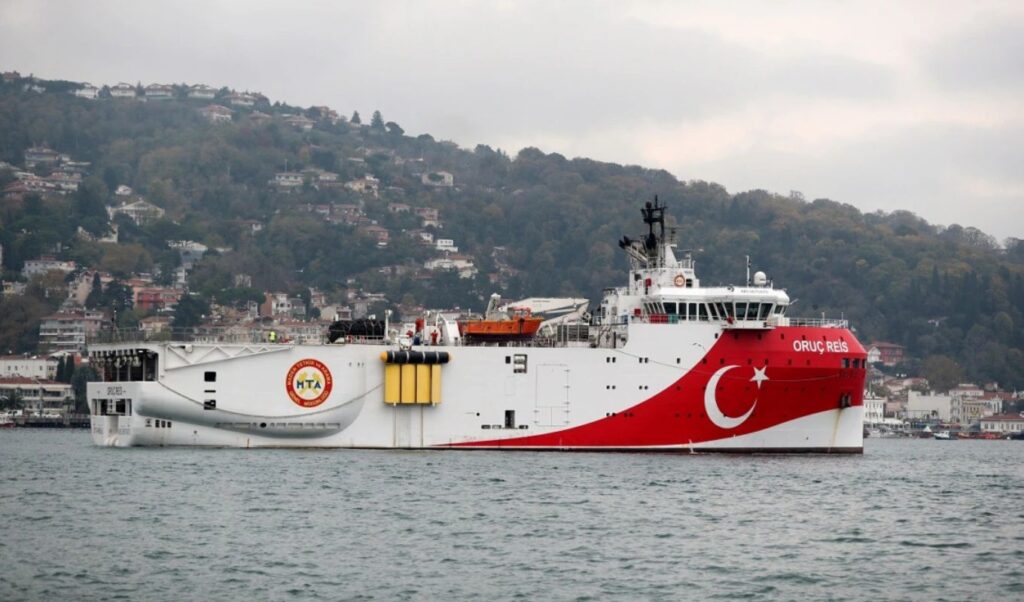
Athens is on a state of constant readiness and diplomatic alertness, closely monitoring the latest moves by Turkey in the Eastern Mediterranean. The issuance of a new NAVTEX for seismic surveys by the vessel Oruc Reis, combined with the official announcement of plans to construct an undersea natural gas pipeline to the occupied territories of Cyprus, has triggered deep concern on the Greek side.
According to a report by the Turkish newspaper Türkiye, the planned pipeline would connect the Turkish coast of Anamur to the Kyrenia region, stretching a total of 101 kilometers — 97 of which would run underwater. The project envisions two parallel bidirectional pipelines and, in its first phase, aims to meet the energy needs of the occupied territories. However, Ankara has made no secret of its broader ambitions to transform the pipeline into an “energy bridge” for transporting Eastern Mediterranean energy resources to Europe — a strategic move designed to elevate Turkey’s role on the region’s energy map.
What is causing particular alarm in Athens is not just the construction of the project itself, but the timing Turkey chose to assert its presence in the region. The highly symbolic and historically charged Oruc Reis departed from the port of Silifke, Turkey, on July 20th — the very anniversary of the 52nd year since the Turkish invasion of Cyprus. Diplomatic sources interpret this move as a deliberate show of force and an attempt to impose facts on the ground in the region.
PASOK MEP and Vice President of the European Socialists, Yannis Maniatis, yesterday submitted a formal question to EU High Representative Kaja Kallas, calling on the European Union to impose sanctions on individuals and entities involved in the planning and construction of the Turkish gas pipeline.
In a statement to parapolitika.gr, Mr. Maniatis called on the European Union to protect Cyprus’s sovereign rights and prevent the construction of such a pipeline between Turkey and the occupied territories — including, if necessary, the imposition of targeted sanctions against the companies involved. As he stated: “52 years after the illegal Turkish invasion that led to the occupation of the island, Turkey continues its attempts to create facts on the ground, in violation of international law and the sovereignty of the Republic of Cyprus. We must not forget that in 2004, the whole of Cyprus joined the European Union, with the EU acquis suspended in the Turkish-occupied territories. Therefore, the European Union is obliged to protect Cyprus’s sovereign rights and must not allow the construction of such a pipeline between Turkey and the occupied territories — imposing, if necessary, even targeted sanctions against the companies participating in its construction. After all, as the European Commission stated in response to a recent question of mine: ‘The EU remains committed to defending its interests and those of its member states, as well as to upholding regional stability. The EU also remains fully committed to a comprehensive settlement of the Cyprus issue within the UN framework, in accordance with all relevant UN Security Council resolutions and in line with the principles on which the EU is founded, as well as the EU acquis.’ Now is the time to prove it in practice.”
Athens is also assessing all possible scenarios regarding the course of the research vessel Oruc Reis. Concerns are focused on the possibility that it may operate in maritime zones around Cyprus — particularly in areas claimed by Turkey under its “Blue Homeland” doctrine — or even in sea zones south of Crete, near Libya. It is worth noting that the NAVTEX, which will remain in effect until August 30th, covers areas for surveys directly linked to the pipeline and forms part of the broader Greek-Turkish disputes over maritime zones.
Furthermore, marking the 52nd anniversary of the Turkish invasion of Cyprus, Turkish leadership further escalated tensions through a series of inflammatory statements and official announcements.
All of this is unfolding as new behind-the-scenes and public efforts emerge to resolve the Cyprus issue, led by the UN Secretary-General’s Personal Envoy, María Ángela Holguín. On the eve of UN Secretary-General António Guterres’ arrival in Nicosia, Ms. Holguín is traveling once again to Turkey, where she is set to meet with Foreign Minister Hakan Fidan, following a series of contacts in Nicosia, Athens, Ankara, London, and Brussels. Ankara is expected to keep its options open in Northern Cyprus until at least 2028, as technical studies are projected to be completed by 2026, with pipeline construction scheduled for 2028.