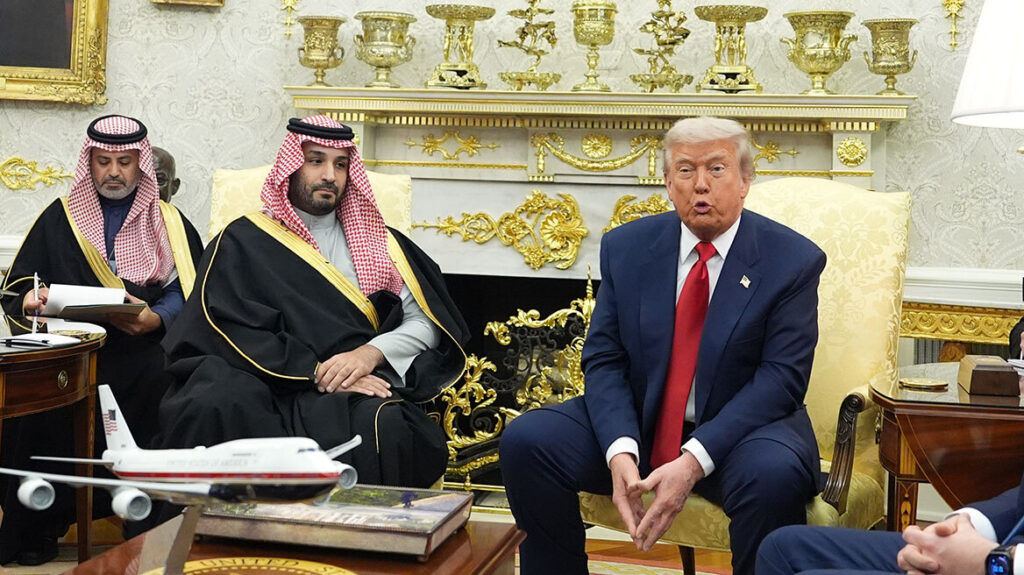
American President Donald Trump has reportedly given the green light to a deal that could fundamentally reshape the geopolitical balance of power in the Middle East — one that would open the door to the development of a nuclear program in Saudi Arabia, including the potential enrichment of uranium on Saudi soil. According to reports, the U.S. government is preparing to unveil a sweeping nuclear cooperation agreement with Riyadh that would allow American companies to participate in the construction and development of Saudi Arabia’s nuclear infrastructure.
The agreement, as reported by The New York Times, is said to span 30 years and be worth tens of billions of dollars, representing a massive commercial opportunity for the American nuclear industry. At the same time, however, it is drawing sharp criticism, as it does not rule out the possibility of Saudi Arabia enriching uranium or reprocessing spent nuclear fuel.
Saudi Arabia and uranium enrichment technology
The most controversial element of the agreement is that it reportedly creates a legal framework for cooperation across the entire nuclear fuel cycle — including uranium enrichment.
This does not mean the United States would automatically transfer enrichment technology to Saudi Arabia. However, following a joint U.S.-Saudi study, the construction of an enrichment facility on Saudi territory could ultimately be permitted.
Uranium enrichment is used to produce fuel for nuclear reactors. The same technology, however, when applied at significantly higher levels, can be used to produce fissile material for nuclear weapons.
This is precisely why American lawmakers, nuclear nonproliferation experts, and Israeli officials are viewing the deal with deep concern.
Based on information available so far, the agreement does not include the so-called “gold standard” — meaning an explicit commitment by a country to renounce uranium enrichment and nuclear waste reprocessing.
The United Arab Emirates accepted such a condition in 2009 when they signed their own nuclear cooperation agreement with Washington.
In addition, the U.S.-Saudi text is not expected to require implementation of the International Atomic Energy Agency’s Additional Protocol — a framework that grants international inspectors expanded oversight powers, including access to undeclared facilities.
The absence of these two key safeguards is at the heart of the debate now raging in Washington.
The fear of a Saudi nuclear bomb
Concerns have been further amplified by past statements made by Crown Prince Mohammed bin Salman, the kingdom’s de facto ruler.
The Saudi crown prince has stated that the kingdom does not seek to acquire nuclear weapons. However, he has made clear that if Iran were to obtain a nuclear bomb, Saudi Arabia would follow suit.
This position has fueled fears that a program launched as entirely peaceful could, in the event of a new regional crisis, take on a military dimension.
The deal is generating even greater debate because it is being advanced at a time when the United States has focused its strategy on preventing Iran from acquiring nuclear weapons.
Critics of the American government are now asking how Washington can oppose uranium enrichment by Tehran while simultaneously leaving open the same possibility for Riyadh.
What the U.S. and Saudi Arabia stand to gain
For Saudi Arabia, the development of nuclear energy is a central pillar of Mohammed bin Salman’s Vision 2030 plan.
Riyadh wants to reduce its domestic consumption of oil and natural gas for electricity generation, freeing up larger volumes of crude oil for export. Nuclear energy could also meet the country’s enormous demands for air conditioning and seawater desalination.
For the United States, the benefits are both economic and geopolitical. American companies — with Westinghouse considered one of the leading candidates for reactor construction — could secure billions of dollars in contracts. At the same time, Washington is seeking to keep Saudi Arabia away from rival powers such as China and Russia, both of which are also vying for a role in the Saudi nuclear program.
A U.S.-led agreement would also give Washington greater capacity to monitor and influence the kingdom’s nuclear activities.
The deal is expected to be submitted to Congress under Section 123 of the U.S. Atomic Energy Act.
American legislators will have approximately 90 days of congressional session to review the text and attempt to block it.
In practice, however, blocking the agreement is considered difficult. It would require a joint congressional resolution and, in the event of a presidential veto, a two-thirds majority to override it.
The political battle ahead is expected to be fierce. On one side stand those who see a multi-billion-dollar agreement that will boost American industry and keep Saudi Arabia firmly in the Western camp.
On the other side are those who fear that Trump’s nuclear “gift” to Mohammed bin Salman could mark the starting point of a dangerous new arms race across the Middle East.