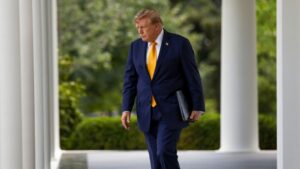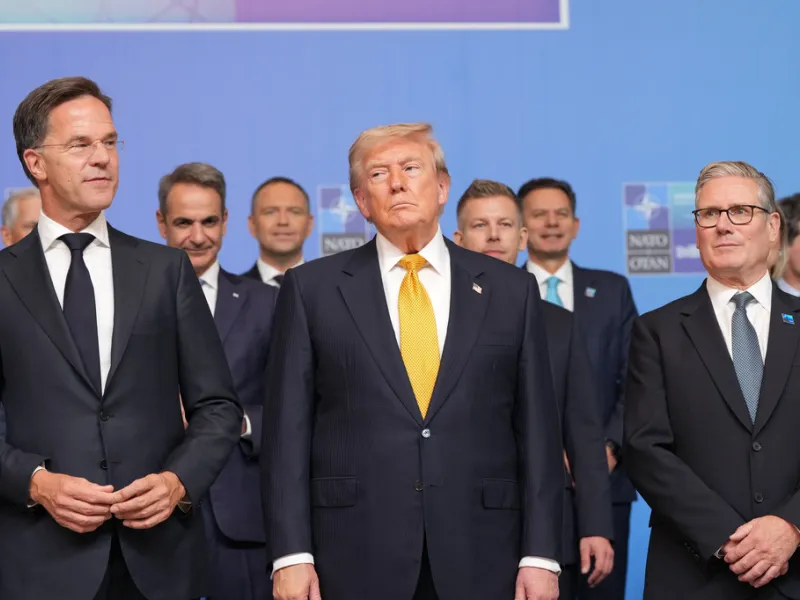
A balancing act or an exercise in intimidation? That is one of the many questions arising from the contacts and statements made by the American president at the NATO Summit in Ankara, with Donald Trump leaving a bittersweet taste on the global political stage at this pivotal diplomatic moment. On one hand, he spoke of good chemistry with Recep Tayyip Erdoğan, declaring he would lift sanctions against Turkey and is considering the country’s re-entry into the F-35 program — a move that signals, in its own way, that relations with Israel are not at their best.
Regarding Iran, and in the wake of the widely discussed memorandum of understanding, Trump further confirmed the fragility of the supposed ceasefire by declaring on his own — following the earlier exchange of fire — that it is no longer in effect.
On the internal front of the North Atlantic Alliance itself, Trump expressed visible frustration with allied members, reserving particularly harsh words for Spain, in a sign that the war in the Middle East is leaving a heavy legacy for Europe and potentially a different, weaker NATO. In this high-stakes geopolitical poker game, the question of who the winners and losers are naturally comes to the fore.
Trump’s frustration with NATO: “Spain is an unacceptable ally”
On the second day of proceedings, the U.S. president brought NATO’s internal divisions into the spotlight, sharply criticizing several allies over their defense spending and openly challenging the united front the Alliance seeks to project.
The NATO Summit in Ankara is taking place at a time when the Alliance faces both external and internal challenges, while the question of how support for Ukraine in its war with Russia will continue remains unresolved.
“Spain is an unacceptable NATO ally. They don’t participate, they don’t pay. I don’t want anything to do with Spain. Stop all trade with them, even visits,” Trump declared during a joint press conference in Ankara with NATO Secretary General Mark Rutte.
On control of Greenland
The American president also reignited tensions within the Alliance by reaffirming his intention to gain control of Greenland, an autonomous territory belonging to Denmark — a NATO member state.
Since returning to the White House last year, Trump has repeatedly expressed dissatisfaction with NATO’s functioning, pressing member states to significantly increase their defense spending. Most recently, he criticized allies for failing to participate in the United States’ military operation against Iran.
At the opening of the Summit, Trump reiterated his sharp criticism, stating he wants “nothing to do” with Spain, which has not committed to NATO’s new defense spending target of 5% of GDP by 2035. Shortly before, Mark Rutte had spoken of greater cohesion among allies, increased defense investments, and new military agreements, describing these developments as the beginning of a “NATO 3.0.”
Despite Trump’s renewed intervention on Greenland, Rutte insisted that the United States remains fully committed to the Alliance.
“The United States’ commitment to NATO is ironclad. There is absolutely no doubt about that,” the NATO Secretary General said upon his arrival at the Summit. He stressed that NATO also serves U.S. strategic interests, contributing to security in the Atlantic, Europe, and the Arctic, and deterring threats such as the deployment of Russian nuclear submarines near American shores.
The agreement to raise defense spending to 5% of GDP
Rutte also described the agreement to increase defense spending to 5% of GDP as a “great victory” for all member states — and a corresponding defeat for Russian President Vladimir Putin.
“I expect that today we will collectively reaffirm that Russia represents the long-term threat to NATO territory,” he said ahead of the allies’ sessions.
When asked whether he had a message for Vladimir Putin, Rutte replied curtly: “Don’t mess with us.”
“My message is that this Alliance, representing one billion people in Europe, Canada, and the United States, will defend every inch of its territory. No one can defeat NATO. This is a defensive alliance. We are not going to attack anyone. We will only defend our way of life, our democracies, and our territorial integrity. So, don’t try to test us,” he emphasized.
Donald Trump’s interventions and the public disagreements recorded during the Summit once again exposed the contradictions within NATO at a time when geopolitical challenges are multiplying. With the war in Ukraine ongoing, the Middle East remaining a source of instability, and debates over defense spending dividing the allies, the Alliance is called upon to prove that it can maintain its unity and adapt to the new security environment. Whether these disagreements will remain at the level of political rhetoric or will substantively affect NATO’s cohesion and strategy remains to be seen in the months ahead.