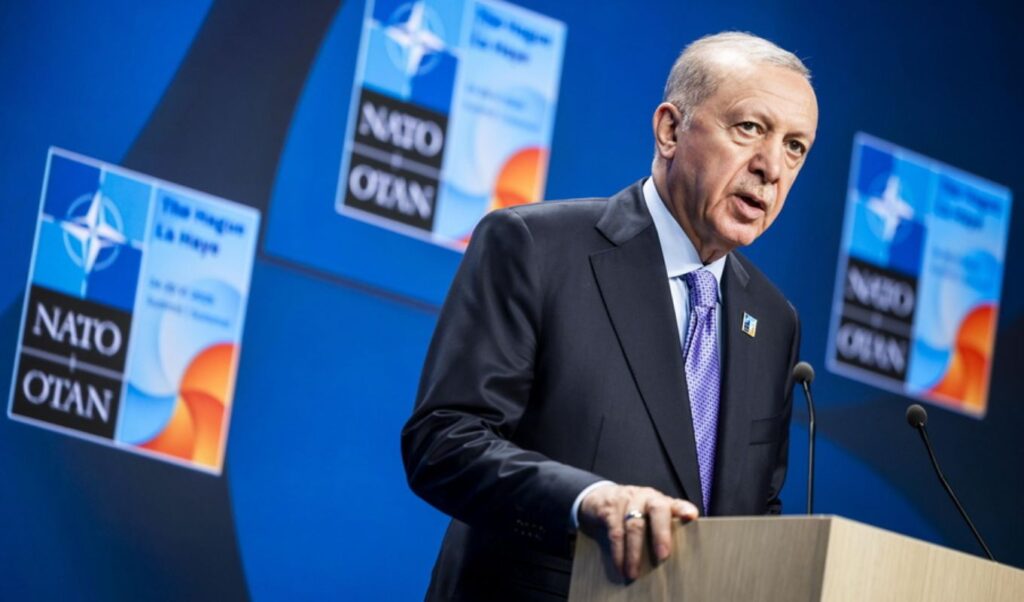
Turkey’s push to strengthen its national air defenses and expand its role in NATO’s defense planning sits at the forefront of Ankara’s agenda for the upcoming NATO Summit, scheduled for next Tuesday and Wednesday in Ankara. Also central to the agenda is the reinforcement of NATO’s eastern and southern flanks during a period of intense regional instability.
NATO Summit: Turkey’s goals and its bid for an upgraded role in the Alliance
Statements made Tuesday by Turkish Defense Minister Yaşar Güler made it clear that Turkey is seriously weighing the purchase of both SAMP/T and Patriot missile defense systems. This move is part of a broader, long-term modernization plan for the Turkish armed forces, and is expected to help meet NATO capability targets set for 2029.
Ankara’s interest in the SAMP/T system is particularly noteworthy, as it is a product of the Franco-Italian Eurosam consortium — Europe’s homegrown alternative for countering aircraft and ballistic missiles — and is expected to be fully integrated into NATO’s defense architecture. This signals that Turkey’s appetite for anti-ballistic missile systems spans both American and European markets.
At the same time, Turkey continues to keep its inclusion in Europe’s ReArm Europe initiative — and specifically the SAFE program — firmly on the agenda, despite having been excluded following vetoes by Athens and Nicosia. Defense Minister Güler stressed that the new European security initiatives, while positive, “lack inclusivity,” signaling that Turkey will push during the Summit for a fundamental shift in Alliance decision-making that would bring it into the European defense fold. Ankara demands equal participation in the planning and decision-making of European defense structures, arguing — as Güler did on Tuesday — that European security cannot be conceived without Turkey’s contribution.
Antonis Klapsis speaks to parapolitika.gr: Why Europeans want Turkey in European defense
Professor of International Politics Antonis Klapsis tells parapolitika.gr that Turkey’s objective is to secure funding from European defense programs and boost its geopolitical leverage. However, as he notes, “on the other hand, if we look at it from the European perspective, many Europeans actually want Turkey involved. Turkey is a large country, it has its own defense industry, it is a client for many systems produced by European defense industries, it has a large military — and a NATO-trained one at that. On top of that, it has the willingness to use it. Turkey has an army that is not only battle-ready, but battle-hardened. Turkish troops have fought at various points in Syria, Iraq, and elsewhere — so they have real battlefield experience. I’d add another factor: they also have the political will to deploy that army. And Europeans, frankly, look on that favorably — because if military force were ever needed, the Belgians, the Dutch, the Swedes, and others would rather see Turkish troops going to the front and Turkish soldiers coming back in coffins than their own. That’s something that can happen, and Turkey will push for it — and may well get something out of it.”
“We’d say ‘don’t get your hopes up’ about what’s going to happen”
According to Turkish analysts, the NATO Summit gives Turkey two key advantages it is expected to leverage in pursuit of its goals: the first is the diplomatic edge that comes with being the host nation, and the second is the arrival of U.S. President Donald Trump in Ankara — a leader who has consistently shown a favorable disposition toward Turkey. According to Professor Klapsis, “these advantages play some role, but I wouldn’t say that Turkey hosting the Summit is decisive for its ambitions. Trump’s stance, however, is certainly more significant. But because he is a man whose views are highly unpredictable, you can’t take what he says at face value 100% of the time. We’d say ‘don’t get your hopes up’ about what’s actually going to happen.”
“Nobody wants to shift the balance of power inside the European Union”
The NATO Summit next week is also viewed by Turkish diplomacy as an opportunity to have its strategic role recognized by EU leaders, with an eye toward thawing the long-stalled accession process. According to Professor Klapsis, “Europeans are trying to strike a balance. On one hand, they want Turkey as an associate linked to the Union — it’s a large market, it has cheap labor when needed, and so on. On the other hand, they don’t want Turkey as a full, equal member. That’s why they’ve kept it permanently in the waiting room, without ever letting it into the living room. I don’t think that’s going to change. Turkey has no intention of adapting to European standards — it would need to reform its rule of law and extend rights to its citizens, and I don’t think it will ever do that. Nor do Europeans have any intention of taking on Turkey, in the sense that if Turkey were to join the European Union, it would become the second-largest country after Germany — and within a few years, possibly the first. That means it would have the most MEPs and significant weight in decision-making. And it’s clear that nobody wants to shift the balance of power inside the European Union.”
In just one week, Turkey will host one of the most consequential NATO Summits in recent memory. Whether it will achieve its objectives remains to be seen. What is certain is that Ankara will push hard to secure the green light for critical weapons procurement deals that would significantly bolster its air defense capabilities.