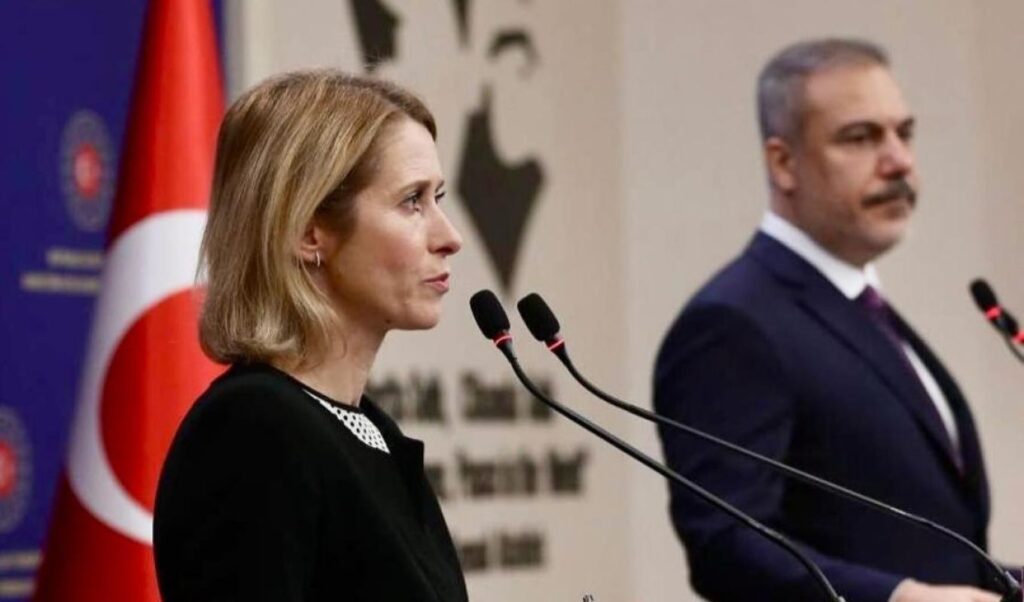
One day after Turkish President Recep Tayyip Erdoğan sharply criticized the European Union for adopting what he called “obstacles” — put forward by Greece and Cyprus — blocking Turkey’s participation in the SAFE defense program, Turkish diplomacy is today welcoming three senior European officials to the country’s capital. EU High Representative Kaja Kallas, Enlargement Commissioner Marta Kos, and Home Affairs Commissioner Magnus Brunner are all arriving in Ankara. These visits signal Ankara’s preparations for a decisive shift in its relationship with the European Union, with Turkey hoping that the incoming Irish Presidency — which begins tomorrow, July 1 — will mark the end of a “six-month diplomatic deadlock” brought about by the Cypriot Presidency.
Why Turkey sees a “window of opportunity” for EU membership
Turkish diplomacy now sees a “window of opportunity” to revitalize EU-Turkey dialogue and reignite Ankara’s accession process. According to Turkish media reports, Foreign Minister Hakan Fidan is expected to once again raise the issue of Turkey’s full EU membership with the three senior European officials. Their simultaneous presence in Ankara is being interpreted by Turkish diplomatic sources as a clear sign of the growing strategic importance that Brussels is placing on Turkey amid rapid global changes.
SAFE, casus belli, and the “Blue Homeland” doctrine at the heart of Greek concerns — Alexandros Mallias: “No EU member state sees Turkey as a potential member of the Union”
Athens is closely monitoring the diplomatic activity unfolding in Turkey, expecting its EU partners to raise the issue of Ankara’s expansionist ambitions — which still include both the casus belli threat and the forthcoming “Blue Homeland” legislation on the table.
Former Greek diplomat in Washington Alexandros Mallias, speaking to parapolitika.gr, argued that “almost all of our partners in the European Union view Turkey not as a democratic state that shares their values on democracy, respect for human rights, respect for the individual, and freedom of the press. That clearly does not concern them. They treat Turkey as an important large market for their exports and for co-producing various goods, including in the defense industry. I don’t know whether Turkey and Mr. Erdoğan appreciate that, but it’s not particularly flattering. As for Ms. Kos and especially Ms. Kallas, they spare no empty flattery toward Turkey.”
For Ankara, full EU membership remains a “strategic priority.” Hakan Fidan, according to diplomatic sources cited by Turkish media, is expected to stress to the European delegation that a fair and merit-based enlargement process — one that treats Turkey on equal footing with other candidate countries — would represent a strategic gain for the EU’s own competitiveness and resilience.
However, according to seasoned diplomat Alexandros Mallias, “no EU member state today sees Turkey as a potential member of the Union. That is why various formulas are being discussed and considered — formulas that in reality do not correspond to the conventional framework agreed upon in Helsinki in 1999, namely the opening of accession negotiations and, on Turkey’s part, the adoption of specific measures. The European Parliament has shown a positive response to the broader questions about what Turkey actually is today. Turkey today is an authoritarian regime. It leans more toward a dictatorship than a European-style democracy. It is a regime where the president decides who leads the main opposition, where all rival political leaders are imprisoned, where mayors are imprisoned, party leaders are imprisoned, journalists are imprisoned. It is the country where more journalists and politicians are behind bars than in newspapers, media outlets, and parliament combined. This is the Turkey that various EU institutional figures — such as Ms. Kallas, who in my personal view is currently doing a disservice to the European Union — are trying to engage with. The EU, especially right now, needs a foreign minister who is respected and capable of playing a meaningful role in Washington and beyond. That is the reality. In any case, if Sweden, Finland, the Baltic states, Germany, Spain, and Italy were to say today that Turkey could become a member of the Union, that would mean those countries — our partners in the EU — consider their own democratic institutions to be on par with Turkey’s.”
“They have nothing positive to offer Turkey”
The flurry of European diplomatic activity in Turkey suggests that both sides are seeking a more predictable and sustainable framework for cooperation in addressing shared geopolitical challenges. Greece continues to remind its partners that the casus belli, Turkey’s revisionist stance in the Aegean, the continued presence of Turkish troops in Cyprus, and the daily threats against Greek islands are issues that cannot be ignored. According to Mr. Mallias, “today’s visit by three European officials to Ankara is clearly also connected to the changeover of the EU’s rotating Presidency. I fully expect they have nothing positive to offer Turkey. When a country knocks on the EU’s door, it knows there is a list — ten pages long — of conditions and prerequisites it must meet. The EU’s representatives know this too, yet they remain silent about it, and I cannot understand why. When they fail to set as preconditions what the Union’s member states have jointly decided and agreed upon, that personally troubles me. In any case, the European Union finds itself today at a difficult crossroads, with diverging policies on many fronts and no easy path to a common position.”
In the coming days, Turkey is expected to attract significant international attention, as it will host the pivotal NATO Summit (July 7–8) next Tuesday, which US President Donald Trump is also set to attend.