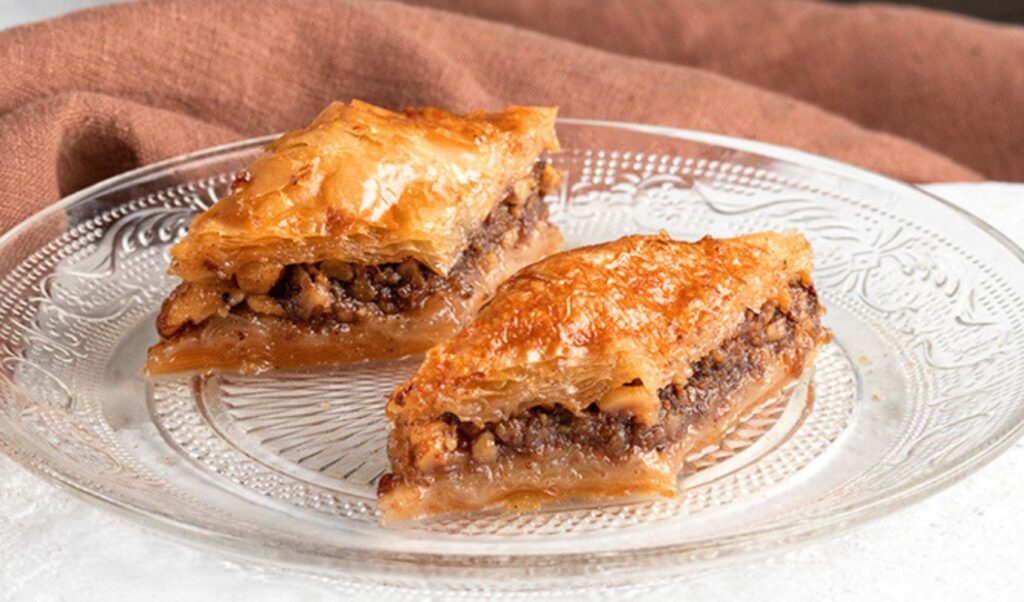
A new front in cultural and culinary rivalry is being drawn, as Turkish media outlets frame the joint initiative by Turkey and Azerbaijan to register baklava with UNESCO as a “strategic move” against Greece — coming in the wake of broader disputes over cultural heritage. According to Turkish media reports, the two countries have submitted a joint dossier to UNESCO requesting that the art and cultural practices surrounding baklava, along with the Azerbaijani pakhlava, be inscribed on the Representative List of the Intangible Cultural Heritage of Humanity.
Read also: Turkey: Man makes baklava while skydiving over mountains — watch the viral video
The news, echoing previous controversies such as the zeybek dance dispute, is being covered in Turkey under headlines like “Turkey and Azerbaijan unite over baklava” and “two states, one flavor.” Some outlets have gone further, claiming the move is a direct response to what they describe as “Greek attempts to appropriate” the dessert.
The final decision is expected to be made at the 21st Session of the UNESCO Intergovernmental Committee for the Safeguarding of Intangible Cultural Heritage, scheduled to take place from November 30 to December 5 in Xiamen, China.
What Turkey and Azerbaijan are aiming for
The joint dossier filed by Turkey and Azerbaijan seeks the inscription of the element under the names baklava and pakhlava. The two countries’ goal is not simply to gain international recognition for the dessert itself, but for the craftsmanship, traditional preparation methods, rituals, social practices, and cultural memory associated with it.
The Turkish side presents the initiative as part of a broader effort to secure international recognition for products and practices it considers central to its national and Ottoman heritage. Azerbaijan, for its part, is participating through pakhlava — its own version of the dessert — which holds a special place in Azerbaijani cuisine and is deeply tied to celebrations, family gatherings, and traditional occasions.
What makes this particularly noteworthy is not just the UNESCO candidacy itself, but the way a significant portion of the Turkish press is choosing to frame it. Coverage goes well beyond the cultural dimension. Instead, the joint Turkey-Azerbaijan move is being presented as a direct response to Greece, with claims that Athens has been trying for years to present baklava as its own cultural product.
This rhetoric fits a familiar pattern in Turkish discourse, where even matters of gastronomy are transformed into arenas of symbolic rivalry with Greece.
Baklava — much like coffee, yogurt, gyros, döner, Turkish delight, and other staples of the broader Ottoman, Balkan, and Eastern Mediterranean culinary tradition — is frequently used as a springboard for debates about who “owns” a cultural tradition.
In reality, however, such flavors have been shaped over centuries of coexistence, exchange, population movement, imperial cuisines, regional variations, and family traditions.
What UNESCO recognition does and doesn’t mean
A crucial point often lost in this debate is that inscription on UNESCO’s intangible cultural heritage list does not function like a trademark or an exclusive national patent. UNESCO does not rule on who “owns” a culture, nor does it grant any state exclusive ownership over a flavor, a technique, or a tradition. What it does is recognize that specific communities, practices, and forms of know-how constitute living cultural heritage that deserves to be safeguarded, transmitted, and promoted.
In other words, even if the joint Turkey-Azerbaijan candidacy is approved, this does not mean that Greece, the Greeks of Asia Minor, the communities of the Eastern Mediterranean, or other peoples who have their own regional variations of baklava somehow “lose” their connection to the dessert.
It means that UNESCO recognizes the Turkish and Azerbaijani cultural practice around this particular element, as presented in their submitted dossier. That is fundamentally different from the way some Turkish outlets are framing it — as a cultural “victory” over Greece.
The history of baklava
The history of baklava is complex. In its current form, the dessert is closely associated with Ottoman cuisine and, in particular, with palace cooking. Turkish sources point out that references to baklava appear in Ottoman records as far back as the reign of Mehmed II, while the tradition of the “baklava alayı” — the ceremonial sending of baklava from the palace to the Janissaries during Ramadan — illustrates the prominent role the dessert played in Ottoman ritual life.
Yet that does not tell the whole story. Variations of pastries made with thin layers of dough, nuts, honey, or syrup exist across many regional cuisines: in Greece, Turkey, the Balkans, the Caucasus, the Middle East, and among communities that lived for centuries within or around the Ottoman Empire.
For this reason, baklava is more than just a dessert. It is a piece of a shared — if often competitively interpreted — history of the Eastern Mediterranean.
It could even be argued that baklava has its origins in ancient Athens, where tables were laden with the famous Athenian honey cakes: doughs filled with fruits, nuts, and honey that bear a striking resemblance to what we know today.
The Gaziantep precedent
Turkey already holds a significant international recognition tied to baklava. The renowned Gaziantep baklava — a source of immense national pride — has been awarded Protected Geographical Indication (PGI) status by the European Union, a major achievement for Turkish gastronomic diplomacy. This recognition specifically covers Gaziantep baklava, acknowledging its distinctive characteristics, local technique, ingredients, and the region’s culinary reputation.
The new UNESCO bid, therefore, does not start from scratch. It fits into a consistent strategy by Ankara to turn gastronomy into a tool of cultural power. The difference this time is that Turkey is not acting alone — it has Azerbaijan by its side, reinforcing the narrative of a shared Turkic cultural sphere.
Why Azerbaijan is part of the equation
Azerbaijan’s involvement is no coincidence. Ankara and Baku have long invested in the “two states, one nation” formula — a political and cultural framework used to describe the exceptionally close relationship between Turkey and Azerbaijan.
The joint candidacy for baklava/pakhlava serves precisely this narrative. It is not merely about a dessert. It is about projecting a shared cultural space stretching from Anatolia to the Caucasus.
In this context, UNESCO becomes an arena for cultural diplomacy. Turkey and Azerbaijan are not simply seeking recognition for a culinary tradition. They are attempting to present baklava as an element of a broader Turkish-Azerbaijani cultural continuum.