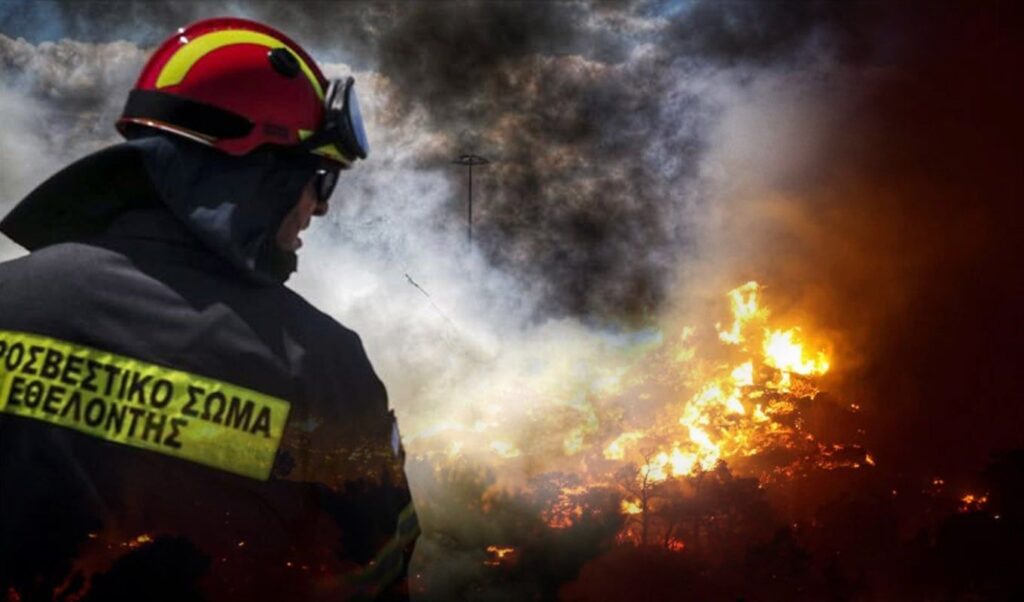
The outbreak of 44 wildfires within a single 24-hour period has thrust the challenges of this year’s fire season back into the spotlight, as most fires continue to be caused by human negligence. Tellingly, according to Fire Service data, from the beginning of the year through June 21, a total of 112 arrests have been made on arson-related charges — 106 of which involve fires caused by negligence, representing a staggering 94.64% of all cases.
Speaking exclusively to parapolitika.gr, Makis Tsiougris, President of the Panhellenic Union of Fire Service Volunteers, offered reassurances about the state’s overall readiness, while highlighting a serious gap: approximately 400 newly trained volunteer firefighters are unable to respond to fires because they have not been provided with the necessary personal protective equipment.
“The Fire Service is fully prepared to handle this fire season. There is an adequate aerial fleet, sufficient personnel, the EMODE rapid response teams that have been established across many parts of the country, and volunteer firefighters. The right preparations have been made and the available resources are sufficient,” he stressed.
As he explained, the challenge lies not in the preparedness of the firefighting apparatus itself, but in situations where multiple fires break out simultaneously in different parts of the country. “When there are multiple fire fronts across various regions of Greece, there is a practical difficulty in tackling all of them at the same time — especially when large-scale fires are involved. In those cases, significant resources need to be deployed to many locations all at once,” he noted.
Wildfires: “400 trained volunteer firefighters remain on the sidelines”
Despite the overall level of readiness, Mr. Tsiougris highlighted an issue that he argues is costing the Fire Service hundreds of trained personnel. According to him, approximately 400 newly trained volunteer firefighters — who have completed their training, passed the required medical examinations, and are ready to serve — cannot participate in firefighting operations because they have not been issued personal protective equipment.
“Right now, there are around 400 people who cannot meaningfully contribute during the summer because they don’t have the necessary equipment. These are people trained specifically to be on the front lines,” he said. He added that many volunteers are forced to purchase their own gear at a personal cost ranging from €1,500 to €2,000.
“It is unthinkable that someone who volunteers their time should have to dig so deep into their own pockets just to be able to respond. This simply does not happen anywhere else in Europe,” he emphasized.
“This is a long-standing problem”
The President of the Panhellenic Union of Fire Service Volunteers argues that this issue did not emerge this year — it is a chronic, systemic dysfunction. He noted that many volunteers operate using equipment they have purchased themselves or inherited from retired colleagues. “I have served as a volunteer for years, and the Fire Service has never once provided me with even the most basic piece of personal protective equipment. Everything I use has either been bought with my own money or passed down from colleagues who have retired,” he said.
According to information the union has received, procurement issues related to public tender processes are responsible for the delays — a situation that, he argues, cannot be allowed to keep hundreds of trained volunteers out of action during the most critical period of the year.
“It’s not just a matter of staffing numbers”
Mr. Tsiougris stressed that even if the number of full-time firefighters were to increase, when dozens of fires break out on the same day, more trained personnel are simply needed across the board. “Even if we had 50,000 firefighters, when you have 100 or 120 fires in a single 24-hour period across the entire country, you need more trained and fully equipped people. That need cannot be replaced by well-meaning civilians who, however good their intentions, lack the training required to operate safely,” he stated emphatically.
“The biggest problem remains human negligence”
The union president underscored that the vast majority of wildfires continue to be caused by human negligence — a fact clearly reflected in official arrest statistics. “A single moment of carelessness can cost people their property, their forests, and even their lives. It’s not only the person who accidentally starts a fire who is at risk — it’s also the firefighters, the volunteers, and the civil protection personnel who will be called upon to put it out. Prevention remains our most powerful weapon against wildfires,” Mr. Tsiougris concluded.