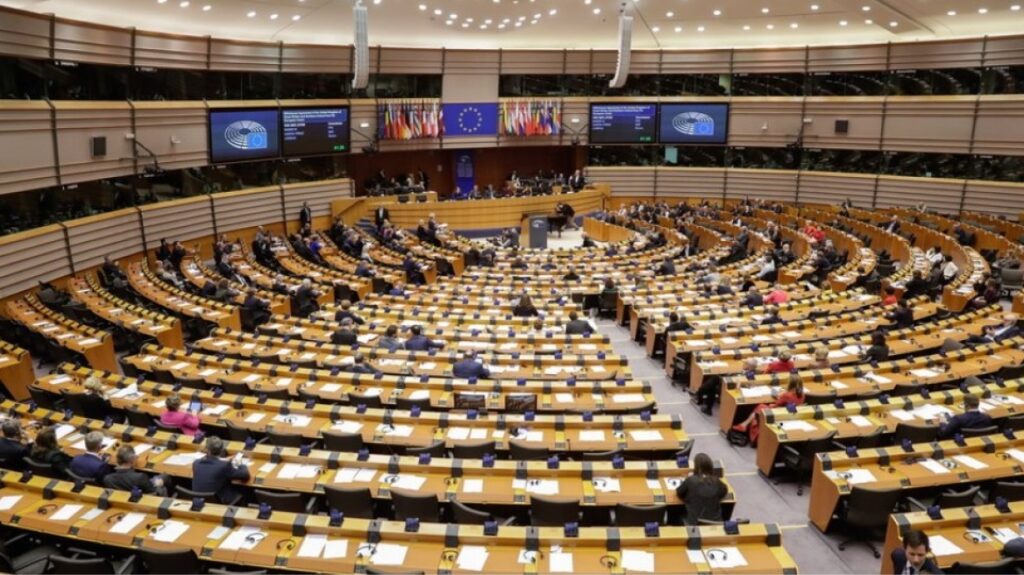
The European Parliament has approved its annual report on Turkey in sharply critical terms, highlighting the widening gap between Ankara and the fundamental values, principles, and strategic interests of the European Union. The report was adopted with 381 votes in favor, 107 against, and 171 abstentions, and underlines that, under current conditions, the prerequisites for relaunching Turkey’s accession process do not exist. Accession negotiations have remained effectively frozen since 2018, due to the deterioration of the rule of law in the country.
The text, drafted by Spanish Socialist MEP Nacho Sánchez Amor, criticizes Turkey on a range of issues, including the state of human rights, democratic backsliding, developments in the Aegean and Eastern Mediterranean, the Cyprus issue, the retention of Russian S-400 missile systems, and Ankara’s relations with the BRICS+.
Turkey: a damning report on its EU accession path
The report’s central conclusion is that Turkey is drifting ever further from its European perspective.
The European Parliament stresses that the absence of meaningful progress and the ongoing democratic regression do not permit the resumption of the accession process. The report’s rapporteur noted that for a decade Europe has been waiting for positive developments from Turkey, yet has not seen the necessary political will to align with European principles.
Sharp criticism over the rule of law
The findings on the state of fundamental rights and the rule of law in Turkey are particularly severe.
The report describes the situation as deeply troubling, noting that legislative arrangements and practices systematically restrict the activities of the opposition, civil society, and the exercise of basic freedoms.
Specific reference is made to the CHP and its presidential candidate Ekrem İmamoğlu, as well as to journalists, lawyers, academics, artists, activists, and human rights defenders.
The European Parliament also calls on EU institutions and member states to adopt a clearer stance on the erosion of the rule of law in Turkey.
References to casus belli and the “Blue Homeland” doctrine
Particular weight is given to Greek-Turkish relations and developments in the Eastern Mediterranean.
The European Parliament supports the continuation of dialogue between Greece and Turkey and views positively the Mitsotakis–Erdoğan meeting of February 2026. However, it calls on Ankara to abandon policies and practices that heighten tensions.
The report directly criticizes the “Blue Homeland” doctrine, expresses serious concern over the maintenance of the casus belli against Greece, and notes that such a threat is incompatible with good neighborly relations and allied cooperation.
Furthermore, it condemns violations of the sovereignty and sovereign rights of EU member states, with specific mention of Greece and Cyprus.
Criticism over NAVTEX, energy projects, and the Turkey-Libya maritime memorandum
The report also addresses a series of Turkish actions that have fueled regional tensions in recent years.
These include violations of Greek airspace, the use of NAVTEX notices as a tool of political pressure, interference with strategically significant EU energy projects such as the Great Sea Interconnector and EastMed, and Ankara’s opposition to the Greek maritime park in the Aegean.
Concern is also recorded over the increase in illegal fishing activities by Turkish vessels in Greek territorial waters.
Regarding the Turkey-Libya maritime memorandum, the European Parliament reiterates that it violates the sovereign rights of third states, contravenes the UN Convention on the Law of the Sea, and produces no legal effects for other countries.
Religious freedoms and cultural heritage
The report devotes considerable attention to minorities, religious freedom, and the protection of cultural heritage.
It calls on Turkey to implement the recommendations of the Venice Commission, with particular reference to the Greek Orthodox population of Imbros and Tenedos.
It also requests recognition of the legal personality of the Ecumenical Patriarchate and the title of Ecumenical Patriarch.
The report further expresses concern over the protection of world cultural heritage sites, such as Hagia Sophia and the Monastery of the Virgin Mary of Soumela, as well as incidents of vandalism at minority places of worship.
A firm position on the Cyprus issue
On the Cyprus issue, the European Parliament reiterates that the only acceptable solution is a fair, viable, and democratic settlement based on a bicommunal, bizonal federation with a single sovereignty, a single citizenship, and a single international legal personality.
It welcomes efforts to restart talks, but condemns unilateral Turkish actions, such as developments in Varosha and the usurpation of Greek Cypriot properties.
It also calls for the withdrawal of Turkish troops from the island and full respect for the Green Line.
Despite its firm tone, the report does not reject cooperation with Turkey.
On the contrary, it proposes the development of a more substantive and strategic partnership in areas of mutual interest, such as security, defense, the customs union, and addressing shared challenges.
However, it makes clear that such cooperation cannot substitute for respect for the rule of law, nor can it bypass the concerns of Greece and Cyprus.
The report’s ultimate message is that the European Union seeks cooperation with Turkey, but considers that restoring the country to an accession track requires substantive policy changes and a clear move toward European values and principles.