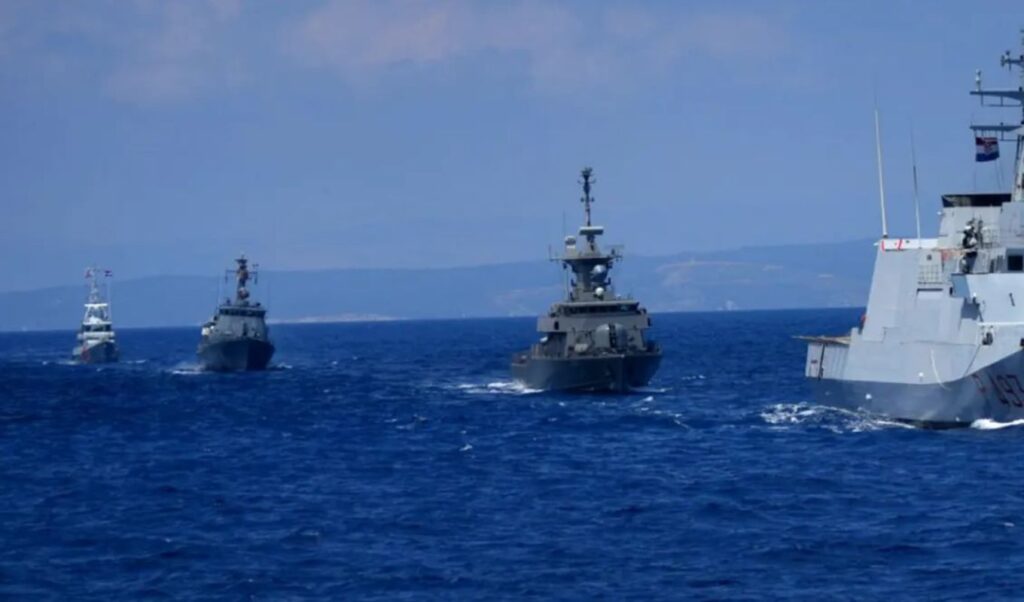
Massive waves have risen in the Aegean, with Athens monitoring the next moves by Ankara, which could further deteriorate Greek-Turkish relations. Diplomatic sources tell parapolitika.gr that “at this moment there is nothing officially known about the content of the law and for this reason the Ministry of Foreign Affairs is not making any comment.”
Turkish press continues references to “blue homeland” – Daily Sabah report
However, references in the Turkish press are extensive. Indicatively, in yesterday’s publication, “Daily Sabah” reports that the “Blue Homeland” bill will help Ankara legally secure its maritime claims, project its power and become a regional actor that sets rules: “It will establish and clarify its rights throughout the Black Sea, the Aegean Sea, the Mediterranean, as well as the Sea of Marmara.” As stated in the report, the need for legal institutionalization was caused by the cooperation of Israel, Greece and Cyprus, whose maritime claims – as it notes – conflict with those of Turkey. The same outlet also references the 1995 casus belli resolution, noting that the unilateral extension of Greek territorial waters beyond 6 nautical miles in the Aegean constitutes a “red line” for Turkey, with the authors supporting the preservation and incorporation of the resolution into the new law.
Antonis Klapsis to parapolitika.gr: “The casus belli has created a phobic syndrome on the Greek side”
International Politics professor Antonis Klapsis argues to parapolitika.gr that “the casus belli creates a problem for Greece, because it has existed for 30 years (since 1995) and has actually created a phobic syndrome on the Greek side. This is also the reason why Greece has not extended its territorial waters in the Aegean, while it has done so in the Ionian. The only reason a rational person can think of is that Greece worries about what such a thing would create in Greek-Turkish relations.”
At the same time that Ankara is making these provocative moves against Greece, it is simultaneously seeking strategic rapprochement with the European Union, intensifying its contacts, with Germany as its main interlocutor. Today, Turkish Foreign Minister Hakan Fidan travels to Berlin to participate in the 3rd Turkey-Germany Strategic Dialogue meeting, aiming to strengthen bilateral relations and Turkey’s ties with the European Union. It remains to be seen whether Germany’s “biased stance” in favor of Turkey in Greek-Turkish relations will remain the same.
No concern in the EU
International Politics professor Antonis Klapsis argues that the European Union shows no concern about what Turkey is doing to Greece and emphasizes that “from previous crises we had with Turkey we did not have any particular support from the European Union (as a Union and not from individual states). This is understandable because the European Union has neither a common foreign policy nor a defense and security policy. That is, it doesn’t have anything special to offer us in practice at that moment. Nor is there coordination of actions. We see this not only in Greek-Turkish affairs, but also in the Middle East, in issues with the United States, in Ukraine. Roughly every state of the Union does what it considers serves its interests. So I think we don’t have much to expect. If we have anything to expect, it’s at a bilateral level, like the strategic relationship we have with France.”
“In 2020, with the provocations in the Aegean, we reacted very dynamically and effectively”
However, the possibility of an extreme incident between Greece and Turkey is gradually entering public debate. Mr. Klapsis argues that even in such a possibility, Greece is today in a stronger position. As he says, “in 2020, with the provocations in the Aegean, we reacted very dynamically and effectively. If something similar arises, Greece will react in a similar way. I don’t see what different it can do. I think that if we consider the balance of power now, we are probably in a better position than we were 5-6 years ago.”
Greece is expected to turn with protests to European Union bodies, as Greek MEPs have already done. There where Turkey maintains undiminished interest in an accession prospect. After all, just yesterday Turkish President Recep Tayyip Erdogan stated that Turkey remains committed to its vision for full membership, despite “biased and inconsistent approaches from parts of the EU,” indirectly targeting Greece.