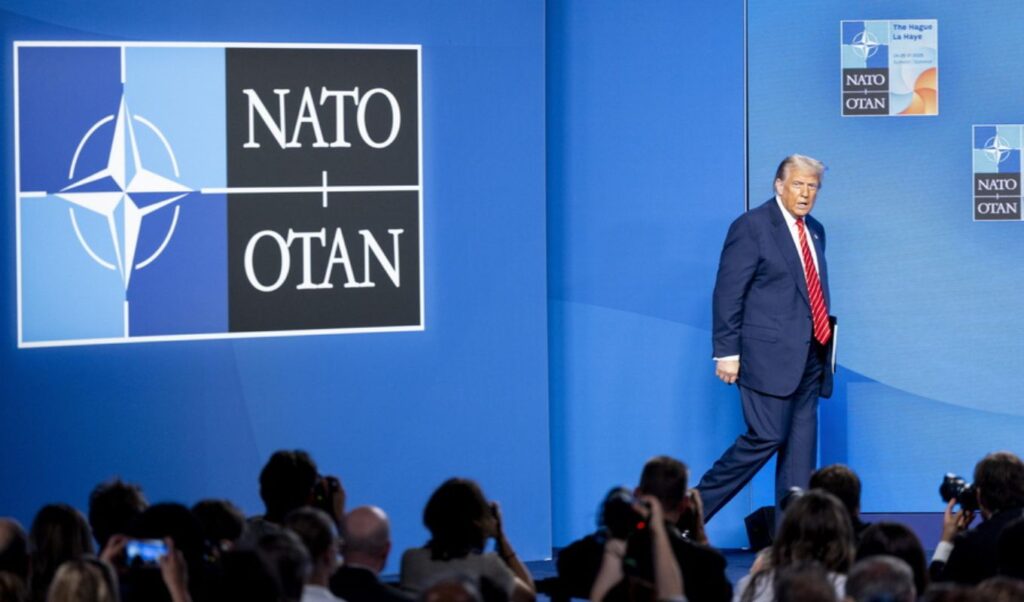
The recent escalation in Donald Trump’s relations with European leadership, as expressed through his clash with Friedrich Merz, dominated much of the discussions during the Gerapetritis-Wandefall meeting on Monday. The subsequent statements highlighted the urgent need for a new security architecture where the Old Continent will take on a leading role and greater responsibility.
What Germany’s Foreign Minister said about troop withdrawal and the “signal” to Europe
The German Foreign Minister, referring to the Pentagon’s announcement of withdrawing 5,000 soldiers from Germany, emphasized the need for “close consultations” with the United States. Despite Donald Trump’s advance warnings about withdrawing medium-range weapons, the German side appears to interpret these moves not as a definitive break, but as an “invitation” for Europe to develop its own defense capabilities. The example of Ukraine, after all, proved that military power can be developed at speeds unprecedented by European standards.
In the same vein, Greek Foreign Minister Georgios Gerapetritis stressed that maintaining the NATO alliance remains extremely important as it serves as the guarantor of international security since World War II. However, he referred to the critical concept of Europe’s “geopolitical maturation” and its strategic autonomy.
Endy Zemenides: NATO weakening
Despite the fact that the crisis in Euro-Atlantic relations is leading Europe to prepare and emerge as an equal and strong pillar of security, the NATO crisis may still prove to be a serious gap in its defensive armor. The executive director of the Hellenic American Leadership Council (HALC), Endy Zemenides, speaking to parapolitika.gr, attributes this policy that the American president exercises toward NATO and his allies to the “absence of strategy and stability and mainly to the lack of serious personnel in his diplomatic office.” This is where the cause lies for his constantly appearing with different positions on the same issue, as he estimates will happen in NATO’s case as well. However, Mr. Zemenides believes that Donald Trump, although he cannot withdraw from the Alliance due to Congress, can cause significant damage, weaken its power and essentially dissolve it from within. This can happen when, for example, he withdraws the ambassador from meetings or when he doesn’t sign communiqués. “It’s not just the dissolution,” he characteristically says, “it’s mainly the degree of America’s participation in the Alliance.”
Petros Vamvakas: “Trump won’t implement any of the threats”
Professor of International Relations at Emmanuel College in Boston, Petros Vamvakas, attributes Trump’s stance toward the Atlantic Alliance to the “exaggeration” that characterizes him and believes that nothing he announces will be implemented. As he points out, “now Germany is in the spotlight with the departure of 5,000 soldiers. All this is completely superficial and the Europeans themselves understand that America has close to 100,000 troops in Europe, at various points, in Spain, Italy, Greece and other countries. The American soldiers in Germany are not only for Germany’s protection, they are also America’s own prestige. So it shows a superficiality that Europeans now understand. The Europeans tried the first year of his second term to get along with him. Remember the image at the White House. Now Mr. Rutte is trying, who was at the White House one or two weeks ago, still seeking to play a bridge-building role between America and Europe. For me, what Europe is going through right now with America is something temporary.”
According to Mr. Vamvakas, after the midterm elections in November we will have a Trump who will be on his way out, because the 2028 elections will be in the spotlight and there will be no room for America’s break with the Europeans. And as he emphasizes, “he won’t implement any of the threats, neither withdrawal from NATO nor troop withdrawal.”
“The possible American withdrawal gives Europeans momentum to stand on their own feet”
It should be noted that throughout NATO’s history, from 1949 onwards, there have been many internal rifts that were overcome over time. In 1966, during the Cold War, France withdrew and expelled NATO forces from French territory. This was a huge crisis that NATO overcame. An intense crisis was created with Turkey’s invasion of Cyprus and Greece’s withdrawal for a short period. As Mr. Vamvakas argues, “NATO is not something that Trump will be able to overturn, despite all his schemes. With his stance, he helps Europeans develop weapons systems and gives them the opportunity to proceed with what they have planned for Europe 2030. The possible American withdrawal gives Europeans momentum to stand more on their own feet.”