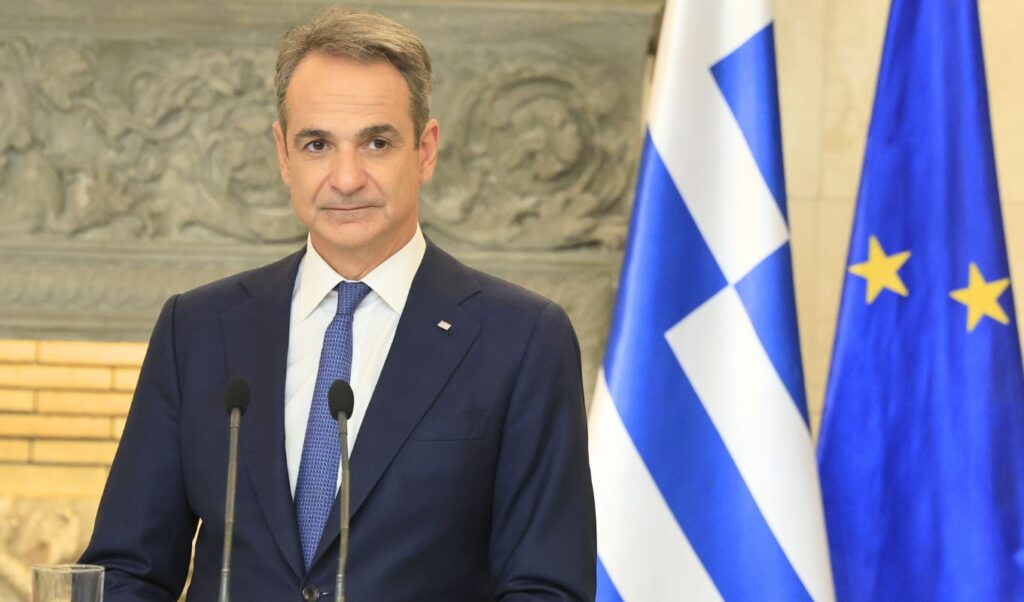
Two defense and security issues are being urgently placed on the European Union’s discussion table by Kyriakos Mitsotakis, who amid rapid developments on the Middle East war front will travel to Amman, Jordan on Wednesday to participate in the Greece-Cyprus-Jordan Trilateral Summit. Under these conditions, the Greek government places particular emphasis on maintaining freedom of navigation in the Strait of Hormuz, as well as on peace in Lebanon and strengthening support for the country’s government.
Kyriakos Mitsotakis to EU: Article 42.7 on the table – Towards operational activation of mutual assistance clause
The first issue raised by the Greek Prime Minister is to give operational dimension to Article 42, paragraph 7, of the European Union Treaty, which states: “If a Member State is the victim of armed aggression on its territory, the other Member States shall have towards it an obligation of aid and assistance by all the means in their power, in accordance with Article 51 of the United Nations Charter”. In his meeting with European Commissioner for Defense and Space Andrius Kubilius, Mr. Mitsotakis noted that European countries that recently supported Cyprus defensively moved in this direction in practice, on an ad hoc basis and without activating the Article. “We demonstrated our commitment to Cyprus when our neighboring country was attacked by Hezbollah, sending ships and aircraft. We particularly look forward to making this Article operationally functional, so as to strengthen the defensive commitment of EU member states, should the need arise again to support a member state under attack,” Mr. Mitsotakis told the EU commissioner.
European air defense shield: Mitsotakis proposal and cooperation with Tusk
The second issue is that of common European funding for programs of common European interest, such as a European air defense shield, a proposal submitted by the Greek Prime Minister in 2024 together with his Polish counterpart, Donald Tusk. Particularly significant are the words of the European commissioner on our country’s defense. “We are really pleased to see Greece leading the development of European defense, with everything you do: with the ‘Achilles Shield’, with the 12-year program worth 26 billion euros. It’s really remarkable. I always tell other countries: ‘Look at Greece, follow what they do’, because certainly the challenges are quite large, both for developing our capabilities and for developing our industry,” Mr. Kubilius said.
Increased investments in European defense within the framework of Europe’s strategic autonomy is a demand that Mr. Mitsotakis has also articulated for several years, with the Greek Prime Minister supporting EU cooperation with third countries in security and defense, but only if it is based on common principles and values and serves EU strategic autonomy, without creating new dependencies.
“Defense constitutes the quintessential European public good and must be supported, beyond the actions we undertake at the national level, through some form of common European borrowing,” emphasize the Prime Minister’s associates. “Greece contributes significantly to discussions on Europe’s strategic autonomy and strengthening defense capabilities,” they add.
Strengthening European Union competitiveness and the Draghi report
Another issue on which Mr. Mitsotakis insists is strengthening the competitiveness of the European Union, “building” on the Draghi report, which analyzes problems but also shows opportunities emerging for united Europe. It is therefore no coincidence that at the award ceremony for the former Italian Prime Minister and former President of the European Central Bank, the main speaker will be Kyriakos Mitsotakis. Mario Draghi will be honored with the international “Charlemagne” award – the most important distinction for services to European integration – and the ceremony will take place in the German city of Aachen on May 14.
Unified energy market: Greek proposal to end price disparities
Moving in the same framework are the Greek Prime Minister’s proposals for a unified energy market against the fragmented landscape that exists today. The initiative undertaken by the Greek government involves including electricity networks in projects of common European interest, which would allow generous European funding. Mr. Mitsotakis is pressing his European counterparts to agree on a European electricity market that operates in a way that avoids large price disparities in electricity within the European Union. He also calls for increased and facilitated investments in nuclear energy as a means of reducing exposure to natural gas – which moreover is not produced on a large scale in Europe – and lignite.