Terror stared back at the 18-member crew of a foreign-flagged cargo ship in the Gulf of Aden, when a drone carrying a bomb “pierced” the ship’s funnel without exploding, leaving the warhead active with the danger of detonation lurking at any moment.
Read: Hezbollah: Launches Ukrainian technology drones against Israel (Video)
The thriller continued, as for days every vibration, every temperature change, even the slightest movement could lead to an explosion, with the threat to the cargo ship crew remaining constant, in conditions of complete isolation, without possibility of escape.
Gulf of Aden cargo ship thriller: 50kg bomb drone neutralized at sea
In conditions of complete isolation, without immediate possibility of escape, the danger was not hypothetical but constantly present, turning the wait into a silent battle against time and fear. At the point where the ship was in motion, one of the most demanding operations unfolded by a specialist team from maritime security company Diaplous for the removal of the unexploded ordnance, weighing approximately 50 kilograms, that had “wedged” into the ship’s structure after the drone attack.

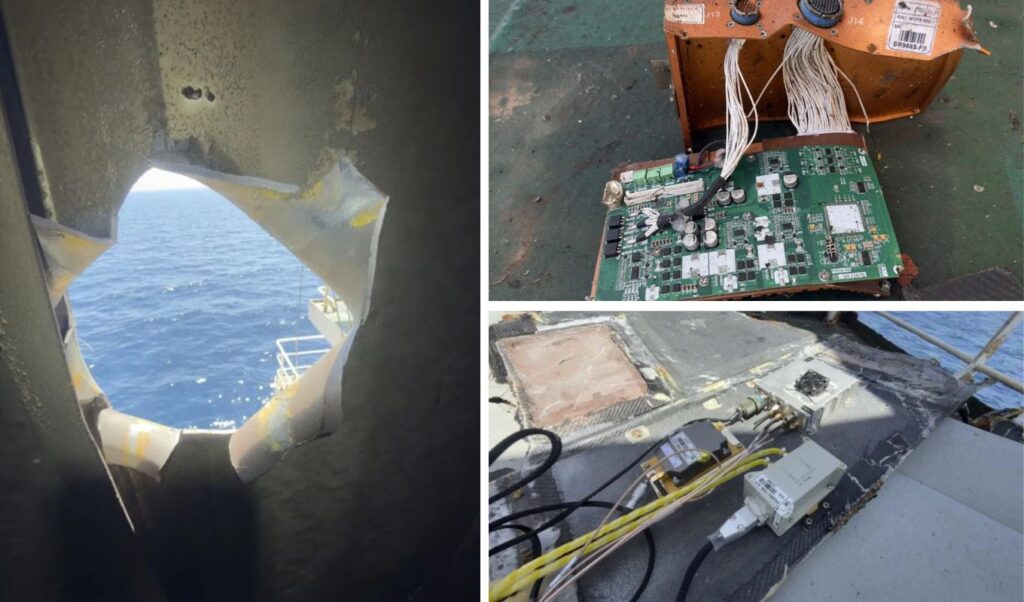
The hole created in the cargo ship’s funnel

The explosive warhead of the drone ammunition
How the incident happened: battle with fear in the middle of the sea
The incident occurred in early April, when the unmanned aerial vehicle (UAV) struck the ship, causing serious damage to the funnel. The explosive payload, instead of detonating, remained inside the ship, creating an extremely dangerous situation: any vibration or temperature increase could lead to explosion.
When Diaplous officials arrived aboard the ship, they faced a silent scene. It wasn’t the familiar, heavy silence of the sea, but one filled with tension, as if holding its breath. No one spoke loudly. Every step sounded more intense than it should. Every small sound seemed threatening. Someone looked at their phone, with no signal. Another brought to mind the last call home. A child’s voice, a conversation left unfinished. At that moment, the distance from their loved ones wasn’t measured in miles, but in anguish.
No one said it aloud, but everyone knew that if this thing exploded, there was no time and no second chance. And yet, they continued. With discipline. With small, careful movements. With looks that said more than words. Some crossed themselves silently. Others simply looked at the sea, as if seeking an answer that wasn’t coming.
Time moved differently. Every minute seemed heavy, almost motionless. And within this waiting, there was a common feeling: not just fear, but responsibility. To stay upright. Not to make mistakes. To return. Because in the end, what sustained them wasn’t just their experience. It was the people waiting for them back home. The crew reacted immediately, shutting down the engine operation to reduce the risk of ignition, while the ship was essentially put out of operation “in open sea”.


The ordnance neutralization operation lasted 12 hours
The operation
Three days later, a specialized explosive ordnance disposal (EOD) team from DIAPLOUS company arrived in Oman and, with the assistance of the country’s Navy, were transferred to the ship, approximately 60 nautical miles from the coast.
The operation lasted a total of 12 hours and was carried out under extremely difficult conditions, at height and in confined space inside the funnel, with risk of fire or toxic gases, with the ship without propulsion and with the possibility of new attack remaining open. The specialists isolated the area, moved the crew to safe points and proceeded step-by-step with the neutralization and removal of the ordnance.
A decisive role in the operation’s success was played by coordination with Oman authorities, as well as the crew’s discipline, who faithfully followed safety protocols. As market sources emphasize, in such conditions success is judged not only by the technical neutralization of the danger, but mainly by the fact that a second, catastrophic incident is avoided.
The incident highlights in the clearest way the new reality facing commercial shipping in areas like the Arabian Sea and Gulf of Aden. Threats are no longer limited to piracy, but include drone attacks, missile strikes, electronic interference and incidents with unexploded ordnance (UXO) either as a result of targeted action or as collateral damage. In this environment, such an incident is not simply a technical issue, but a comprehensive security crisis requiring coordination, training and immediate response.
Source: APE-MPE
Photos: Diaplous