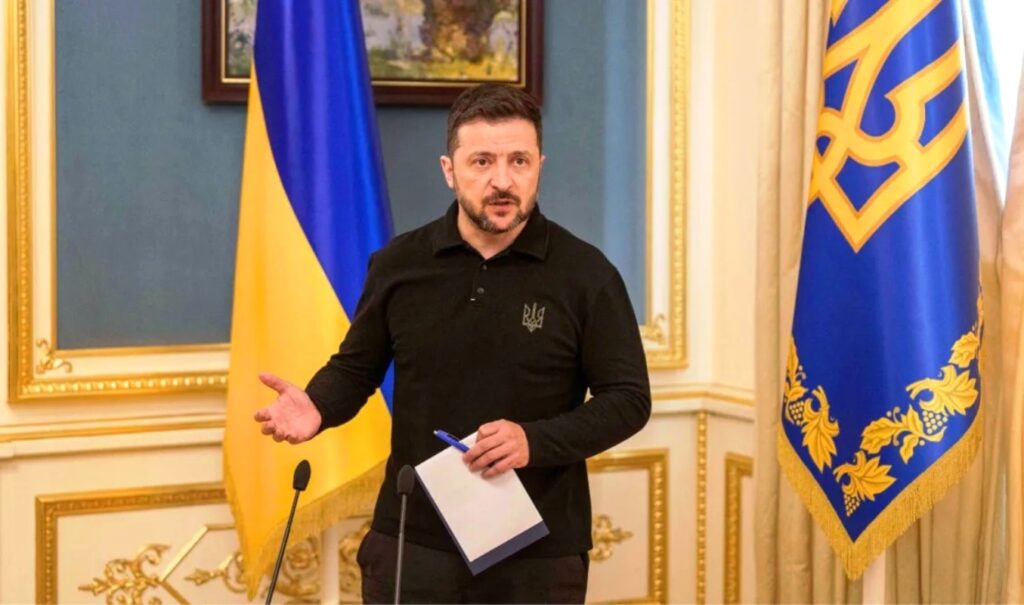
The informal Summit of European Union leaders in Cyprus takes on heavy geopolitical weight, as the spotlight simultaneously falls on the war in Ukraine and Zelensky’s demands, the turmoil in the Middle East, energy pressure, and the next phase of the European budget. Within this scenario, Volodymyr Zelensky is attempting to keep Ukraine at the top of the European agenda, pressing both for the final activation of the €90 billion loan and for a clearer political signal regarding his country’s EU accession prospects. However, there is a critical element that must be recorded with precision: until this moment, the official European Council program states that the Ukrainian president will brief the leaders via video conference and not through physical presence. This means that information about a surprise personal trip to Cyprus is not confirmed by the EU’s official program, which was published by the Council and continues to explicitly mention remote connection.
Read: Ukraine asks Turkey to organize Zelensky-Putin meeting
Zelensky: What the official Cyprus program says
The European Council clearly states that leaders will meet in Nicosia and Ayia Napa on April 23 and 24, 2026, with central themes being the geopolitical environment and the multiannual financial framework 2028-2034. In the geopolitical section, the official document explicitly notes that “Ukrainian President Volodymyr Zelensky will brief via video conference on the latest developments in Russia’s aggressive war against Ukraine.” This formulation is clear and has particular significance, because it shows that at least at the level of official European organization, no change toward physical participation has been recorded. Therefore, any reports speaking of personal appearance should be read with reservation until there is official confirmation from the Ukrainian presidency, the Cypriot presidency, or the European Council itself. In such a critical event, this detail is not technical but substantial, because it changes the political symbolism of Zelensky’s presence.
Zelensky: The €90 billion and Kyiv’s battle
In the substantive part of the discussion, the major front for Ukraine is the €90 billion loan for the years 2026 and 2027. The EU Council has already confirmed since early February the legal framework for providing this support, while the Commission in early April took the first preparatory steps for its implementation, specifically for the first phase of €45 billion concerning 2026. The case was blocked for a period due to tension with Hungary around the interruption of Russian oil flow through the Druzhba pipeline, but today the picture has shifted. Reuters reported on April 22 that, after the lifting of the veto and the resumption of flow, the EU proceeded to the final approval phase of the loan and the 27 were expected to formally sign the agreement by Thursday. In simple terms, Zelensky is not pressing for an abstract demand, but for the faster finalization of a package that the EU has already decided politically and has begun to activate institutionally.
EU accession and the political message
Parallel to the loan, Kyiv’s other major pressure concerns the accession process. Zelensky has stated that Ukraine is completing the technical aspect required to begin negotiations in all chapters of the accession procedure and is now asking European leaders for a more stable political decision and a clear timeline. Reuters had reported since early March that the Ukrainian president considers accession central to the country’s future security and stability, but that the process continues to stumble mainly on Hungary’s resistance. The fact that Ukraine is raising the issue precisely at an informal Summit with such intense geopolitical content is not coincidental. Kyiv is attempting to tie its military and economic survival to its European institutional prospects. It wants accession to not be treated as a distant symbolic promise, but as part of a real security architecture.