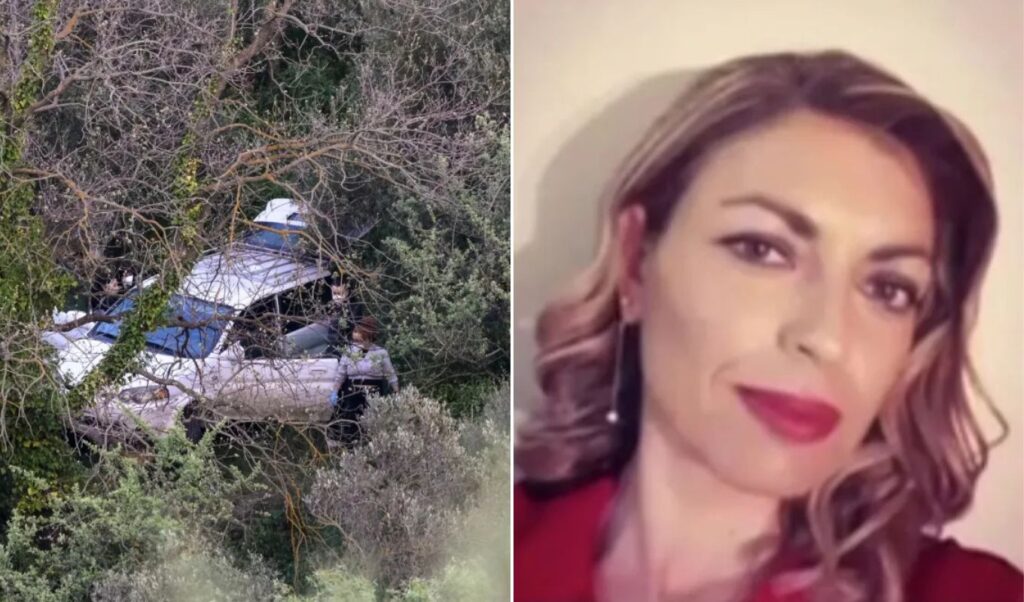
New, decisive evidence strengthens the reconstruction of the circumstances under which the apparent murder of 43-year-old Eleftheria Giakoumaki from Dafnes, Heraklion, Crete, was committed.
Read: Crete: Eleftheria Giakoumaki’s ex-partner orchestrated her disappearance (Video)
Current police assessments converge on a specific scenario: the woman received a fatal gunshot to the head from almost point-blank range while sitting in the driver’s seat of her vehicle. A vehicle that both the police and emergency response teams had been desperately searching for since last Sunday (19/4).
According to evidence collected so far, 39-year-old Marinos Andreadakis, who later committed suicide and is the probable murderer and ex-partner of Eleftheria, allegedly used a pistol, as the head wound of the 43-year-old is attributed to a handgun bullet, likely 9mm caliber. Police authorities estimate that the perpetrator was outside the vehicle, standing upright, and shot the 43-year-old from the exterior while she was sitting at the wheel. This remains to be confirmed by the coroner and forensic laboratories.
Of particular significance is the fact that no weapon was found near the body at the scene, evidence that immediately ruled out suicide and directed investigations toward criminal activity. Conversely, cigarette butts and a gun casing were found nearby. Based on evidence collected so far, police estimate that the murder took place on Sunday morning, occurring just hours before the disappearance was officially reported by her family.
Additionally, significant evidentiary value is attributed to an automated message sent from the 43-year-old’s mobile phone to her children, containing the text “I’ll call you later,” at a time when they were trying to contact her. This specific message activates when a user rejects an incoming call, which reinforces authorities’ assessment that the device was used after the time of disappearance, possibly by a third party.
Regarding the reconstruction of the alleged perpetrator’s movements, the Heraklion Security Subdivision has already documented, through analysis of security camera footage and other evidence, a detailed sequence of actions during the critical Sunday hours. According to this data, shortly after 11:00 AM, the 39-year-old, riding a motorcycle, arrives in the area near the chapel of Saint Panteleimon in Dafnes, where he meets Eleftheria Giakoumaki. About an hour later, he is recorded by cameras walking on foot on the provincial road from Heraklion to Moires. From that point he calls a taxi, boards it, and travels to his home in Malades. Subsequently, he returns to the Dafnes area driving a Smart car, arrives again at Saint Panteleimon chapel, and then leaves with the 43-year-old’s car, heading via the same provincial road toward Agia Barbara, the area where the body was later discovered.
The route is confirmed by security camera recordings from a gas station, which show that the 43-year-old’s vehicle was abandoned near Agia Barbara. At 13:13, the same man appears recorded on foot calling another taxi and returning to the point where he had left the Smart car, near Saint Panteleimon chapel in Dafnes.
The comprehensive mapping of evidence leads authorities to a coherent assessment of the method of operation, sequence of movements, and timeframe within which the murder unfolded, with final answers expected from complete forensic and laboratory examination findings.