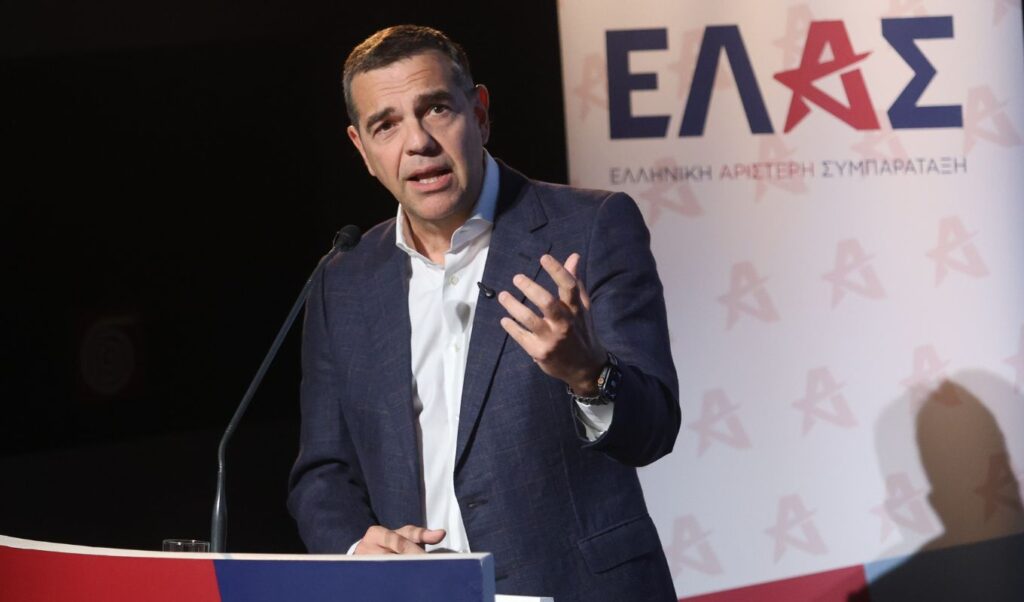
Alexis Tsipras was particularly revealing about the future of independent SYRIZA MPs who wish to join the Greek Left Alliance (ELAS) during his interview on PARAPOLITIKA 90.1 yesterday, while his remarks about relations with PASOK also drew significant attention. “We have made it clear that we will not have a Parliamentary Group, and that any MPs who wish to become members of the Greek Left Alliance can do so — provided they resign from Parliament. Because, you understand, it is contradictory for MPs to be members of a party that does not want a Parliamentary Group and does not want to play that particular game. And we will clearly not be playing that game.”
Tsipras’s message to prospective ELAS candidates and Achtsoglou’s appearance in Ilion
Setting a clear timeline, Tsipras stated that “you will not see on our ballot papers anyone who resigns in March and joins our lists in April.” On Wednesday evening, however, Efi Achtsoglou appeared at the ELAS meeting in Ilion, effectively opening the door to Tsipras’s party. The next expected step for the former SYRIZA MP is to formally register as a member of ELAS. It should be noted that the decision of independent MPs to join ELAS carries no guarantee of candidacy in the next elections. All will be admitted as ordinary members, with decisions about their inclusion on ELAS electoral lists to be made at a later stage.
Tsipras: PASOK must decide who it stands with and who it leaves behind
Turning to PASOK, Tsipras described it as a party that “borders” both ELAS and New Democracy, calling on Androulakis to “decide who he will align with and who he will leave behind.” “It borders both ELAS and New Democracy — it sits in between. And it must decide who it will go with and who it will leave,” he said pointedly. He added: “It has a tradition and a base, because it was the defining opposition pole to the right — there are people still there whom we respect, comrades in the broader progressive struggle.” However, he noted that there are also “figures within PASOK who are currently championing a strategy — which I consider a dead end — of an almost single-front attack on ELAS,” arguing that this “only serves Mitsotakis.” He further remarked that Nikos Androulakis “appears, at this stage, to be endorsing it.”
“I want to keep this at the level of political debate. I have said in countless ways that our opponent is not PASOK, but New Democracy,” he said. In contrast, he pointed to PASOK figures who “go on the media and in 7 out of every 10 words say that Tsipras is just as bad as Mitsotakis. I don’t think that does the broader progressive camp any good.” He identified two reasons for this. The first is that it allows the impression to take hold — “which Mr. Mitsotakis wants — that some people are not focused on him and his government, but are fighting amongst themselves. And we are not falling into that trap.”
Tsipras rules out joint electoral run but remains open to post-election cooperation
The second reason, according to Alexis Tsipras, is that those within PASOK pursuing a single-front strategy against him are not really thinking about how to reduce his party’s vote share, but rather about the day after the election. “By building a psychological wall against ELAS, they are cutting off the prospect of an agreement for the day after — and thus opening the road to supporting and cooperating with New Democracy,” he argued. He added that he believes “Mr. Androulakis has not made that decision himself, but I do believe that experienced figures within PASOK have adopted this strategy.” Political disagreement is legitimate, he added, “as long as we play with our cards on the table and don’t muddy the waters.”
Of particular interest were also his remarks directed at figures in the broader progressive space who have spoken about running jointly in elections. The former prime minister responded that the electoral law effectively makes such an option counterproductive, as a coalition of parties — even if it comes first — does not receive the seat bonus. With this position, Alexis Tsipras in practice rejected scenarios of a joint electoral front, without, however, closing the door to post-election cooperation among progressive forces — a prospect he directly linked to the decisions PASOK will ultimately make about its own political future.