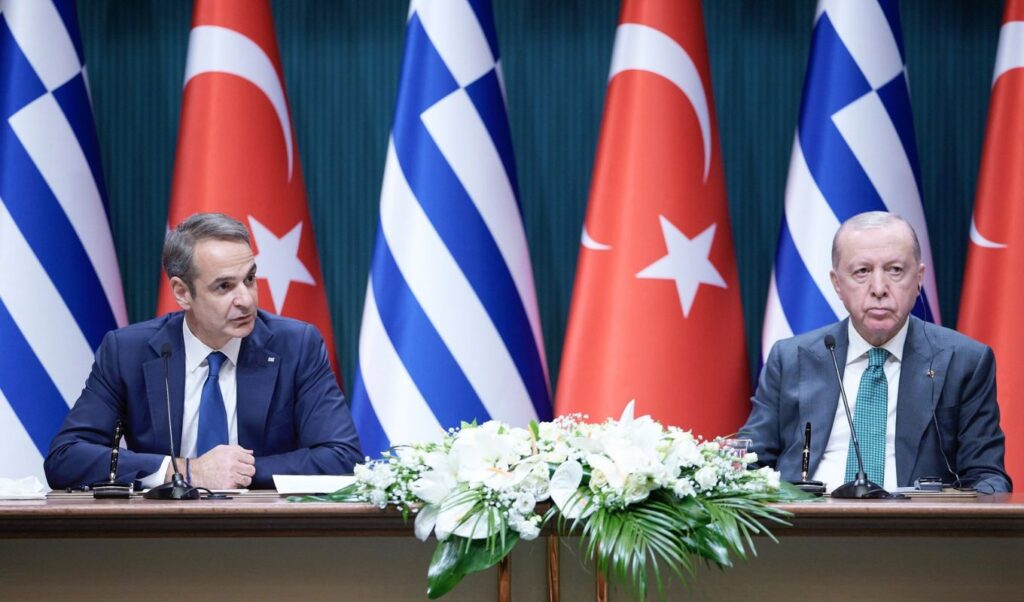
Greek-Turkish relations are once again heading toward heightened diplomatic tension, this time over the advancement of the Great Sea Interconnector (GSI) — the undersea electricity cable linking Greece and Cyprus. Ankara is escalating its provocative rhetoric, warning that it will not allow “any unauthorized activity,” while Athens, through government spokesperson Pavlos Marinakis, firmly states that the project is moving forward as planned and requires no Turkish authorization.
Read more: Greece’s Plan B if a second “Kassos Incident” occurs: Restarting surveys for the electricity interconnection as Greek-Turkish relations face a new test
Greek-Turkish relations on a trajectory of growing diplomatic tension
The latest flashpoint was ignited by official statements from Turkey’s Ministry of National Defense. A Turkish defense ministry spokesperson expressed Ankara’s strong objection to the GSI cable, arguing that any activity involving the laying of cables, pipelines, or scientific research on what Turkey claims as its continental shelf must be coordinated with Ankara in advance. Invoking the controversial Turkish-Libyan memorandum and the maritime delimitation agreements with the Turkish-controlled pseudo-state in northern Cyprus — which Ankara submitted to the United Nations in March 2020 — the Turkish official declared that no unauthorized actions would be permitted.
Professor Sotiris Roussos, an International Relations scholar at the University of the Peloponnese, told parapolitika.gr that Turkey pushes as far as it is allowed to go, and believes the planning behind the cable project has not been sufficiently thought through. “I have the sense that we don’t have a Plan B,” he said. “Our Plan B was to turn to the French, under the naive assumption that they would deploy their warships and engage in a naval battle with Turkey. But the French said ‘let’s move five miles down and that’s the end of it.’ That’s what they said. That’s what was reported in Kathimerini. So do you have the means to make those moves? Because if you don’t, you’ll create a far bigger problem.” The professor added: “It is very dangerous to consider how the Turks might react, because there is a very serious underlying issue. If we enter into a crisis with Turkey right now, the Americans will intervene — and the Americans at this moment are not focused on legal rights. Their mindset is ‘let’s work something out, guys.’ They’ve always had that approach to Greek-Turkish disputes, but now they have it even more so. Trump has no grasp whatsoever of international law. When we go to present our legal case, he’ll tell us: ‘Fine, put those papers away and let’s talk business.'”
For seasoned diplomat Giorgos Poukamisas, Turkey’s reaction is also sharpened by the planned extension of the GSI to Israel. “If we assume there is significant Israeli involvement and Israeli interest in the Great Sea Interconnector, then the Turks will obviously react with even greater intensity — like a bull seeing a red flag. The Greek side, or the Greek-French side, will need to have taken precautionary measures before anything happens on the ground. Another Kassos incident is unthinkable. So I would speculate that if the Turks persist, we either go all the way, or quite simply, we won’t lay any cable at all,” he argued.
Alongside the escalating rhetoric, Turkey also made tactical moves on the ground yesterday. Through the Antalya station, it issued a NAVTEX designating a reserved maritime zone from October 1 to 25, allowing the research vessel Oruç Reis to conduct surveys. The operations relate to a planned 97-kilometer undersea natural gas pipeline intended to connect Anamur in Mersin to Teknecik, located east of occupied Kyrenia.
Professor Roussos interprets this move as part of a consistent and long-standing Turkish strategy. “Turkey has a fixed objective,” he explained, “which on one hand is essentially the protectoratization of Cyprus as a whole, and on the other, the unification by every possible means of the occupied territory with Turkey. It also seeks to prevent the Republic of Cyprus from functioning as a normal state. That is the fundamental way Turkey operates. On one side, it wants to effectively unite — and has largely succeeded in doing so — the occupied territories with Turkey, without them formally becoming Turkish sovereign soil. On the other, it aims to have northern Cyprus function as a state ‘under mandate.'”
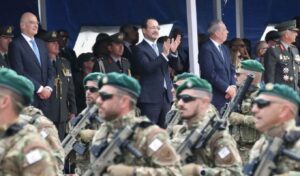
In this context, it is worth highlighting that on the very day of the anniversary of Cypriot independence, Ankara criticized the island’s military parade, going so far as to object to the presence of allied nations — the United States, France, the United Kingdom, and Egypt — arguing that the military cooperation between Greece, Cyprus, and third countries negatively affects the security environment on the island.