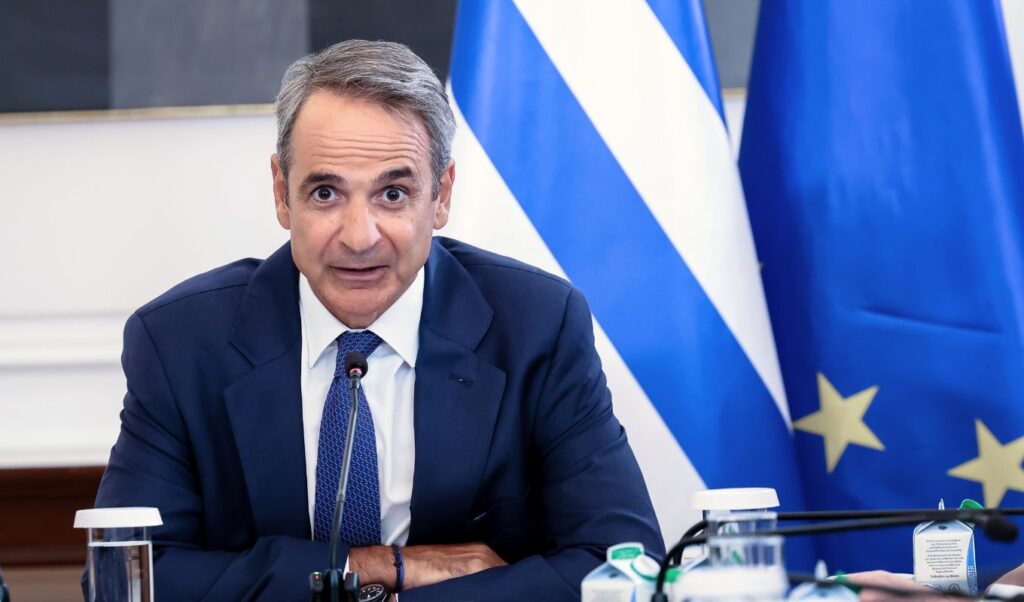
“At a time when rules and international agreements are being tested, Greece stands firm on International Law, multilateralism and dialogue,” writes Prime Minister Kyriakos Mitsotakis in his regular Sunday post, calling for “dialogue without concessions with Turkey.”
In his weekly review, centered on his address to the 81st United Nations General Assembly, the Prime Minister stressed that “Greece must be present wherever these discussions take place. With clear positions, alliances, and a plan.”
Read also: Mitsotakis opens the door to $4.5 trillion investors and draws red lines with Turkey – What was discussed in closed-door meeting on energy, banks and infrastructure
Kyriakos Mitsotakis’ full weekly review:
“Good morning everyone. This week I was in New York and San Francisco — two very different corners of America — but with the same feeling: that we are living in a world more uncertain and more demanding than ever. Wars continue, geopolitical balances are shifting, new pressures are mounting on energy and migration, and technological developments like artificial intelligence are advancing at remarkable speed. All of this may seem distant. It is not. It affects our country’s security, the economy, energy costs, jobs, and the opportunities available to young people. That is why Greece must be present wherever these discussions take place. With clear positions, alliances, and a plan.
This was the central message of our presence at the UN. At a time when rules and international agreements are being tested, Greece stands firm on International Law, multilateralism and dialogue. As a member of the Security Council — whose presidency we will assume in October — and as a country positioned at the crossroads of Europe, the Middle East and North Africa, we want to be a bridge, not part of the problem. This means engaging in dialogue with all parties, but without compromising our positions, which remain firm. With Turkey, it is essential that we maintain open channels of communication and pursue dialogue grounded in International Law and good neighbourly relations. After all, geography has destined us to live side by side. I reiterated during my address to the UN General Assembly that the only institutional framework for resolving our dispute is International Law. However, meaningful dialogue cannot coexist with unilateral actions that violate international legality.
In New York, I met with more than 30 institutional investors with exposure to Greece and Greece’s largest companies, whose total assets under management exceed $4.5 trillion. I reaffirmed that prudent fiscal policy — which underpins the achievement of surpluses and enables rapid debt reduction — remains our top priority. The most pressing immediate government priority, amid significant international uncertainty and turbulence, is tackling the cost of living, primarily through reducing energy costs with a focus on heating oil, and in the medium term through increasing disposable income, further tax relief, and higher average nominal wages.
There is, however, another issue that I believe will shape our future far more than we have yet realized: artificial intelligence. In San Francisco, we met people at the forefront of this technological revolution. And here, history offers a crucial lesson. When nuclear energy emerged, humanity understood that it was not enough to know how a new technology works. Rules, institutions, oversight, and international cooperation are needed to manage both its enormous potential and its risks. The same question now arises for artificial intelligence — perhaps with even greater urgency. When even the creators of the most advanced AI models admit that they do not fully understand how these systems function and improve themselves, the notion that self-regulation is sufficient is simply not convincing.
We therefore need regulation. Not to stifle innovation, but to make it safe and beneficial for humanity. And we need a state that understands technology well enough neither to fear change nor to become a hostage to those who develop it. This is the great challenge for Greece: to harness AI in the economy, in public administration, in healthcare and in productivity — without allowing technology to evolve without boundaries or accountability. From New York to San Francisco, the conclusion was ultimately the same: a country’s power today is not measured solely by its size. It is measured by its ability to build alliances, to defend its positions through rules and arguments, and to engage proactively with the great changes of our era. This is what we want Greece to be: a bridge-builder, not a troublemaker. A country that is present, credible, and useful in managing the great challenges of tomorrow.
The fact that I was in America does not mean nothing was happening back home. Opening the domestic highlights of this week’s review, I begin with the payment of the double rent reimbursement for educators and healthcare workers serving in regional areas, which commenced last Friday and applies retroactively from the 2024 tax year. This is the first of the new support measures I announced at the Thessaloniki International Fair (TIF) to be implemented. A useful reminder also for all other rent reimbursement beneficiaries: until Wednesday, 30 September, you can correct any errors or omissions in your E1 tax form in order to receive a one-month rent reimbursement.
In the same area of housing protection, an important change to the out-of-court settlement mechanism came into effect last Monday. This allows debtors to now request a separate settlement arrangement for their primary residence, while agreeing to the liquidation of their other properties. Let me give an example: a debtor owes a total of €300,000 and owns a primary residence valued at €150,000, along with other properties worth €50,000. Under the new arrangement, they can request that their primary residence be protected separately and agree to have the remaining real estate liquidated. In practice, this means the settlement for their home will not be calculated on the full €300,000, but based on the value of the primary residence — €150,000 — and of course their income capacity. This can result in a lower monthly instalment, a greater debt write-off, and a repayment plan of up to 35 years. I believe that in this way, we are giving hundreds of thousands of borrowers a solid second chance to restructure their debts in a sustainable manner, without the fear of losing their home. A solution that combines social sensitivity with realistic debt management.
We have spoken before about the expansion of the Digital Work Card. This week, the next practical step was taken: a clarifying circular was issued for its implementation across the new sectors I mentioned back in June, following a pilot period and consultations with representatives of both employees and employers. Full implementation will roll out in two phases: from 12 October for private healthcare, telecommunications, hairdressers, beauty centres, dry cleaners and cleaning services; and from 16 November for consulting services, advertising, repairs, logistics, water and sewage services, and gambling. In total, approximately 500,000 additional workers will be covered, bringing the overall number to around 2.5 million.
I now turn to three of our initiatives that form part of our broader effort to strengthen decentralisation by offering incentives to relocate to regional areas. The first initiative concerns employment. We are preparing a new subsidised employment programme for businesses that hire workers living in mountainous and remote areas. The programme provides for remote working arrangements, with a subsidy covering 90% of wages and social insurance contributions for 12 months. In simple terms, a person will be able to work for a business located elsewhere without having to leave their hometown. And the business will have a strong incentive to retain them beyond the subsidy period. The second initiative concerns vocational education. In Karpenisi, a new hospitality and hotel management specialisation is being launched under DYPA — the Hellenic Public Employment Service — offering 25 places for 2026–2027, with an apprenticeship allowance of up to €588 per month. This is an option that links training to a genuine local need: mountain tourism. It gives young people the opportunity to learn a profession that can keep them in their community while supporting local businesses. The third initiative targets areas with acute demographic challenges, where the Relocation Programme — launched as a pilot in Evros and previously discussed — is now being extended to seven municipalities in the Regional Unit of Ioannina, as well as to the municipalities of Souli and Filiates in Thesprotia. The programme offers — as a reminder — financial support of up to €10,000 for individuals and families who choose to settle permanently in these areas. In October, the application platform is expected to open for the eight Regional Units already included in the plan: Kastoria, Kilkis, Serres, Florina, Pella, Drama, Kozani and Grevena.
Autumn may have arrived, but tourist activity continues, and all signs point to the year closing on a very positive note. In the first seven months alone — January through July — tourism revenues rose by 12% compared to last year, reaching €13.5 billion, while the number of international visitors increased by 8.6%, despite the uncertainty generated by the situation in the Middle East. The goal, however, is not only for tourism to perform well overall, but for its benefits to extend to more regions — particularly those affected by major natural disasters. With this in mind, we launched the platform for the Thessaly–Evros Pass 2026 on Thursday. The programme includes 7,500 digital cards worth €200 each for selected destinations in Thessaly, and 1,400 cards worth €250 each for selected destinations in Evros.
A more everyday — but by no means insignificant — change also concerns the Land Registry. Through the metavoles.ktimatologio.gr platform, applications for the correction of boundaries, surface area, and other geometric data can now be submitted electronically for the cases covered by the platform. This was the last Land Registry procedure that required physical presence. It may sound like a technical matter, but it represents a very significant convenience for citizens. It means that a property owner no longer needs to take time off work, travel, and appear in person at a Land Registry office to correct a boundary or the surface area of their property on the cadastral map. They can log in online, assign the required technical procedure to their engineer, submit the supporting documents, track the progress of their case, and — where applicable — file an objection or appeal. The citizen does not go to the state; the state becomes more accessible to the citizen, regardless of where they live. We have already achieved this in so many other services.
On migration, the asylum seeker reception facility in Thermopylae has now ceased operations, as there are no longer any residents on the premises, and the site will shortly be returned to the local community. I should also note that this year, migration and refugee flows are significantly reduced — by approximately 34% — compared to 2025. At the same time, in the first half of 2026, forced returns and deportations of irregular migrants to their countries of origin increased by up to 40% compared to last year, while the asylum recognition rate for the first eight months of 2026 stood at 37%, compared to 72% in 2024 and 58% in 2025. The motto of our government on migration is “strict but fair policy.” This is why we serve as a model for Europe in managing this issue.
I will close with a piece of news that briefly takes us out of the week’s current affairs and brings us back to the deeper currents of our history. Fifteen antiquities that had been unlawfully removed from Greece are being returned from the United States. Some will be reunited with finds from the same excavation, at the Heraklion Archaeological Museum. With this repatriation, the total number of antiquities returned since 2022 through decisions of the Manhattan District Attorney’s Office reaches 179. Behind every such return lies persistent effort, and I will never tire of saying it: congratulations are due to the people at the Ministry of Culture and all those who contributed. Every repatriated antiquity is a significant victory — until the greatest one of all. And since we are speaking of our culture, today, as part of the European Heritage Days, admission to all public archaeological sites, museums and monuments managed by the Ministry of Culture is free. So if there is a museum or site you have always meant to visit, perhaps this Sunday is the right moment.
Happy Sunday to all!”