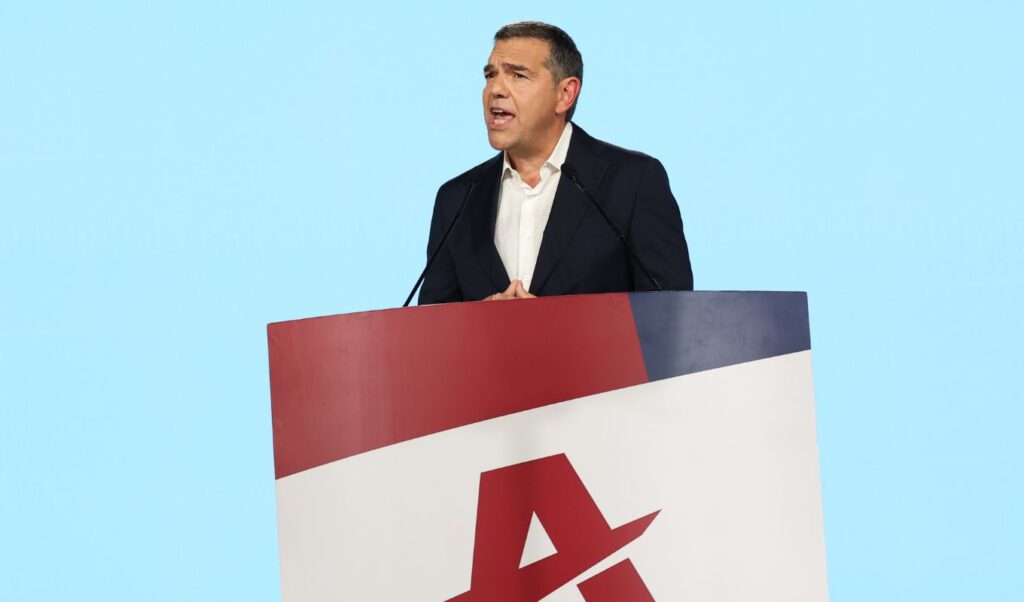
Alexis Tsipras‘ speech in Thessaloniki has left SYRIZA officials feeling particularly optimistic, as the former prime minister’s proposals were received with strongly positive impressions. Party members noted that his proposals were thoroughly substantiated and realistic — free of exaggeration and paradox — and focused on the next four-year governing period. Senior SYRIZA figures emphasized that Tsipras managed to break from the so-called “Mavrogialouros logic” and the traditional “take everything” approach that has long characterized speeches at the Thessaloniki International Fair (TIF).
SYRIZA officials who attended Tsipras’ Thessaloniki speech
Alexis Tsipras, accompanied by party officials, entered the hotel venue shortly after 8 p.m. Members of the party’s National Council occupied the front rows. Among his longtime allies who attended were Giorgos Karameros, Symeon Kedikoglou, Katerina Notopoulou, Kostas Zachariadis, Athena Linou, Vassilis Kokkalis, and Kostas Sarakiotis. Independent SYRIZA members in attendance included Miltos Zamparas, Kalliopi Vetta, Ozgur Ferhat, and Panagiotis Kouroumblis.
Alexis Tsipras: The standout proposals from his policy programme presentation
The former prime minister’s speech was not only fully costed but also contained several genuinely groundbreaking proposals, including the relocation of government ministries to various cities across Greece. Tsipras spoke at length about tax justice, stressing that his party’s programme aims to “reduce the burden on those who are already carrying a disproportionate share.” In this direction, he announced that his National Reconstruction Plan includes doubling the tax deduction for families with children, abolishing the business licence fee for all businesses, eliminating advance tax payments for sole traders, and reducing advance tax payments for legal entities.
He stressed that “income from capital cannot permanently receive more favorable treatment than income from labor.” He pledged that SYRIZA would introduce a progressive tax scale on dividend income and increased taxation on properties owned by legal entities that remain empty as investment holdings. The programme also includes tighter taxation of gambling and the elimination of what he called “provocative” tax exemptions for the super-wealthy.
The “Patriotic Contribution” for the top 1%
Tsipras outlined in detail the Patriotic Contribution targeting the wealthiest 1% of Greeks. “One euro per year for every one hundred euros of net wealth, replacing other general levies on the same assets. One percent on the most powerful one percent,” he said emphatically, adding that this represents “a condition for social cohesion, an act of responsibility, and a patriotic duty.”
Average wage to reach €1,000 by 2027 — with a target of €1,800
Addressing wages, Tsipras noted that the average salary has fallen by 22% compared to 2009. He announced that the average wage would reach €1,000 by 2027, while the average full-time salary would rise to €1,800 by the end of the four-year term. On energy, he said he intends to establish a minimum guaranteed quantity of energy at a fixed, affordable price for every household, alongside an average 30% reduction in electricity bills. His programme also includes reducing VAT on basic food items to 6%, and he pledged zero out-of-pocket costs for pensioners’ medications — a saving equivalent to €360–€720 per year.
More specifically, Tsipras stated in his speech: “Tax justice also means that those who are already carrying a disproportionate burden should pay less. That is why we are relieving pressure on families, workers, and small businesses,” and continued:
“- We are doubling the tax deduction for families with children.
– We are abolishing the business licence fee for all businesses.
– We are eliminating advance tax payments for sole traders.
– We are reducing advance tax payments for legal entities.
– We are giving a genuine second chance to borrowers or guarantors who lost assets due to loans taken out during the financial crisis. They will regain their tax and insurance clearance so they can re-enter economic life.
– Those who made every effort to remain compliant through debt restructuring will be removed from the Teiresias credit blacklist.
– We are reinstating the 2015 debt settlement programme for tax and social security debts — 120 installments on the principal, with surcharges written off.”
“Our second commitment is clear: wealth will be distributed more fairly”
“Wealth must be shared — today it is accumulating provocatively in just a few hands, and that must be reversed,” Tsipras declared. “That is why our second commitment is clear: the wealth we create will be distributed more fairly,” he added, noting that this means more from those who have more.
“We are introducing a Patriotic Contribution for the wealthiest 1% of Greeks: one euro per year for every one hundred euros of net wealth, replacing other general levies on the same assets. One percent on the most powerful one percent — for the benefit of one hundred percent of society,” he explained, describing it as an act of responsibility and a patriotic duty.
Thessaloniki: Tsipras’ vision for a “Balkan metropolis”
Regarding Thessaloniki, Tsipras stated: “Our vision is for Thessaloniki to become the Metropolis of the Balkans — green, functional, and resilient.” He described plans to “establish a strong multilateral framework for trans-Balkan trade and economic cooperation with neighboring Balkan countries, with Thessaloniki at its center.”
“We will connect the transport networks, railways, ports, energy infrastructure, and logistics of our neighboring countries,” he added. He explained that the city’s key gateways and infrastructure — port, airport, railway, road network, and logistics — would function as a unified system, and also referenced a metropolitan transport network, westward expansion of the Metro, and a unified redevelopment plan for the city’s waterfront.
Five ministries to relocate outside Attica — the cities Tsipras has chosen
Tsipras highlighted the need for a gradual transition toward a polycentric Greece. “We will gradually transfer services and administrative positions to the regions. Over a decade, five ministries will relocate outside Attica,” he said, specifying:
– The Ministry of Industry to Thessaloniki.
– The Ministry of Rural Development to Larissa.
– The Ministry of Tourism to Heraklion, Crete.
– The Ministry of Island Policy to Lesvos.
– The Ministry of Digital Policy to Kozani.
“And we are planning a Special Defense Industry Zone in Thrace,” he added.
Tsipras on railways: Safety is the first and non-negotiable priority
On the subject of railways, he underlined one phrase which, he said, is not an announcement or a pledge but an oath: “The first and non-negotiable priority is safety.” He continued: “Full operation of signaling and remote management systems. Staff certification. Independent investigation of every incident. And only after these are in place do we talk about speeds and corridors.” He added: “And once the essentials are secured — a plan for a unified freight transport system from Greek ports to the Balkans. Because we want our ports to be hubs of a national network, not prime assets to be sold off.”
“Mass biometric surveillance is prohibited”
“Because technology is not neutral, every algorithm that makes decisions affecting a citizen’s life will be entered into a public register and subject to human review,” the former prime minister continued. “And mass biometric surveillance in public spaces is prohibited,” he added.
“Public infrastructure for computing power and data”
“We don’t have the scale to compete with the largest AI models, but we do have the ability to choose specific fields and become leaders in them,” Tsipras observed.
“We are creating public infrastructure for computing power and data, with guaranteed access for research teams, hospitals, schools, and small businesses,” he continued, identifying four priority areas:
– Health and diagnostics.
– Energy and grid networks.
– Shipping and supply chains.
– Disaster prevention.
Denmark and the Netherlands cooperatives held up as a model
Addressing farmers, Tsipras said: “Water is treated as productive infrastructure and a matter of national security — with a unified project for water storage and the modernization of irrigation networks in Thessaly and Central Greece. With a Land Bank that leases public land on a long-term basis to young farmers. With multi-year production contracts offering guaranteed quantities and prices that are not set unilaterally. And with mandatory traceability, to put an end to the fraudulent relabeling of foreign products as Greek.” The model, he explained, is “the cooperatives of Denmark and the Netherlands, which control the entire chain from field to shelf and remain in the ownership of producers.”
Energy: “Cleaner, cheaper, more secure”
“Our goal for energy can be described in three words: cleaner, cheaper, more secure,” he emphasized. “We are also building a Greek value chain — a photovoltaic assembly line, a storage systems unit with Greek design, and completion of the island interconnections, so we can finally stop burning oil just to keep a light on in the Aegean,” he said.
“The green transition becomes production and ownership, not simply the import of equipment,” he added. “Energy will no longer be a mechanism for uncertainty and profiteering. It will become infrastructure for production, security, and lower costs. And the benefit will not stay in the wholesale market — it will reach the bill,” he continued.
“No scattered projects”
“The flagship core of our objectives is clear,” he stressed, listing:
– Water security and modern irrigation networks.
– A Greek chain for photovoltaics, batteries, and storage.
– Affordable housing on public land.
– A rail freight corridor from our ports to the Balkans and Central Europe.
– Agri-food clusters that transform bulk produce into technology, branded goods, and exports.
– Next-generation social infrastructure, climate resilience, ship repair, and dual-use industries.
“Not scattered projects — but specific objectives that reshape the map of the country,” he said pointedly. “In the first year we organize our goals and bring projects to maturity. Over the four-year term we lay the foundations of new infrastructure. Over the decade we transform the productive map of the country,” he noted.
“The Fund does not distribute subsidies”
“By leveraging private capital, investment capacity could easily approach €25 billion over the four-year period — translating into firepower exceeding €50 billion over a decade,” the former prime minister continued. “The rule is absolute: the Fund does not distribute subsidies. It finances targets with public oversight, mature projects, and measurable outcomes. Its distinguishing feature lies both in the plan and in governance — professional management, independent evaluation, full public disclosure of risks, and reinvestment of every public return,” he emphasized.