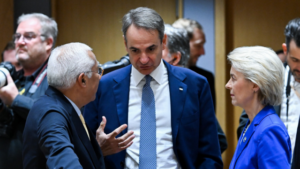
Using maps illustrating the Marine Parks that Athens has designated in the Aegean, alongside maps showing what Turkey presented on August 15 as Marine Parks in the Northern Aegean and Eastern Mediterranean, Foreign Minister Giorgos Gerapetritis briefed his European Union counterparts on Wednesday at the informal summit held in Wicklow, Ireland.
Greece-Turkey relations: Greece’s message on Ankara’s revisionist strategy
The aim of Greek diplomacy was to expose Turkey’s revisionist tactics in the Aegean and the violations of international law that these moves entail. At the same time, Greece made clear that its own policies — regarding both Marine Parks and Maritime Spatial Planning — are firmly grounded in respect for and compliance with international law.
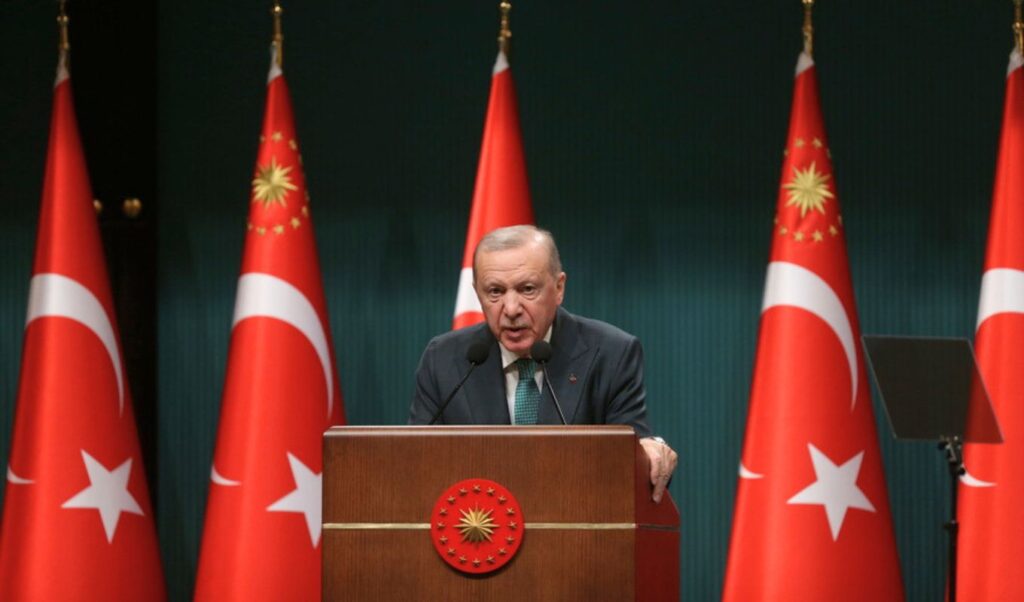
On the sidelines of the foreign ministers’ discussions in Ireland on the situation in the Aegean and the Eastern Mediterranean, the provocative statements of Turkish President Recep Tayyip Erdoğan also came to light. Erdoğan had demanded the demilitarization of the Aegean islands and issued stark warnings to Greece, calling on the country to “learn from the past” and change course.
Gerapetritis responded swiftly and unequivocally, stating that “there is absolutely no possibility of accepting any retreat with regard to our sovereignty and sovereign rights.” Reflecting the overall mood of the summit, he also noted the strong solidarity among European allies: “We have the immediate solidarity of the European Union and its member states against any form of aggression. Aggression, regardless of its source, has no color. It must be confronted in a unified and resolute manner.”
Turkey links Erdoğan’s statements to the “Achilles Shield” agreement
In Turkey, virtually all pro-government media outlets have drawn a direct connection between Erdoğan’s statements and the signing of the Greece-Israel defense agreement known as “Achilles Shield” — which, Turkish analysts claim, represents an effort to encircle their country. Hürriyet writes that “Erdoğan responded to Greece’s efforts to arm the Aegean islands — which carry demilitarization obligations — at the expense of relations with Ankara. Greece and Israel recently signed a multi-billion-dollar agreement to bolster Israel’s air defense system.” Similarly, Daily Sabah connects Erdoğan’s remarks to the Greece-Israel defense alliance: “Both countries are in opposition to Turkey. Ankara has repeatedly warned against Israel’s expansionist ambitions in the region. President Erdoğan has previously cautioned that Turkey could be Israel’s next target, following the Netanyahu government’s launch of what he describes as a genocidal campaign in Gaza.”
“Turkey feels encircled”: Syrigos analyzes Ankara’s fears
According to Professor of International Law Angelos Syrigos, speaking exclusively to parapolitika.gr, “Erdoğan’s statements were more or less expected. For many decades, Turkey has been invoking the demilitarization status of the eastern Aegean islands. Greece, in turn, invokes Article 51 of the UN Charter, which grants us the right of self-defense. The deployment of weapons systems manufactured in Israel is a source of irritation for Turkey. It feels encircled by Israeli weaponry — in the Middle East, in the Eastern Mediterranean, and in the Aegean. Erdoğan said he ‘will not allow the violation of Turkish rights.’ But what rights does Turkey actually have under an agreement like the 1947 Paris Peace Treaty, which defined the status of the Dodecanese — and which Turkey itself never signed?”
The GSI cable and “Blue Homeland”: Turkey’s next move that worries Athens
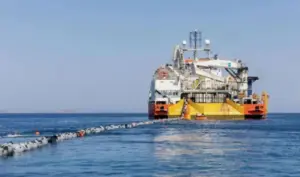
According to analysts, Turkey’s recent conduct also signals its likely stance on two thorny issues in the near future: the laying of the GSI submarine cable and the anticipated move to enshrine its “Blue Homeland” doctrine claims into national legislation — a step Turkey has already announced and is expected to take in the coming period, barring any significant shift in the political or diplomatic landscape.