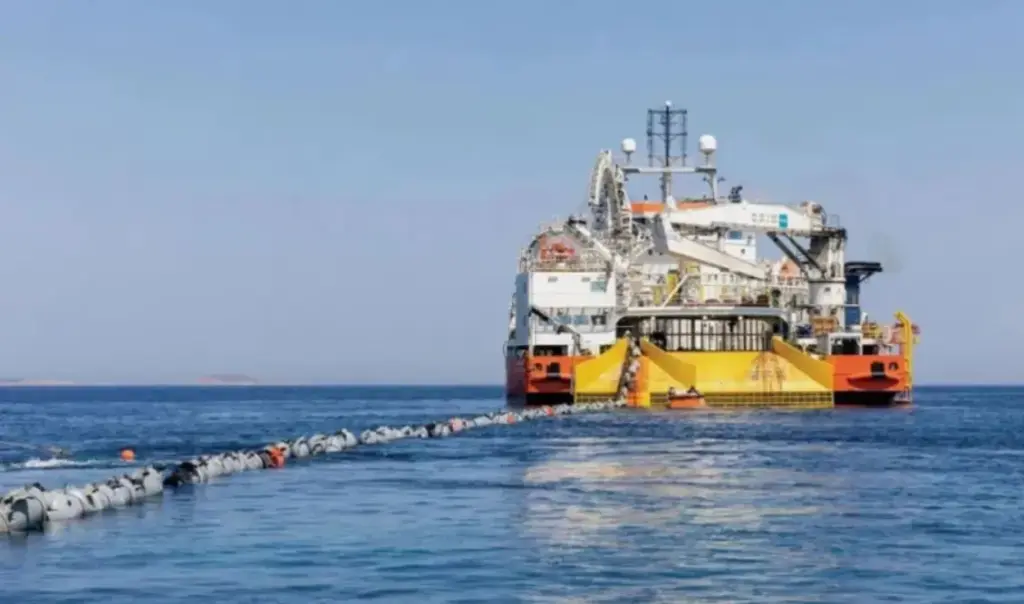
Ankara has made a new move to challenge Greek authority in the Eastern Mediterranean, issuing two NAVTEX notices — the first in connection with the multinational exercise “Evnomia,” in an area south of Kastellorizo through which the research vessel conducting work on the Greece–Cyprus electrical interconnection is expected to pass, and the second targeting an area within Cyprus’s Exclusive Economic Zone (EEZ).
The Turkish intervention carries particular weight as it comes at a time when preparations are underway for the resumption of surveys for the Great Sea Interconnector, with Turkey’s stance remaining the most significant geopolitical factor of uncertainty.
Turkish NAVTEX notices over “Evnomia” exercise and the Greece–Cyprus electrical interconnection
Specifically, the Heraklion Station of the Hellenic Navy’s Hydrographic Service issued a NAVTEX on Thursday evening for the conduct of the multinational exercise “Evnomia” on October 19, with the participation of Greece, Cyprus, France, and Italy. The exercise, which has been planned for months, includes live-fire activities.
On Friday morning, the Turkish Antalya station issued its own notice, declaring the Greek station incompetent and asserting that the specific maritime area falls within its own jurisdiction. Notably, the Turkish NAVTEX reproduces the coordinates of the Greek notice, effectively attempting to present Ankara as the competent authority for issuing navigational guidance to mariners.
A second Turkish NAVTEX followed in response to Cypriot authorities, who had issued their own NAVTEX for the conduct of geophysical surveys by the vessel S/V KOBI RUEGG, as part of the preparatory work for the EMC cable system.
The move does not in itself constitute an operational obstruction, but it does reflect Turkey’s intent to keep its claims in the region active, ahead of the next phases of the electrical interconnection project. Ankara has repeatedly sought to link the conduct of survey activities to prior notification or coordination with Turkish authorities. Attention now turns to the French research vessel Abeille Marengo, which is preparing to carry out surveys for the installation of the submarine cable. The issuance of the relevant NAVTEX — once the required procedures are completed — is expected to mark the next critical step.
Turkey: The prospect of escalation and Athens’ position on Turkish NAVTEX notices
The Greek government has made clear that it has no intention of seeking permission from Turkey for the implementation of the project, maintaining that the issuance of the required notices falls within the remit of Greek authorities. The key question, however, goes beyond the exchange of NAVTEX notices. It concerns whether Ankara will choose to escalate its response from the level of diplomatic statements and maritime notices to the operational level — recreating conditions similar to those seen in the Kasos strait.
Should that scenario materialize, Athens will be called upon to manage not only Turkey’s challenge to its jurisdiction, but also the practical matter of ensuring the unimpeded continuation of survey operations. Meanwhile, Turkish media are stoking a confrontational atmosphere, with the newspaper Hürriyet arguing that it is up to France to prevent a “crisis” in the Eastern Mediterranean — against the backdrop of the recent rapprochement between Ankara and Paris.
Originally published in Apogeumatini