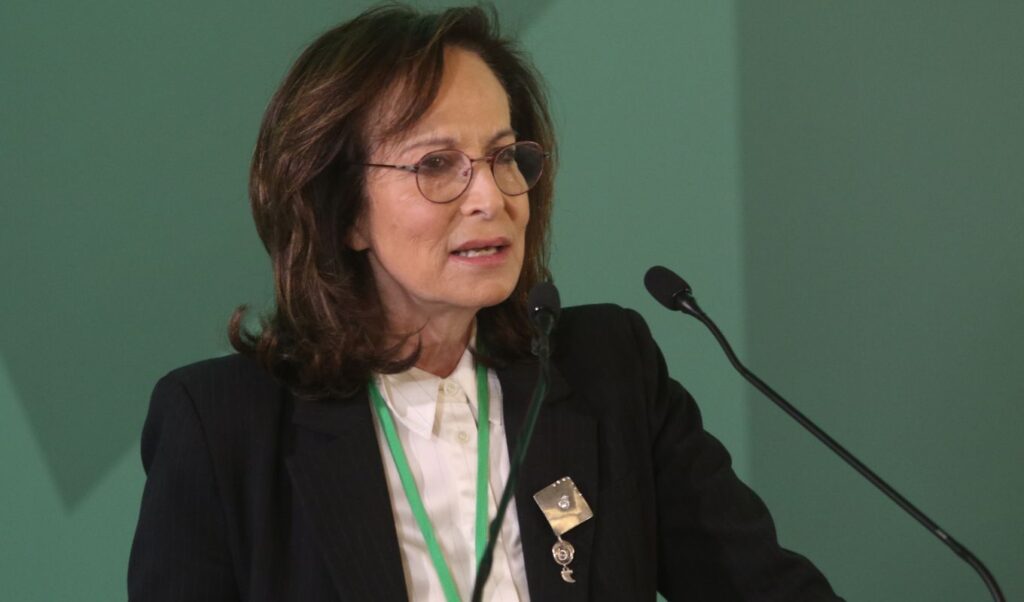
Anna Diamantopoulou leveled criticism at Alexis Tsipras, among others, when asked about the polling gap between the former prime minister’s new party and PASOK. She commented: “In the end, they’ll shave the groom” — a Greek idiom meaning that promises will ultimately fall through. The former minister and member of PASOK’s Political Council also dismissed as “nonsense” Tsipras’s allegations that PASOK is targeting him.
During her Wednesday morning (12/8) appearance on SKAI television, Anna Diamantopoulou opened by congratulating Miltiadis Tentoglou on winning the gold medal at the European Athletics Championships. She then outlined the opposition strategy PASOK is pursuing even in the middle of August, noting characteristically that “politics never stops.”
Turning to PASOK’s announcements regarding the removal of nursery schools from the Recovery Fund, she said this affects at least 50,000 places in those facilities, and also referred to the exclusion of people on the autism spectrum from the labor market. On the housing crisis, she cited Spain and Portugal as counterexamples, noting that their governments have announced the inclusion of thousands of homes in social housing programs — in stark contrast to the Greek government, which announced only 100 units in Athens and Thessaloniki. She pointed out that while Greece could have leveraged the Recovery Fund for this purpose, the government has effectively abandoned it.
Using the rehabilitation and development program in Dadia, Evros — following the catastrophic wildfire — as an example, Diamantopoulou continued her criticism of the government, stating that while the Recovery Fund had allocated €3 billion for projects in the area, the government utilized only €300 million. She also addressed the Social Tourism program, noting that applications only opened on August 5th despite the program having been announced back in February: “Who is going to take a vacation in October when applications only opened on August 5th?” she asked.
Diamantopoulou on Tsipras: “In the end, they’ll shave the groom”
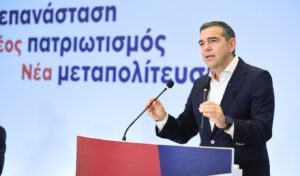
Anna Diamantopoulou then turned her criticism to Alexis Tsipras when asked about the polling gap between the former prime minister’s new party and PASOK, and about the competition for centrist voters. As she put it: “In the end, they’ll shave the groom.” She added: “Mr. Tsipras needs to prove that he is a genuine opposition force, and people should compare what he has said so far — because these are things PASOK had already said and proposed earlier — without him having presented anything original of his own.”
When asked whether PASOK was mounting a harsh attack on Alexis Tsipras — whom the party had labeled in an official statement as a “compromised Maduro” and “managing director of oligarchs” — Diamantopoulou responded that Tsipras had launched his opposition role by undermining PASOK and directing more criticism at the party than at the government. “PASOK cannot respond to this attack with Christian practice by turning the other cheek,” she said pointedly.
She added that the former prime minister will receive the response he deserves. When asked about Tsipras’s allegations that PASOK is targeting him because it claims that Charilaou Trikoupi — PASOK’s headquarters — will cooperate with New Democracy after the elections, Diamantopoulou replied: “That’s nonsense.”
“I do not publicly comment on defamatory fabrications”
The former minister and member of PASOK’s Political Council was also asked about reports claiming that she and other PASOK officials had attended secret dinners described as “rehearsals for a coalition government with New Democracy.” She responded by characterizing these reports as fabricated events. As she stated: “I do not publicly comment on defamatory fabrications that have been visualized through Artificial Intelligence — I only respond to those through my lawyers.”
In closing, she touched on European affairs regarding the continent’s security from external threats, citing as an example the incident involving drones at German airports. She noted that the data and priorities are shifting — both politically and economically — when it comes to defense spending and threat response, as well as in relation to climate change.