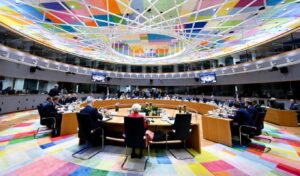
Tensions were palpable over these two days in Brussels, particularly during discussions on the European Union budget. Nevertheless, the Summit left “a clearer path forward for Europe,” as Ursula von der Leyen stated on platform X. The Commission President also announced the preparation of a new tool that would allow the European Union to defend its internal market “quickly and effectively” in the event of a trade conflict with a third country. The initiative is reportedly a joint proposal from France and Germany, initially aimed at strengthening the Union’s defensive arsenal in the event of a trade conflict with China.
We have had a long and dense European Council.
After these two days of discussions, the way ahead is clearer.
We will continue to deliver ↓https://t.co/zwOkjjV6Np
— Ursula von der Leyen (@vonderleyen) October 16, 2026
Von der Leyen: There is no magic solution
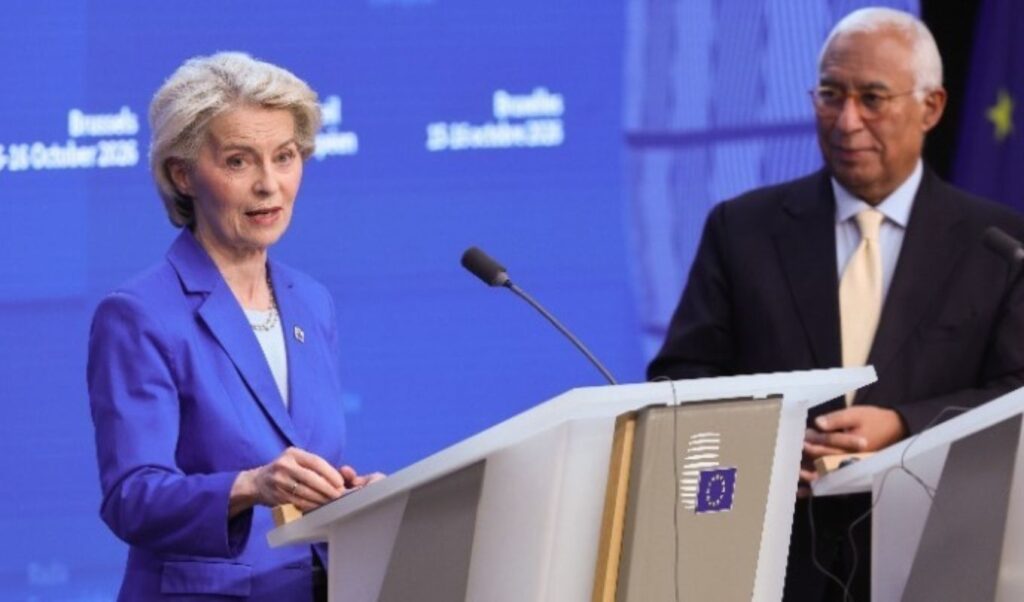
On the issue of energy prices, Von der Leyen and António Costa, President of the European Council, agreed at a joint press conference that effectively marked the close of the EU Summit that “there is no magic solution” to tackling high prices. According to the European Commission President, “we need a set of actions.” António Costa, for his part, stressed the need for “coordinated European action” in response to the energy crisis.
The Commission President highlighted that since the outbreak of war in the Middle East, the cost of imported fossil fuels has risen by €106 billion, without a single additional unit of energy being added. She also noted that natural gas prices have surged by approximately 140% since the end of February, while diesel prices have doubled. As she pointed out, the differing energy mixes across member states make a one-size-fits-all solution impossible, making a combination of measures at both the global and European level necessary.
The five short-term interventions
In this context, the Commission President outlined five short-term interventions:
* The release of 100 million barrels of oil and diesel over the next four months, managed by the International Energy Agency.
* The extension and broadening of the temporary state aid framework, established in February, to address the impact of the energy crisis.
* A one-year postponement of the implementation of the methane regulation.
* The launch of a strategic dialogue on European refineries, aimed at boosting refining capacity within the European Union and reducing prices.
* The strengthening of the European joint energy procurement mechanism, enabling the EU to purchase energy resources from international markets in a coordinated manner, leveraging its collective purchasing power.
Looking at the medium-term horizon, Von der Leyen stressed that Europe must stay the course on the energy transition, with the goal of securing access to affordable, clean, and domestically produced energy sources such as renewables and nuclear power. She also underscored the need to replace imported fossil fuels with electricity generated within Europe, as well as the importance of modernizing and upgrading European energy networks to ensure that cheaper energy reaches where it is needed.
Referring to the Emissions Trading System (ETS), she noted that the Commission had already submitted a proposal in July to modernize ETS1. European leaders, she said, sent a clear political message to the relevant ministers to urgently complete the associated legislative process.
The need to reach an agreement
The President of the European Council emphasized that European leaders agreed on a coordinated European response and on the need to adopt short-term measures to contain the impact of the crisis. He noted, however, that while the crisis is being triggered by developments outside Europe’s borders, Europe is paying the price for its dependence on fossil fuels and the absence of a unified energy market. In the long term, he described reducing dependence on fossil fuels as essential for strengthening Europe’s strategic autonomy and resilience, stressing that the energy transition is the path toward achieving this.
António Costa also stressed the need to reach an agreement on the new Multiannual Financial Framework by the end of 2026, so that it can enter into force on schedule on January 1, 2028. He noted that farmers, businesses, researchers, students, and universities are all awaiting access to the new European funding.
He dismissed the possibility that elections in member states could serve as grounds for delaying negotiations. As he pointed out, with 27 democracies in the EU and elections taking place in some country almost every month, if that were a reason for postponement, a new budget could never be approved.
On the matter of negotiations, António Costa stressed that the goal is to keep national contributions at reasonable levels without undermining the Union’s ambitions or the means to deliver on shared priorities. In this context, he described progress on the issue of new own resources as decisive, announcing that he would accelerate the related work in cooperation with the European Commission and member states.
“To serve common European priorities”
Von der Leyen, for her part, emphasized that the Commission’s proposal for the multiannual budget has been designed to serve common European priorities. As she noted, the key question is not which priorities should be abandoned, but how they should be funded.
She placed particular emphasis on the need to maintain adequate flexibility in the budget, so that the EU can respond to unforeseen crises. She drew on the experiences of the pandemic, natural disasters, the energy crisis, and the war in Ukraine, pointing out that flexibility provisions had allowed Europe to intervene — though they ultimately proved insufficient, as a mid-term revision of the current budget became necessary.
She concluded by stressing the importance of advancing an ambitious package of new own resources, noting that without them, the fiscal equation cannot be balanced.