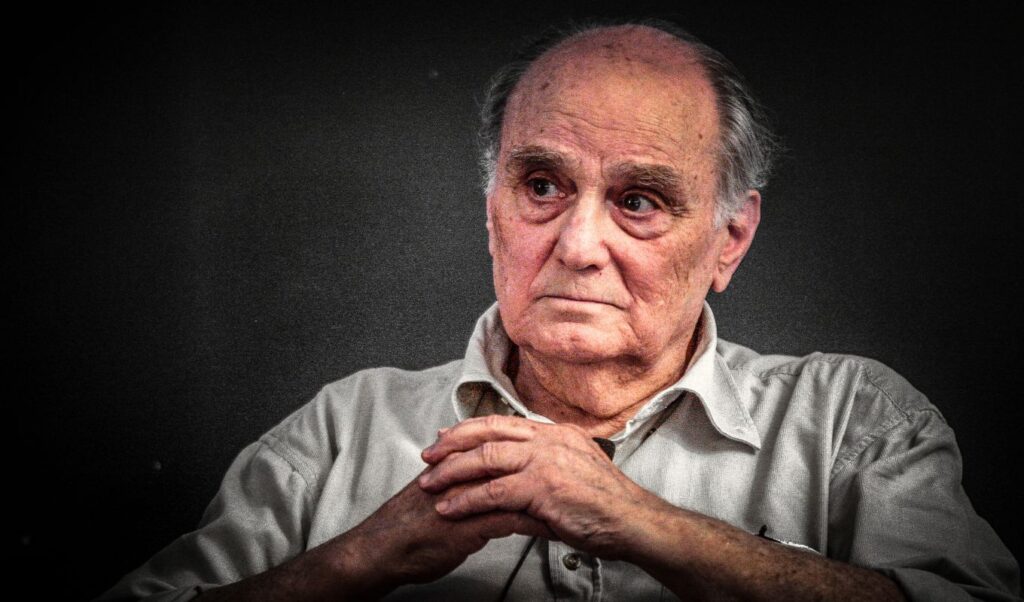
The news of the death of Stelios Ramfos has cast a shadow of grief over the Greek political world. A distinguished author, philosopher, and one of the most influential figures in modern Greek intellectual life, Ramfos passed away at the age of 87, leaving behind a remarkable intellectual legacy. Greece’s entire political leadership has come together to express its deep sorrow and condolences over the loss of this great thinker.
Read: Author and thinker Stelios Ramfos dies at the age of 87
Tasoulas on Stelios Ramfos: “He dedicated his life to deepening our national self-awareness and stood out for his moral integrity”
Konstantinos Tasoulas expressed his profound grief over the loss of Stelios Ramfos, who passed away today at the age of 87.
Full statement by the President of the Republic
“With feelings of deep sorrow, we bid farewell to Stelios Ramfos, one of the most significant thinkers of our time,” Mr. Tasoulas begins in his statement.
The President of the Republic describes Stelios Ramfos as “a distinguished intellectual,” noting that “he dedicated his life to deepening our national self-awareness.”
“A restless spirit, he stood out for his moral integrity, combining refined manners with a passion for deeper truths,” he adds.
Referring to his body of work, Mr. Tasoulas highlights that Stelios Ramfos bridged ancient letters, the Byzantine tradition, and Western philosophy, using this synthesis to analyze “the structures of modern Greek thought, its mentalities, as well as our historical and religious compositions and references.”
He also makes special reference to Ramfos’s presence in public discourse, noting that through his writing, teaching, and public interventions he “sparked a creative dialogue about society,” establishing a public presence that was “steadfast, fertile, and substantial.”
“To his loved ones, I extend my warmest condolences,” the President of the Republic concludes.
Mitsotakis on Ramfos: “He emerged as a uniquely critical observer of public life — he believed that ideologies imprison ideas”
Prime Minister Kyriakos Mitsotakis expressed his condolences over the loss of Stelios Ramfos. Among other things, Mr. Mitsotakis noted that “I am losing a friend and interlocutor who enriched every conversation we had, regardless of whether we always agreed on everything. Stelios Ramfos, after all, believed that ideologies imprison ideas.”
Full statement by the Prime Minister
“Greece and the world of ideas mourn today the loss of one of their most faithful and selfless servants. But I, too, am losing a friend and interlocutor who enriched every conversation we had, regardless of whether we always agreed on everything. Stelios Ramfos, after all, believed that ideologies imprison ideas. That is why the verb he preferred was usually ‘I think’ rather than ‘I believe.’
One of the most luminous personalities of the pre-dictatorship Left, and through the historic student movement ‘Panspoudastiki,’ he was at the forefront of its ideological and cultural pursuits at the time. During the years of the dictatorship, he embarked, in Paris, on his great journey into philosophy — a journey he continued, with dedication, in post-junta Greece right up until yesterday. Far from dogma and constraint.
Stelios Ramfos studied and taught all the great thinkers, giving new dimensions to their ideas while drawing on insights from social anthropology and psychoanalysis. In this way, across the approximately 50 books he authored, he cuts across all the problems of modern life — and, along with it, modern Greece. His contribution, therefore, is not merely academic. It is, above all, social.
He approached Orthodoxy through a progressive lens, and he ‘read’ the history of the country by bringing to the fore the consequences of the fact that Greece did not experience the Renaissance after the Middle Ages. In this way, he was able to answer many of the contradictions that have run through not only our political system for decades, but also our everyday behaviors.
In other words, among many other things, Stelios Ramfos emerged as a uniquely critical observer of public life — always putting reason and responsibility ahead of populism, and explaining that there is no tradition without evolution. All of this, while living quietly and discreetly himself, combining the consistency of his words with that of his daily life.
I bid farewell with sorrow and respect to this brilliant Greek and gentle human being. My thoughts go out to his wife Irini, his two daughters, and his thousands of students and friends. This is a national loss. I am certain, however, that what Stelios Ramfos stood for will become a guide in the thoughts and actions of all citizens who wish to be free, unbound, and of service to others,” wrote Kyriakos Mitsotakis on social media.
Dendias on Ramfos: “One of the most important Greek thinkers, he had a clear sense of what justifies human life”
“Stelios Ramfos was one of the most important Greek thinkers, with a major contribution to the study of the formation of modern Greek identity and the influence of the Orthodox tradition,” said Nikos Dendias, expressing his grief over the death of the great philosopher and thinker.
Nikos Dendias’s post on the death of Stelios Ramfos
“Stelios Ramfos was one of the most important Greek thinkers, with a major contribution to the study of the formation of modern Greek identity and the influence of the Orthodox tradition.
He will live on through what he bequeathed to us in resurrection.
He had a clear sense of what justifies human life, and he expressed it with rare clarity to those who were willing to listen or read him. The beyond was not terra incognita for Stelios Ramfos, but the ultimate otherness.
He honored me with his friendship, and I will always remember our conversations. My sincere condolences to his loved ones.”
Ο Στέλιος Ράμφος υπήρξε ένας από τους πιο σημαντικούς Έλληνες στοχαστές, με μεγάλη συμβολή στη μελέτη της διαμόρφωσης της νεοελληνικής ταυτότητας και την επίδραση της ορθόδοξης παράδοσης.
Θα παραμείνει εν ζωή μέσω όσων ο ίδιος αναστάσιμα μας κληροδότησε.
Είχε σαφή αίσθηση…
— Nikos Dendias (@NikosDendias) August 10, 2026
Hatzidakis on Stelios Ramfos: “His intellectual legacy will live on forever”
Kostis Hatzidakis expressed his grief over the death of the eminent thinker and author Stelios Ramfos, who passed away at the age of 87.
Kostis Hatzidakis’s post on the death of Stelios Ramfos
“Greece’s foremost intellectual, Stelios Ramfos, has passed away. A remarkable, contemporary philosopher. Among his intellectual pursuits was the connection between modern creation and the Greek Orthodox tradition. A longtime professor in Paris, he possessed broad knowledge, clear thinking, a sharp voice when needed, a readiness to intervene, and an unwavering focus on Greece. I was impressed from the very first time I heard him as a student in the 1980s. We invited him to make an extraordinary intervention at the New Democracy party congress in 2017. He had a remarkable ability to combine his intellectual richness with contemporary political and social debates. The intellectual legacy of Stelios Ramfos will always remain alive. My sincere condolences to his loved ones.”
Kerameus on Stelios Ramfos: “He leaves behind entire generations shaped in their thinking — I bid him farewell with deep emotion”
Minister of Labour and Social Insurance Niki Kerameus bid her own farewell to Stelios Ramfos in a social media post. “With deep emotion, I bid farewell to Stelios Ramfos,” she writes.
Niki Kerameus’s post on the death of Stelios Ramfos
“There are people who, when they leave, leave behind something far greater than their work. They leave behind the way they shaped the thinking of entire generations.
Stelios Ramfos was such a person. I was very fortunate to know him personally and to have had unique conversations with him, especially on matters of education — conversations that remain indelibly etched in my memory. They were the kind of conversations that didn’t end when you walked away, but continued, distilled, within you.
I bid him farewell with deep emotion. Warm condolences to his loved ones. Safe travels!”
PASOK on Stelios Ramfos: “His personality and thought will be missed, but his work will remain forever relevant”
PASOK issued a statement of condolences following the death of the eminent philosopher and thinker Stelios Ramfos.
Full statement by PASOK on the death of Stelios Ramfos
The Culture Sector-Network of PASOK – Movement for Change and the Culture Parliamentary Spokesperson – MP for Laconia, Ms. Nagia Grigorakou, bid farewell to the great intellectual Stelios Ramfos.
A prolific and multifaceted thinker, he engaged with questions of philosophy, psychology, history, and religion, always keeping Greece at the center of his inquiry.
“We trap ourselves in our weaknesses and dependencies. The culture of independence is absent — one in which gaps are filled not with schemes but with creativity. Our difficulty has to do with our tendency toward the easy way out. We are interested in excuses for our misfortunes.”
He always spoke his mind with courage, making sharp interventions on public life and developments in our country. His personality and thought will be sorely missed. His work, however, will remain forever relevant, placing him among the foremost figures of our intellectual life. Our sincere condolences to his loved ones.
Evangelos Venizelos on Stelios Ramfos: “Farewell with respect and love”
Evangelos Venizelos bids farewell to Stelios Ramfos with a personal and heartfelt tribute.
Full statement by Evangelos Venizelos
“On his beloved Kythnos, in Potamia, I learned that Stelios Ramfos had passed away — persistently seeking answers to the questions with which he surrounded the issue of modern Greek identity, while simultaneously shaping his own philosophical constitution. He moved across the entire spectrum, from theories of historical causality to his own reception of Platonic philosophy, from Papadiamantis and patristic theology to his resistance to anti-memorandum populism and his championing of the need to modernize the state and society.
“We had the joy of hosting him at the Circle of Ideas, and above all of private conversations with the Kythnos circle. I bid him farewell with respect and love, recalling one of his phrases: ‘I try to do what I ask everyone to do — to start from myself, to search through our history. My subject is exclusively Greece. Elements of this civilization and culture may be Plato, Aristotle, the Church Fathers, contemporary issues — all of them, without exception.'”