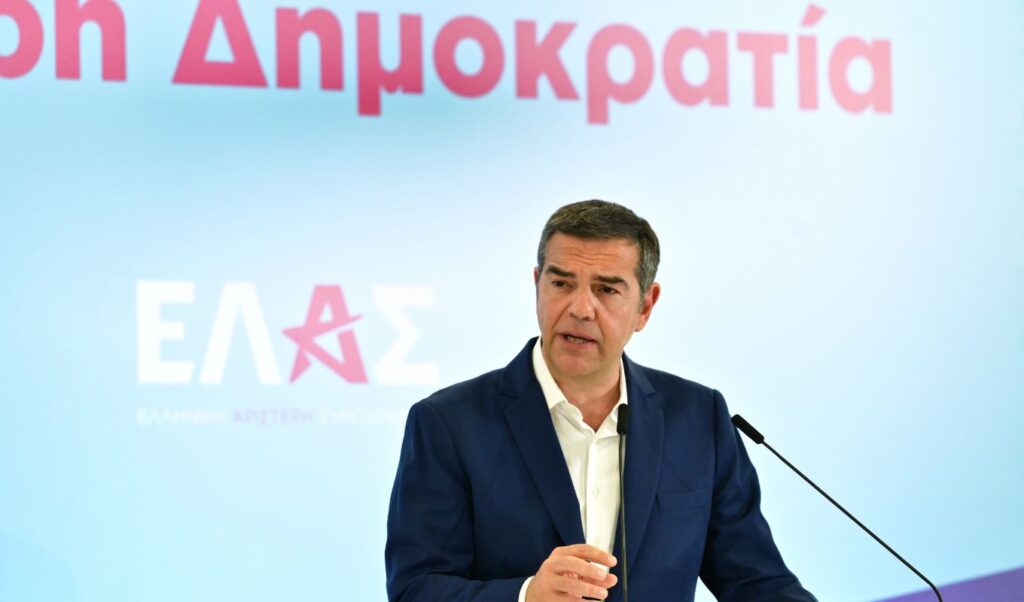
The truth is that Alexis Tsipras’s ELAS, just seventy days after its founding, has managed to poll as the official opposition, securing second place — leading many to regard it as the potential rival to New Democracy and Kyriakos Mitsotakis in the upcoming elections. However, significant challenges lie ahead for both Amalia Avenue headquarters and the former prime minister, especially as autumn approaches and the country enters the final stretch of the pre-election period.
The big bet for Alexis Tsipras
• The big bet for Alexis Tsipras is clearly not simply finishing second in the elections at any vote share. A second-place finish with a meager percentage cannot be considered a victory, even if it gives him the platform to compete for far more in subsequent elections. The real bet is for ELAS to secure a share that starts with the number “2” — surpassing 20% — if not in the first election round, then at least in the second. If they achieve this in the first round, they could become a genuine contender against Kyriakos Mitsotakis for first place in a second round, cutting through the other parties of the progressive camp while exposing internal tensions within the current ruling party.
• In this context, how ELAS re-emerges after the August recess is critically important, both in terms of perception and substance. It is clear that by the time of the Thessaloniki International Fair (TIF), the party must have improved its polling numbers, ideally narrowing the gap with New Democracy while widening its lead over PASOK. This would demonstrate that it continues to show momentum and is on the cusp of a second wave of growth — a second surge. This dynamic needs to be reflected in any polls released before the TIF, even if publishing surveys in August is considered ethically questionable.
• It is clear that the policy programme Alexis Tsipras presents at the TIF will play a crucial role in the momentum ELAS needs heading into the final stretch of the campaign. Teams already working on Tsipras’s TIF proposals are finalizing their work so that definitive decisions can be made after the summer break. By general consensus, however, the political messages Tsipras delivers through his speech — and potentially his press conference — may carry even greater weight than the policy programme itself. The answers he will need to provide are numerous, as are the issues he will need to clarify.
• A major challenge for the ELAS leadership is the formation of its electoral lists, with party secretary Miltos Hatzigianakis, the president’s office director Giorgos Vasileiadis, and others playing leading roles. ELAS does not have established party branches, and therefore its parliamentary candidates will play a pivotal role in determining the party’s strength. This is especially true in the provinces, where ELAS lags behind PASOK in many regions — both in terms of personnel and organizational capacity — whereas in major urban centers, sources suggest ELAS will field considerably strong to very strong candidate lists. Consequently, the electoral lists need to be formed as soon as possible, and with the broadest possible roster of candidates. According to reports, Alexis Tsipras himself is playing a decisive role, holding meetings with prominent public figures as well as (currently mid-level) officials from the PASOK orbit.
• By general consensus, the party’s communications team — those who represent ELAS on broadcast media — is in need of an upgrade. Some spokespeople are not delivering effectively, particularly given that the party’s positions on key issues remain unclear. The planned expansion of the party is expected to decisively address this problem, as experienced political figures joining ELAS will complement the stronger members of the current team.
• Amalia Avenue must avoid falling into the trap of engaging in confrontation with other forces in the progressive camp. The PASOK leadership, for example, used the significant issue of New Democracy’s and Charilaou Trikoupis Street’s debts to consolidate its own voter base as much as possible. It is worth noting that figures from within that space — such as Dionysis Temponeras and Nikos Bistis — disagree with this confrontational approach, both on this specific issue and more broadly regarding inter-party clashes within the progressive camp, even though, in fairness, Amalia Avenue has so far resisted that temptation.
Published in the weekend edition of the newspaper Karfi