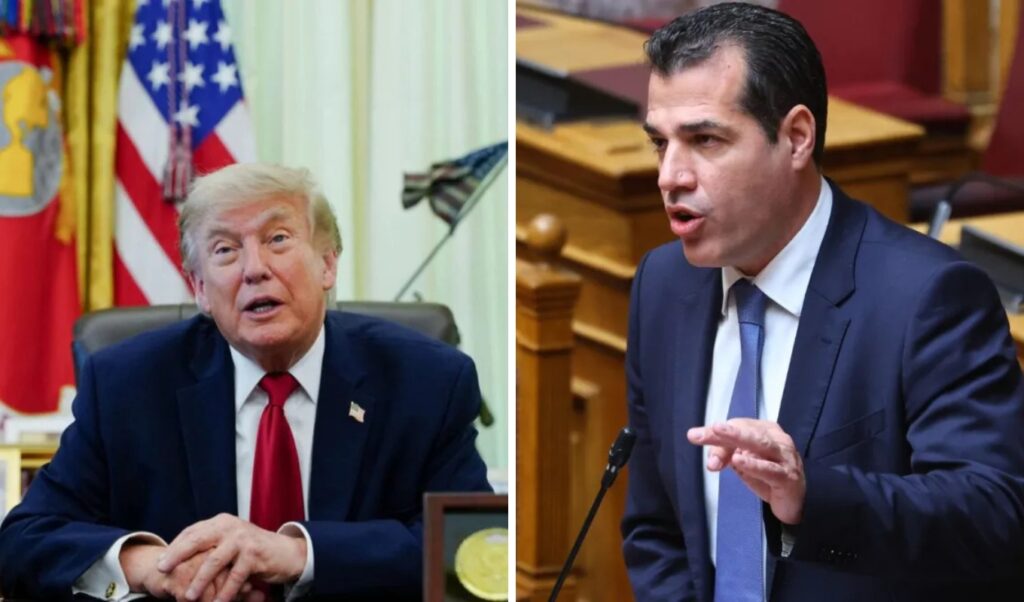
United States President Donald Trump chose to reshare on his Truth Social account an interview given by Greek Minister of Migration and Asylum Thanos Plevris to Breitbart, giving international visibility to the Greek minister’s statements on immigration policy. In the interview, Thanos Plevris argues that Donald Trump’s return to the American presidency helped shift the political climate around irregular immigration, both in the United States and across Europe.
The Minister of Migration describes himself as an open “admirer of Trump” and believes that one of the most significant changes following Trump’s return to the White House was the adoption of a stricter approach toward irregular migration.
According to Plevris, countries such as Germany, France, the Netherlands, Denmark, and Sweden have moved toward tougher policies, driven by growing public pressure for more effective border control.
In his view, the shift in stance in the US created a more favorable political environment for European governments that are pursuing stricter measures on migration.
The message from citizens
Thanos Plevris argues that a similar trend is being recorded in Greece, citing polls which, as he notes, show that a significant portion of public opinion either supports the government’s policy or favors even stricter measures.
“The message from our citizens is clear: enough,” he states pointedly. At the same time, he presents the Mitsotakis government’s immigration policy as “strict but fair,” with an emphasis on curbing irregular arrivals and increasing returns.
Declining arrivals and rising deportations
The minister refers to new legislation and the results it has reportedly produced in managing migration flows.
Specifically, regarding the route from Libya via Egypt, he notes that in the first half of 2025, there were 3,200 irregular arrivals and just 69 returns. During the same period in 2026, arrivals dropped to 802, while returns increased to 330.
According to Minister Plevris, overall migration flows to Greece have decreased by approximately 70% within a single year, while return rates have risen significantly.
He attributes this development, among other factors, to the detention of individuals who do not meet the criteria for refugee status, stricter enforcement against those who remain in the country illegally following the rejection of their asylum application, and an increase in voluntary returns.
The Evros border fence: a “shield” against illegal crossings
The minister also makes special reference to the fence along the Evros river, describing it as a key tool for reducing irregular crossings at the country’s land borders.
Thanos Plevris recalls the 2020 crisis, when thousands of people attempted a mass crossing from Turkey into Greece, arguing that the fence — combined with the presence of security forces — played a decisive role in managing the situation. He also emphasizes that Greece’s borders serve as external borders of the European Union.
Greece–US cooperation on asylum
In his interview, Plevris also highlights that Greece and the United States are now cooperating in the field of asylum, exchanging practices and expertise.
He points out that Greece had already begun implementing a stricter immigration policy in 2019, when New Democracy came to power under Kyriakos Mitsotakis.
The minister draws a contrast with the situation in 2015, when, as he notes, approximately one million people passed through Greece during the height of the refugee and migration crisis.