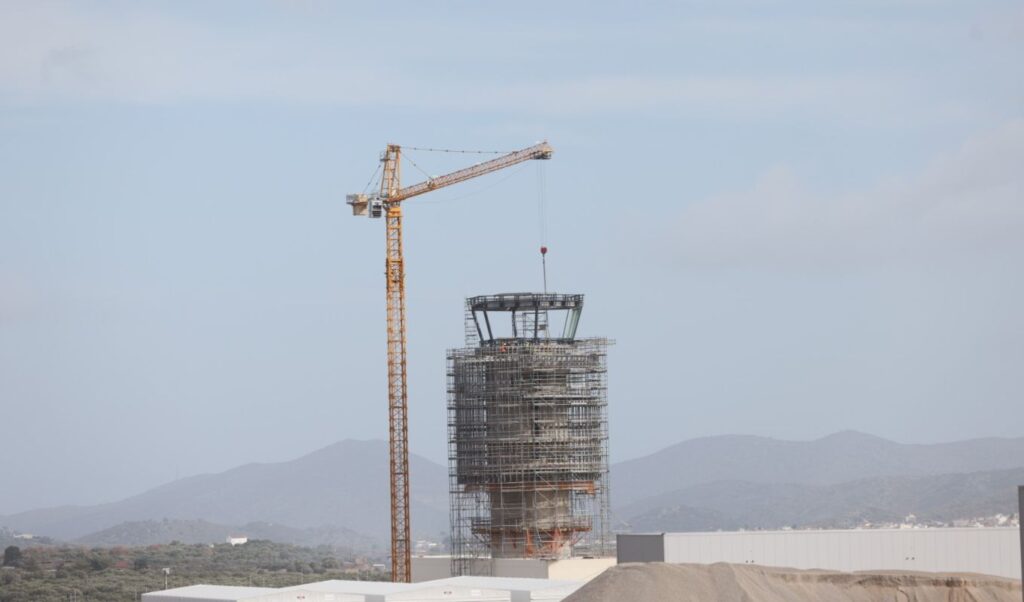
The new Heraklion International Airport at Kastelli is expected to begin operations in November 2028, according to Minister of Infrastructure and Transport Christos Dimas, who — following the signing of the Air Navigation Systems contract — expressed full confidence that the project will meet its deadline.
Close coordination among stakeholders drives project progress
“The goal remains the same — for the airport at Kastelli to be fully operational by November 2028,” Minister of Infrastructure and Transport Christos Dimas stated, recalling that just a few months ago, at the same site and in the presence of the Prime Minister, the relevant agreement had been signed and a commitment made to accelerate the completion of the tender process.
“Today I am very pleased to announce that this agreement has been signed between Heraklion Crete International Airport and the Spanish company Indra,” the minister said, highlighting that close coordination among all involved parties had paved the way for the project’s progress. Commenting on construction progress, he noted that “we are at 76% of the construction scope,” adding that this figure is expected to rise soon.
He also expressed confidence that the new airport will become a landmark project. “We won’t just have a new airport at Kastelli — we will have the most modern airport in Greece, one of the most modern airports in Europe and the world, an airport that will serve both the residents and visitors of Crete, while always maintaining the necessary balance between delivering critical infrastructure and showcasing our region’s rich cultural heritage,” he said.
Road connection between the airport and the BOAK highway progressing smoothly
The minister also addressed the accompanying infrastructure works, emphasizing that the road link connecting the airport to the Northern Road Axis of Crete (BOAK) is advancing on schedule. “The road connection with BOAK is moving forward — it’s something we are monitoring very closely and we are very satisfied with how the works are progressing,” he said, adding: “Day by day, week by week, I follow the progress of the works and I think we are all very pleased with what we see.”
Speaking specifically about the BOAK project, Minister Dimas noted that the concession agreement was signed on May 9, 2025, and that construction sites are already active at multiple points along the route. He explained that the option for the Chania–Kissamos section was activated seven months ahead of the original schedule, describing the overall progress as “very satisfactory.” He also highlighted that among the first sections to open to traffic will be the Chania, Rethymno, and Heraklion bypasses. He made special mention of progress on the project’s tunnels, noting that “yesterday we reached an important milestone — the breakthrough of the S2 tunnel, measuring 1,980 meters in length and presenting significant geotechnical challenges.” He also announced that the first 10 kilometers of the public Neapoli–Agios Nikolaos section will open to traffic shortly.
Road safety measures on BOAK remain a firm government priority
Christos Dimas placed particular emphasis on the implementation of road safety measures along the BOAK highway, underscoring that these remain a consistent government priority and a personal concern of Prime Minister Kyriakos Mitsotakis. “The road safety measures are in line with those we implemented on the Patras–Pyrgos highway, where we eliminated head-on collisions and reduced fatal accidents by 85%. The goal is the same for BOAK — to enable significantly safer travel,” he stressed.
He explained that the interventions include vegetation clearing, tree pruning, installation of central barrier systems, resurfacing, road markings, and lighting upgrades. “These may sound like minor details, but they are extremely important — and I am very pleased that, to a very large extent, the local community has embraced them,” he concluded.
It is worth noting that among those attending the contract signing and the construction site tour were Deputy Minister of Infrastructure and Transport Nikos Tachiaos, Secretary General of Infrastructure Dimitris Anagnopoulos, Governor of Crete Stavros Arnaoutakis, local members of parliament, and representatives of the bodies involved in the project.