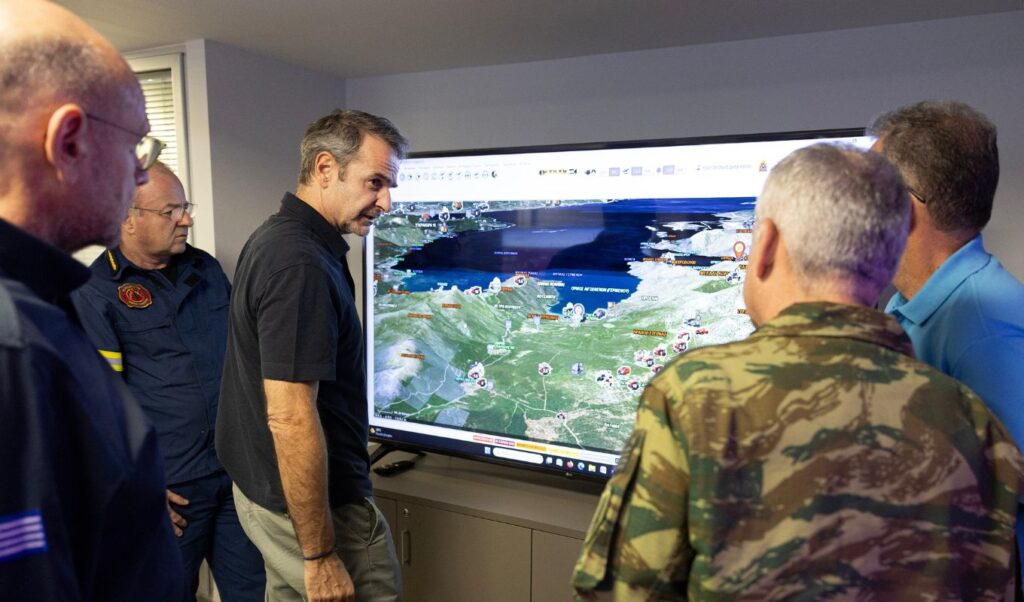
State relief teams have begun assessing damage to citizens’ properties caused by the devastating wildfires of recent days, with the aim of fast-tracking identification and delivering state support. The government has made clear that protecting human life and supporting those affected remain the absolute top priorities.
Government orders immediate support for wildfire victims
Over the past 24 hours, multiple fire fronts pushed the Fire Service, Civil Protection, local authorities, and citizens themselves to their limits. Severe weather conditions prevented the use of aerial firefighting assets in several cases, effectively paralyzing operational planning and making aerial fire suppression impossible — the very capability on which everyone had pinned their hopes for containing the massive fire fronts. “There are moments when the nature and intensity of weather events exceed any human planning and any operational capacity,” Prime Minister Kyriakos Mitsotakis stated during his weekly government briefing, referring to the catastrophic fires, while also pledging that support for those affected would be immediate. “When winds blow with such force, even the dozens of aerial assets at our disposal cannot operate safely. In several instances over recent days, neither water collection nor water drops were possible, as extreme turbulence made flights prohibitive — meaning the burden of the battle fell almost entirely on the people on the front lines,” the Prime Minister emphasized.
In this context, Kyriakos Mitsotakis expressed his boundless gratitude to the men and women of the Fire Service, to volunteers, Civil Protection officers, the Security Forces, the Armed Forces, municipal and regional workers, and to all those who are once again fighting a battle that frequently pushes human endurance beyond its limits.
“Sadly, this battle has also come at a heavy cost,” the Prime Minister noted, referring to the firefighters who lost their lives in the line of duty. “Three firefighters lost their lives while on duty. They gave the most precious thing they had to save their fellow citizens, properties, and forests. In their memory, we are obliged to continue strengthening our country’s capabilities against increasingly extreme natural phenomena.” He further added that absolute priority remains human life, followed by citizens’ property and forest ecosystems. The Prime Minister had already sent a message of confidence and support to the men and women of the Fire Service and other Security Forces on Saturday, when he visited the Civil Protection Operations and Crisis Management Coordination Center, where he was briefed on the progression of fires across the country amid difficult weather conditions caused by powerful winds.
Strengthening the state response mechanism
In his Sunday government review, Kyriakos Mitsotakis focused on the reinforcement of the state apparatus for tackling such events. It is worth noting that at the start of this year’s fire season, the Fire Service had 17,727 permanent and seasonal personnel — a number set to reach 18,804 by the end of the season. Similarly, significant reinforcement has been achieved in the vehicle fleet, which now stands at 4,299 units. “In recent years, we have invested more than ever before in strengthening Civil Protection — acquiring more aerial and ground assets, leveraging new technologies, hiring personnel, and better organizing the state mechanism,” the Prime Minister stated in his address.
According to official figures from the Ministry of Civil Protection and Crisis Management, the forest commando units (EMODE) — the first six of which were established in 2022 — now number 21 and total approximately 1,450 members. In addition, the Fire Service is being reinforced with pre-deployed personnel from four European countries. Progress is also continuing on the implementation of the “AEGIS” program, while a dedicated plan is in place for the use of drones in Attica and other vulnerable regions across the country, enabling rapid detection and swift initial response to fire outbreaks. Drone bases alone now exceed 100, supplemented by three mobile drone operations centers. Finally, regarding national aerial assets, official figures show these remain at 33, with leased aerial assets increasing by a further two to reach 51 — bringing the total available fleet to between 80 and 85 assets on a daily basis, depending on availability.