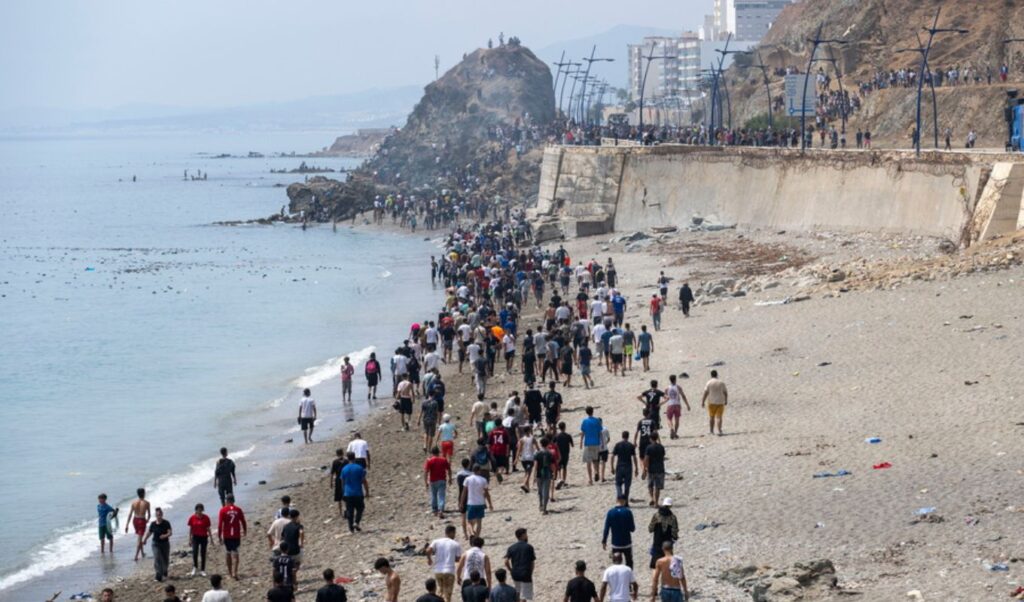
The dramatic escalation of the migration crisis in the Spanish enclave of Ceuta in North Africa has ignited a fierce political battle within the European Union. In a joint letter addressed to European Commission President Ursula von der Leyen, European Council President António Costa, and Irish Prime Minister Micheál Martin — whose country currently holds the EU presidency — 22 European leaders, including Greek Prime Minister Kyriakos Mitsotakis, have launched a direct broadside against the handling of the crisis by Pedro Sánchez’s government.
The so-called “coalition of 22,” which includes German Chancellor Friedrich Merz and Italian Prime Minister Giorgia Meloni, is demanding immediate European coordination and stricter border controls, while squarely targeting Madrid’s controversial plan to regularize hundreds of thousands of undocumented migrants. In their letter, the 22 leaders express grave concerns over the security of the EU’s external borders, stressing that “we have a duty to effectively prevent and continuously combat irregular migration.” They also raise the issue of unilateral measures taken by member states that act as so-called “pull factors.”
At the heart of this criticism lies Spain’s recent initiative to proceed with the phased regularization of up to 1.2 million undocumented migrants. According to the signatories, policies of this kind send the wrong message to smuggling networks and fuel mass migration flows. “We cannot allow uncontrolled mass crossings or the instrumentalization of migration to create the perception that illegal entry into the EU can be converted into legal residency,” they warned, making clear that domestic regularization programs are not the sole business of individual member states but require strict EU-level oversight. Spanish Prime Minister Pedro Sánchez, who finds himself increasingly isolated in Europe and under heavy fire at home, went on the offensive in response. Hitting back at the “coalition of 22,” he branded his counterparts’ reactions “selfish, divisive, and illegal,” arguing they are driven by political opportunism and prejudice.
Greece is firmly aligned with the bloc of countries pushing for a stricter border protection framework. Prime Minister Mitsotakis underscored this position in his weekly Sunday address: “The scenes we are witnessing in Ceuta remind us that migration remains one of Europe’s greatest challenges. Greece knows all too well what it means to be on the front line. That is why, since 2019, we have consistently implemented a firm but fair migration policy — one that today largely reflects the common European direction: effective protection of land and sea borders, accelerating returns for those not entitled to international protection, and a resolute response to any attempt to weaponize migration flows. We proved it on the Evros border in 2020, when we repelled an organized hybrid attack, and again in the summer of 2025, when we made difficult but necessary decisions to protect our country. The results of this policy are now measurable.”
The political storm is now moving to Brussels. An emergency meeting of EU Interior Ministers has been convened for tomorrow, with the Ceuta crisis and a redefinition of European migration strategy as its sole items on the agenda. Greece’s delegation is expected to push for enhanced operational support from Frontex at the EU’s external borders, calling for strict European safeguards against national amnesty or regularization programs. Athens will also demand the immediate activation of return mechanisms to countries of origin and transit. Greece maintains that European solidarity cannot be reactive — it must be built on strong deterrence, the dismantling of smuggling networks, and a firm rejection of unilateral action by member states.