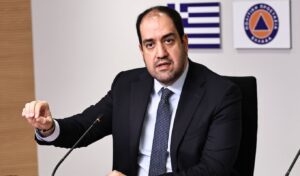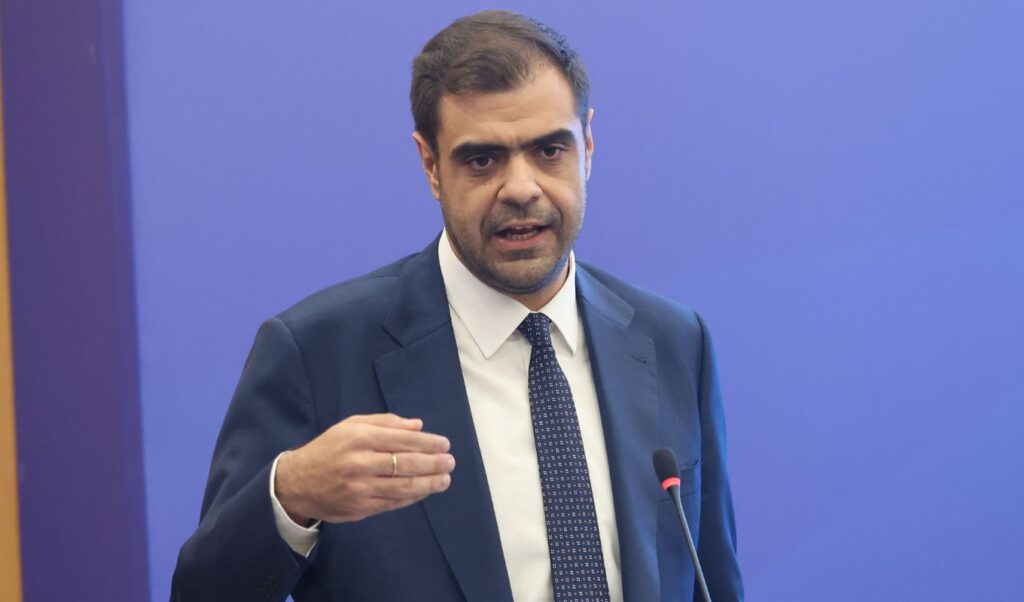
Government spokesperson and Deputy Minister to the Prime Minister, Pavlos Marinakis, has outlined a timeline for launching the regional television licensing process, noting that the National Council for Radio and Television (ESR) is expected to begin the relevant proceedings in September or shortly thereafter. In an interview with the news website typologies.gr and journalist Vasilis Koufopoulos, Marinakis stated that the process will take several months, as it is not feasible to complete it for the entire country within one or two months. As he explained, licensing will proceed on a region-by-region basis, with Attica treated as a separate case, while the remaining regions will be grouped in pairs or, where smaller regions are concerned, in groups of three.
He noted that this is an issue the state had left unresolved for 23 years, and that he had no intention of passing a “hot potato” on to the next government. “This is an unresolved matter — and not just for business owners. It affects society, workers, citizens, and Greek taxpayers. We’re talking about state advertising. State advertising is not some abstract concept; it’s people’s money that was being spent without any criteria,” he added.
Marinakis on the radio licensing bill
When asked about the radio licensing bill, the government spokesperson announced that by the end of September he will submit the radio broadcasting legislation to the Cabinet. “Ideally, I would like us to also have the frequency map ready. The Ministry of Digital Governance is making a very significant effort to complete this by the end of August. The information I have is that we will have it by September at the latest. Why is this so critical for radio? Because in radio broadcasting, our goal is that whoever holds a frequency — or more precisely, whoever has transmission capability — and holds a provisional license, what we call ‘legally operating’ stations, should be recognized as such. So, ‘legally operating’ stations, just as with regional TV channels, may be broadcasting on a frequency like 100.6 or 100.9 — the exact frequency matters here, unlike with television. The frequency in radio is significant. So, we intend to legislate along the same lines as we did for regional TV channels, with one key difference. In the first phase, priority will be given to current users — the legally operating frequency holders, to be precise — and if they meet the required standards, similar to those set for TV channels, they will receive an official operating license, structured along the lines of the regional channels model, meaning over a multi-year period. If they do not meet the standards, those frequencies that remain unallocated, along with already unallocated ones, will be put out to tender following the regional channels model. So, what do we need? We need the Ministry of Digital Governance to tell us who is broadcasting and where. Without that information, we cannot move forward with the process. But we will bring the bill forward, and as soon as we have that frequency table, we will proceed,” he emphasized.
“We managed to achieve something with regional TV channels, and we will do the same for radio — ensuring the law can be implemented regardless of signal status. Right now, the bill we are working on — which I expect to have in final form and submitted to the Cabinet by the end of August, followed by public consultation a few weeks later — will include provisions for this process, regardless of how the signal situation develops,” he added.
“Everything announced at the Thessaloniki International Fair will be heard for the first time”
Marinakis reiterated that elections will be held in the spring of 2027, as the Prime Minister has stated, while regarding the measures the Prime Minister is expected to announce at the Thessaloniki International Fair (TIF), he noted: “Nothing that has been written about it is exactly right — so everything that will be announced at TIF will be measures we are hearing for the first time, to a greater or lesser extent.”