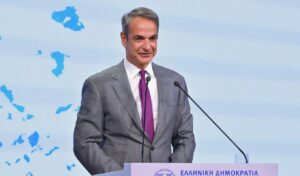
Fifty days remain until Saturday evening, September 5th, when Kyriakos Mitsotakis will announce the government’s economic policy for 2027 from the Vellidio Convention Center — at what will be the last Thessaloniki International Fair before the next general elections, whenever those may ultimately be held. The economy’s performance in the first half of the year leaves room for new support and relief measures worth up to €1.5 billion, though sources indicate the final package for this year’s Thessaloniki International Fair will exceed €2 billion.
Thessaloniki International Fair: High primary surplus opens the door for new interventions
Specifically, according to preliminary state budget execution data for the January–June period, the primary surplus reached €4.48 billion, against a target of €1.95 billion. Tax revenues amounted to €33.92 billion — up €679 million against target (excluding proceeds from the Egnatia Motorway concession agreement and the second installment of the Hellinikon casino license fee). Revenue returns stood at €4.13 billion, exceeding the target by €351 million, while Public Investment Program revenues reached €2.75 billion, surpassing the target by €90 million.
The minister responsible, Kyriakos Pierrakakis, and the government’s economic team are waiting for July to wrap up — a critical month for tourism — in order to get a clearer picture of revenues and form a more accurate estimate for the full year. Beyond that, however, there is also a recently introduced but largely overlooked provision that will be leveraged to push the support package announced by the prime minister above the €2 billion mark. This is the flexibility granted by the European Commission to extend the scope of the existing National Escape Clause, originally established to facilitate increases in defense spending.
Up to €500 million for energy and lower electricity bills
This extension will allow expenditures related to strengthening energy resilience to be counted under the clause, provided they are temporary and limited in scope. Measures will qualify under this framework if they contribute to reducing dependence on imported fossil fuels, thereby enhancing the European Union’s energy security. For these energy investments, a special annual ceiling of 0.3% of GDP has been set for the 2026–2028 period.
As a result, measures worth up to €500 million for 2027 are being added to the Thessaloniki Fair package, with proposals focusing on reducing energy costs for households as well as industrial electricity tariffs — which remain particularly high in Greece.
Farmers are also expecting support measures — a sector that has been deeply wounded by the OPEKEPE scandal and with which New Democracy is seeking to rebuild political and social ties.
Mitsotakis’s strategy: Supporting productive Greece instead of across-the-board handouts
How does the government intend to deploy these €2 billion? Kyriakos Mitsotakis, minister Kyriakos Pierrakakis, deputy ministers Thanos Petralias and Dimitris Markopoulos, and the head of the prime minister’s economic office, Michalis Argyrou, have already held numerous meetings on the matter. According to sources, the prime minister has requested a clear emphasis on “productive Greece,” with one key conclusion already reached: the funds will not be deployed in a single sweeping move — such as a 13th pension payment, which would exhaust every fiscal margin available. Instead, financial and tax relief will be distributed across several social and professional groups.
“We will reconnect with New Democracy’s core constituency,” a government official familiar with the discussions told Parapolitika. What does this mean in practice? Requests are pouring into the Maximos Mansion from various sectors, and representatives of organizations, associations, and chambers of commerce are presenting their demands to Mr. Markopoulos as he travels across the country these days. A rational mapping of these requests, however, can identify the core priorities and single out those that can realistically be addressed, producing a satisfactory outcome.
Tax cuts and incentives for self-employed workers and small businesses
For the self-employed and small-to-medium-sized enterprises, the primary measure under consideration is a reduction in advance tax payments, which is being explored specifically for tax-compliant taxpayers as a form of reward for meeting their obligations. A second measure involves reducing the minimum deemed income for the self-employed, based on criteria such as the geographic location of their registered business, years of professional activity, or other qualifying factors. Since the overarching theme running through discussions at Maximos is the rewarding of tax-compliant citizens, the reduction in deemed income may be targeted at those who have fulfilled all their obligations — meaning they have installed a POS terminal, use IRIS, file their tax returns on time, and pay their taxes promptly.
For businesses more broadly, the establishment of a protected professional bank account exempt from seizure is a proposal currently generating significant discussion, though it has not yet been finalized.
Pension increases and expanded eligibility on the table
For pensioners, discussions are underway regarding either an increase in the November benefit — potentially from €300 to €400 — or an expansion of the pool of eligible recipients. As a reminder, the benefit is currently paid every November to approximately 1.7 million pensioners aged 65 and over with an annual individual income of up to €24,000, or up to €35,000 for married couples.
Support measures for farmers
Farmers can also expect support measures — a sector that has been deeply hurt by the OPEKEPE scandal and with which New Democracy is seeking to rebuild political and social ties. It is no coincidence that the Property Ownership and Management Registry (MIDA) will launch with declarations of agricultural properties, so that payments can be made this year on time and based on the data officially registered with MIDA.
Interventions under consideration for taxis, property owners, and diagnostic centers
There is a lively debate within the government’s economic team regarding taxis, as officials explore further ways to support the sector. On the table is a reduction in the minimum deemed income or some other form of tax relief for taxi license holders — for example, those who inherited their license — as well as targeted support measures for drivers who are not also license owners.
Property tax cuts, clawback reforms, and possible lower road tax
For property owners, a new, targeted reduction in the ENFIA property tax remains on the table, while for diagnostic centers, changes are being examined to the mandatory rebate and clawback system, which would relieve them of some of the financial burdens they currently face.
Also under consideration at the Ministry of Finance is a potential reduction in road tax, possibly for older vehicles, acknowledging the reality that the cost of purchasing a new car has risen significantly and that owners of older private vehicles face a heavy financial burden.
Published in Parapolitika