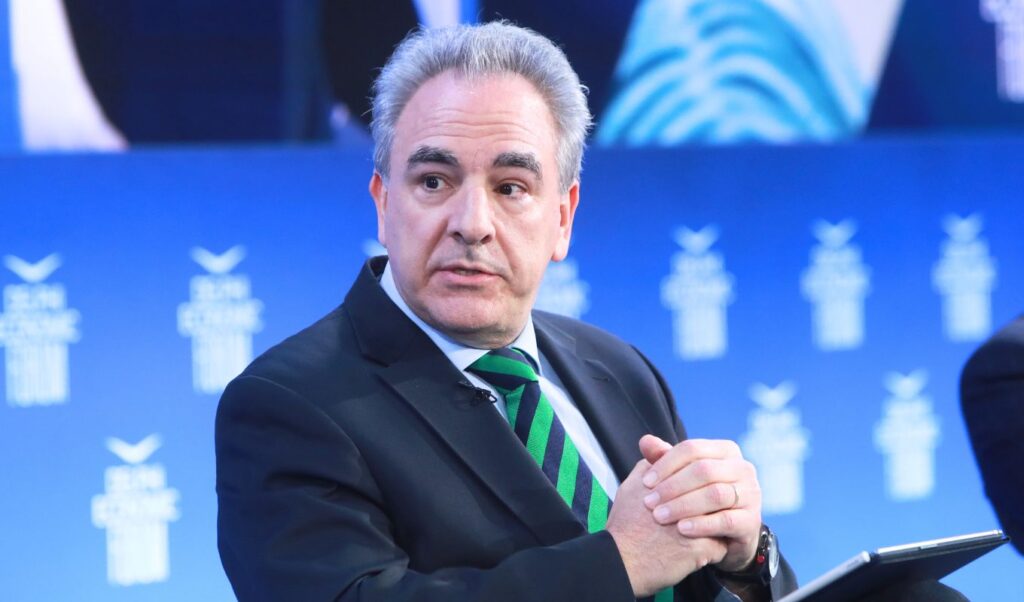
A major political storm erupted around Thanos Dokos after he fell victim to a prank by the notorious Russian duo Vovan & Lexus, who posed as Ukrainian officials and successfully deceived him. Several opposition parties called for his resignation in the aftermath. The Secretary General of National Security spoke on SKAI television on Friday evening (03/07), giving his own account of the “conversation” he had with the well-known Russian pranksters, and attempting to explain how he became the victim of an incident that has triggered significant political controversy and raised serious questions about security protocols.
Read also: Antonis Samaras on Thanos Dokos: “Is he still in his position?”
Thanos Dokos on the Russian pranksters: “They stole both my voice and my image”
In a revealing interview, Mr. Dokos spoke in detail about the conversation, stating with complete candor that he had no indication whatsoever that the contact was fake. He maintained that before the call with the Russian pranksters, the standard verification procedure had been followed, and noted that just one week earlier he had met in person with his Ukrainian counterpart, with several issues left open for further discussion.
The Secretary General of National Security said he saw nothing suspicious at the start of the communication, as he was watching his interlocutor respond in real time to what he was saying. “They stole both the voice and the image. That is what is deeply troubling,” he said, describing an incident that, according to the government’s account, involved the use of advanced artificial intelligence technology.
Thanos Dokos noted that his mobile phone is protected and that its security software had been upgraded, adding that until now, security protocols had already been reinforced precisely because similar incidents had been recorded abroad.
“You can no longer trust even your own eyes”
Dokos described the experience as “deeply unpleasant,” adding that “I felt that you can no longer trust even your own eyes.” He also noted that the Prime Minister, who was immediately informed of the incident, was deeply troubled by it.
The persistence over the drone incident
According to Dokos, the only element that raised his suspicions was his interlocutor’s insistence on the issue of a Ukrainian drone off the coast of Lefkada.
He explained that the supposed Ukrainian official kept insisting that, despite clear warnings from the Greek government, certain individuals in Ukraine might attempt something similar near Greek islands. Thanos Dokos maintained that everything he said during the conversation reflected “the national position,” adding meaningfully that “it’s not just about what one says, but also about how the material can be edited and manipulated.”
He contacted Greek intelligence and briefed Mitsotakis
Thanos Dokos further revealed that immediately after the call ended, he contacted Greece’s National Intelligence Service (EYP). He then, as he explained, called his real Ukrainian counterpart under a pretext — claiming there was something he hadn’t fully understood — and it was at that point he realized he had not been speaking with the same person.
He also explained that Greece’s experience in communicating with Ukraine is that, due to the ongoing war, connection problems are frequent. This, he said, was one of the reasons why no greater alarm was initially triggered.
When asked about Prime Minister Kyriakos Mitsotakis’ reaction upon being informed, Dokos said he was “troubled.” “This is something that had concerned him before, and this incident came as a confirmation of those concerns,” he noted, adding that the affair validated existing fears about how artificial intelligence could be weaponized to deceive senior officials.
The full interview with Thanos Dokos
1. How had you verified that you were speaking with your Ukrainian counterpart and not someone else? What credentials did you have? What guarantees?
“We had all the necessary material — the names, the addresses, even the letterheads used in these situations. The wording was exactly what is routinely used. And of course, my own contact details are not publicly available online — one would need to dig considerably deeper to find them. All of this led me to conclude that it was a genuine conversation with my Ukrainian counterpart, not something else. I had also never heard of an incident where both audio and video had been spoofed simultaneously, simply because this was an entirely new kind of approach — and I repeat, a deeply unpleasant one.”
2. So, to be clear — the standard procedure was followed. There were credentials confirming who you were speaking with?
“That I was speaking with the National Security Council of Ukraine — specifically, Mr. Umerov.”
3. When had you last been in contact — either in person or by phone — with your Ukrainian counterpart?
“One week before the video call incident occurred.”
- And had you agreed during that meeting to speak again about an open issue, or did nothing of the sort come up?
“We had left certain matters open. There are always issues where a discussion begins and then continues in a follow-up meeting, either in person or via video call. That is standard procedure.”
5. From the time you met your real Ukrainian counterpart in person to the time you had the call with the deepfake Ukrainian official — did you notice anything suspicious in the interim, on your phone or in your communications, anything that gave you pause?
“No, because my phone is protected. Security measures have been upgraded on mobile devices, and soon they will be extended to what are known as triple-encrypted secure phones as well. But that only covers communications between government officials — not with people outside the system.”
- So you accept the invitation — or in any case, this contact — and you initiate the connection. What do you see, Mr. Dokos?
“I see my counterpart, and we begin to talk.”
7. So you see him…
“Just as I can see you now — it was a normal conversation, with him live on screen, reacting in real time to what I was saying.”
- So you’re sitting on one side of the screen, and on the other side you have the adviser to the Ukrainian president — his image and his voice. So we’re not talking about two unknown faces on the call, or an unfamiliar voice. They stole both the voice and the image…
“That is what is so alarming — because until now, our own security protocols had already been strengthened, precisely because we had seen many such prank incidents occurring over phone calls. President Macron had been a victim, President Duda of Poland, and a number of other leaders, prime ministers, and ministers. We had decided that from then on, calls would require both voice and video.”
9. And that is exactly what happened here.
And so the conversation began — and that’s how it unfolded.
10. Did anything about the content of the conversation concern you?
Toward the end of the discussion — because my counterpart was insisting on the Echelon issue, and with certain positions that were slightly odd, though not odd enough to make me suspect that something so extraordinary was happening. Not until the very end.
11. Could you give us a bit more detail about what it was that troubled you and made you feel that something might be wrong?
He kept insisting that, despite the clear warnings the Greek government had issued at all levels regarding the alarming drone incident off Lefkada, some individuals within the Ukrainian government had not gotten the message and were planning to do something similar near Greek islands. He repeated this several times and in a way that, toward the end, I began to wonder whether it was a language issue. The English wasn’t helping. There was something else going on in this exchange — so the moment the call ended, I immediately contacted the National Intelligence Service, and they began looking into the matter. I also called my Ukrainian counterpart again by phone alone, under the pretext that there was something I hadn’t fully understood and wanted to clarify. And it was then that it became clear that the person I had been speaking with was not my Ukrainian counterpart at all. It was someone else entirely.
12. So this would be the first fake deception of this kind at such a senior official level.
That’s also what the Ukrainians told us — that around the same period, though without many details, something similar had happened to an official from a Baltic country. This confirmed our own suspicions.
13. Was there anything in the video image that — now that we know what happened — might allow someone to suspect the image had been altered, or was in any way fake? Was it so perfectly designed and executed that even now we wouldn’t be able to tell?
There were some minor delays, but our experience with Ukraine is that, due to war-related issues, there have always been connection problems. I recall, for instance, a video link with President Zelensky at a leaders’ summit where the video hadn’t come through — it was audio only. So there was nothing alarming about it, because the connection quality with Ukraine had always been somewhat inconsistent. But nothing severe enough to immediately trigger concern that something entirely different was going on.
14. Can they be traced? Have you had a preliminary discussion about what can be done and what security measures need to be put in place — because the landscape is changing, and changing fast?
A review of security protocols has already begun. And I should say here that what is alarming for all of us is that even what we see with our own eyes can no longer always be trusted — and that could have profound implications for information, communication, and political discourse. A whole range of issues that touch even our daily lives. The positive side, if there is one, is that as a country we have taken significant steps recently — both in terms of the National Intelligence Service and, just a few days ago, the inauguration of the cyber warfare facility at the Hellenic National Defence General Staff, with all the technology that entails. The National Cybersecurity Authority has also made major strides. So we have a national-level mechanism that has been mobilized, that has developed real capabilities, and that is gradually closing the gap with those who seek to cause harm. I am therefore cautiously optimistic that, after this unpleasant experience, we will be better prepared to detect such disinformation and deception attempts in a timely manner.
15. At this level, can we say with confidence that the next time you — or anyone on the Greek side — connects with someone, it won’t be a fake?
Just as technology evolves for defensive purposes, it also evolves for offensive ones. I believe that next time we will be protected against this kind of software and technology — but no one can predict how many more steps AI technology will have taken in the opposite direction. It’s an ongoing battle. I hope we will win it, but no one can be absolutely certain.
16. Does this concern you — especially coming just before the NATO Summit, where Ukraine will be at the top of the agenda?
It’s clearly not a coincidence in terms of timing. But I think if you look at all the operations that have been carried out, sometimes the pre-election period is chosen — and we’ve seen very intense activity during those windows. This time, it’s Russian services. We know that with certainty. In the Moldovan elections, in the Armenian elections, there are concerns in European countries as well. So at various points in time, there is a coordinated plan that manifests in precisely this way.
17. That dimension is interesting. If we assume this is a Russian operation aimed at interfering in national affairs, do you think they could use this conversation with you as a lever of pressure during the upcoming election period? We are, after all, in an informal pre-election climate — which is why I’m asking.
I think that whatever I said reflects the national position and the message we have consistently communicated to the Ukrainians at various levels — through the Prime Minister and the relevant ministers. I don’t believe anything was said that could create a problem.
18. But they didn’t know that. When they attempted to engage with you — they had no idea what you would say, while their intent, if it relates to something like this, was clearly aimed elsewhere.
Their intention would obviously have been to cause trouble. Let me add something else: it’s not only about what someone says — it’s also about how that material can be edited and reconstructed using advanced algorithms and software to make it appear as though someone said something they never actually said.
19. Mr. Dokos, when this happened to you personally — setting aside your role for a moment — how did it feel?
It was a deeply unpleasant experience. I won’t hide that. I felt that you can no longer trust even your own eyes. And it’s something that leads me to reconsider a number of things — both professionally and on a personal level.
20. Given that our country has made significant efforts in this area — in terms of awareness and artificial intelligence — when you informed the Prime Minister, what did he say?
He was troubled. But when it comes to the issue of fake news, he is someone who has a very good grasp of technology. He understands these matters. This is something that had concerned him before, and this incident came as a confirmation of his existing concerns.