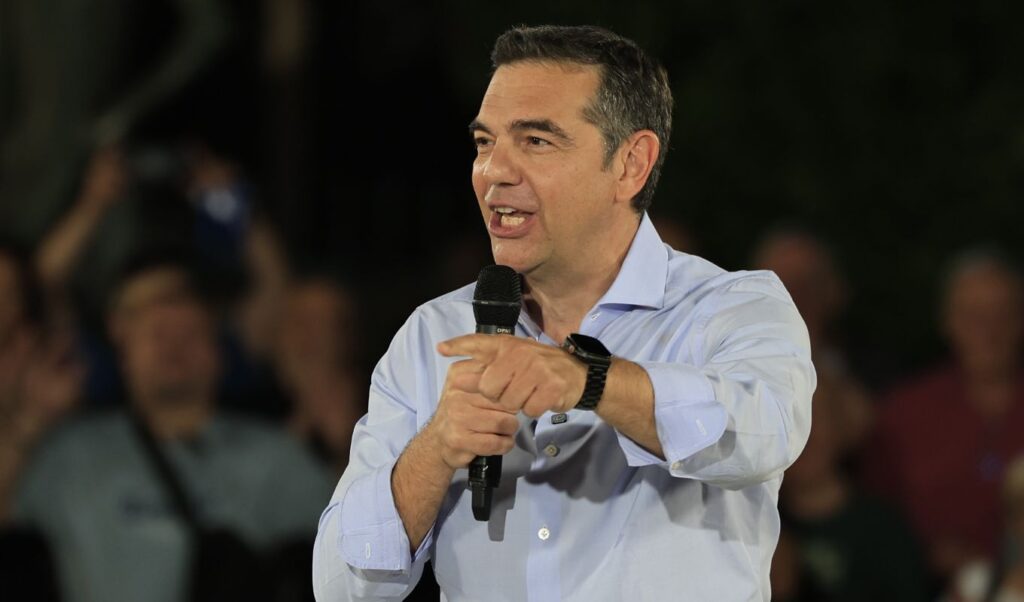
Alexis Tsipras, president of the Greek Left Alliance (EL.A.S.), has launched a sharp attack on the government over its handling of European funds, while also weighing in on taxation, social cohesion in the European Union, and Greek-American relations in an interview with Politico.
The former prime minister argues that corruption places a direct burden on society, warning that: “Every euro lost through direct contract awards and the misappropriation of European funds is a euro taken away from hospitals and schools.”
He also invokes what he calls the “invisible corruption tax,” stressing that it drains vital resources from social policy and severely limits the state’s ability to support its citizens.
On foreign policy, Tsipras takes aim at the New Democracy government, arguing that: “The government has handed Trump a blank check.” On the European Union, he insists that strengthening social cohesion requires new revenue streams, stating that: “A prerequisite for social cohesion in the EU is taxing multinationals and carbon emissions.”
Tsipras’s full interview with POLITICO
Greece needs to “cool down” its overly close relationship with the MAGA movement, the opposition leader and former prime minister told POLITICO. Outlining his agenda ahead of general elections expected by next spring, the left-wing politician criticized current conservative Prime Minister Kyriakos Mitsotakis for making excessive concessions to the United States. He drew a pointed contrast with Spanish Prime Minister Pedro Sánchez, who barred American forces from using Spanish military bases. “While much of Europe is distancing itself from the MAGA movement, Greece is deepening its relationship with US President Donald Trump,” the report notes.
“The Mitsotakis government has granted the United States open-ended access to critical military bases across the country — including the main naval base in Crete — rather than requiring regular renewal of the agreement with renegotiated terms. Tsipras believes Mitsotakis has gone too far,” it states.
“Greek-American relations are strategic in nature and must be governed by the principle of mutual benefit,” he said. “The government is pursuing a ‘blank check’ policy, and that does not serve our national interests.”
The 51-year-old Tsipras argued that the priority in the use of military bases should be Greece’s own security, not simply satisfying American demands.
“This issue came into sharp focus during the recent war in Iran. We saw how the Greek prime minister responded — and how the Spanish prime minister responded.” His pre-election stance that Greece must maintain greater distance from Washington appears designed to tap into widespread Greek public skepticism toward Donald Trump.
According to a Pew Research Center survey conducted in late June, only 22% of Greeks polled said they trust the US president to handle international affairs responsibly. Tsipras, who lost power in 2019, rose to international prominence as leader of SYRIZA, the radical left party that clashed with Brussels and Berlin through successive rounds of grueling negotiations at the height of the eurozone debt crisis.
In May, he founded a new political party called EL.A.S., aiming to unite the fragmented opposition against Mitsotakis’s New Democracy. He has already emerged as the second political force in Greece, though he remains significantly behind the prime minister.
According to POLITICO’s Poll of Polls aggregate, New Democracy stands at 30% and EL.A.S. at 17%. Elections are expected to be held before Greece assumes the rotating presidency of the EU Council in July 2027.
“Tax the multinationals”
If he is prime minister during that presidency, Tsipras said he would prioritize cohesion policy spending aimed at reducing economic inequalities between EU regions, while leaving the door open to higher taxation of large corporations.
“Social cohesion must be strengthened and the EU’s own resources must be increased. That means there must be the political will to tax multinational corporations, as well as carbon emissions,” he said. Given the threats to European security, Tsipras agreed that defence investment must increase — but not at the expense of social spending.
“If that happens, in a few years we will find ourselves with a European Union that is stronger militarily, but governed by far-right governments.”
The “corruption tax” in Greece
“Tsipras still faces the major challenge that Kyriakos Mitsotakis remains firmly on top in the polls. Despite a series of major scandals that have shaken the country — including the government’s mishandling of a deadly train crash in Greece and a widespread fraud involving European agricultural funds — the government has maintained its lead, in part due to the severe fragmentation of the opposition,” the report states.
Tsipras argues that this is precisely why he created his new political movement. “The picture is not positive for the government,” he says, “but it is rather negative for the opposition, and that is why EL.A.S. was created.” He stressed that public outrage over corruption should ultimately translate into political change. He cited polls showing that around 70% of Greeks want political change, approximately 90% believe corruption is widespread, and around 55% say they were better off in 2019 than they are today.
He observed that Greek households have faced a “double blow” over the past seven years: a high cost of living and pervasive corruption. Annual inflation in Greece stood at 5.2% in May 2026, exceeding the eurozone average of 3.2%.
“According to the 2026 UBS Global Wealth Report, wealth inequality has increased, as fewer and fewer people benefit from the rise in total wealth. Although total net wealth has been growing steadily since 2020, the gap between the wealthy and the general population continues to widen,” the report notes.
“We have the invisible corruption tax — and I call it a tax because I believe the cost of the widespread and unprecedented levels of corruption in Greece is so great that it deprives resources from social policy,” Tsipras said.
“Every euro lost through direct contract awards in public tenders and through the misappropriation of European funds is a euro missing from public schools, teachers’ salaries, public hospitals and nurses’ wages,” he added.
When asked about the political fallout from his reputation as a radical and unpredictable politician during the eurozone crisis era, Tsipras replied that many people remember his time in government only for the first turbulent six months, when Athens teetered on the brink of being forced out of the eurozone.
He himself, however, presented his record as that of a leader who ultimately managed to stabilize the situation.
“There is an effort to keep the discussion focused only on the first six months of governance, from January to July 2015. But there is a period before and after. The country did not enter the crisis because of our policies… We reached a difficult agreement, through conflict and tension, but we put an end to the memoranda, restored the credibility of the economy and achieved positive growth rates.”