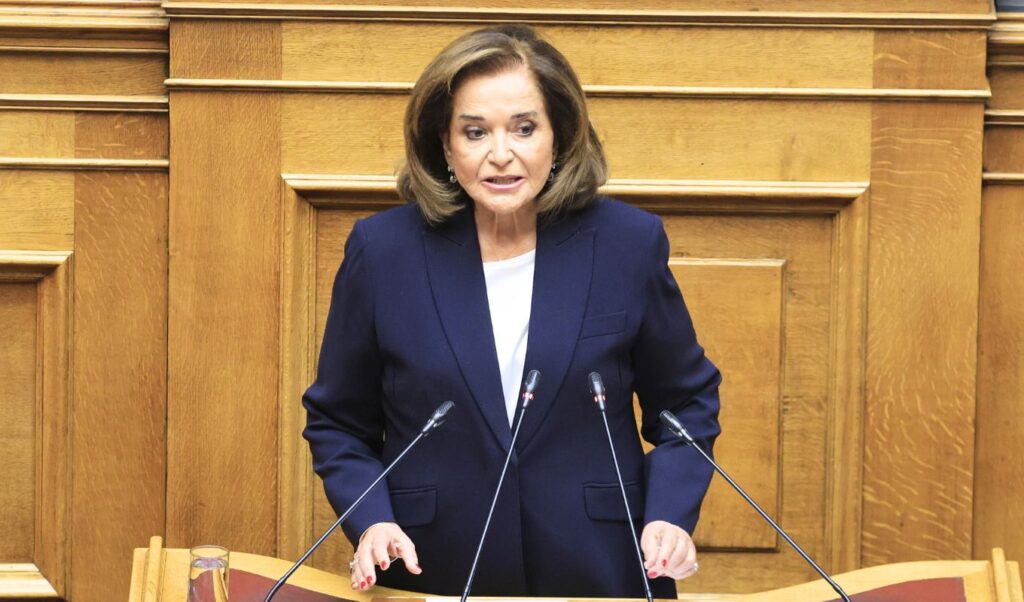
Former Foreign Minister and current MP for Chania Dora Bakoyannis made a particularly noteworthy intervention during today’s session of the Committee on Constitutional Revision. Referring to the ruling party’s proposal to abolish amnesty for political crimes — as provided under Article 47 of the Constitution — she emphasized that “it constitutes an act of institutional self-confidence in the democracy we have managed to build, and a minimum tribute to all those families of terrorism victims who cannot tolerate seeing the murderers of their loved ones treated as anything more than what they are: murderers.”
Bakoyannis: “Abolishing the possibility of amnesty for political crimes is an act of institutional self-confidence”
“For many decades now, our democracy has no need to provide special exceptions for those who turn against it, and it must not offer any cover to those who attempt to dress up their intolerance, inhumanity and perversion in the guise of so-called constitutionally recognized political motives. Nothing — absolutely nothing — not a single clause should exist within the Constitution that serves the narrative of democracy’s enemies,” the former Foreign Minister stressed.
“Abolishing the possibility of amnesty for political crimes is an act of institutional self-confidence in the democracy we have managed to build, and a minimum tribute to all those families of terrorism victims who cannot tolerate seeing the murderers of their loved ones treated as anything more than what they are: murderers. This is what respect for the institutions of the rule of law and democratic legitimacy demands, and I would hope that at least on this point we could find common ground,” she further noted.
“This provision has historical roots and for many decades served the national interest,” said the New Democracy MP, adding: “It was necessary in an era of civil wars, national divisions and political instability. National reconciliation demanded a different approach to crimes committed between political opponents. It sometimes required us to forget our past in order to prevent it from haunting our future. Our greatest source of pride — in the quality of our democracy since the restoration of democratic rule — is that we no longer need such necessary evils in order to coexist. Fortunately, over the years that followed, Greek democracy matured, grew stronger and proved, when called upon, its resilience and its capacity for self-preservation. The democratic institutions we built, the political culture we established, and the unimpeded transfer of power we guaranteed, stripped political violence of its ideological cloak and equated it with common crime.”