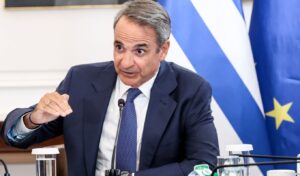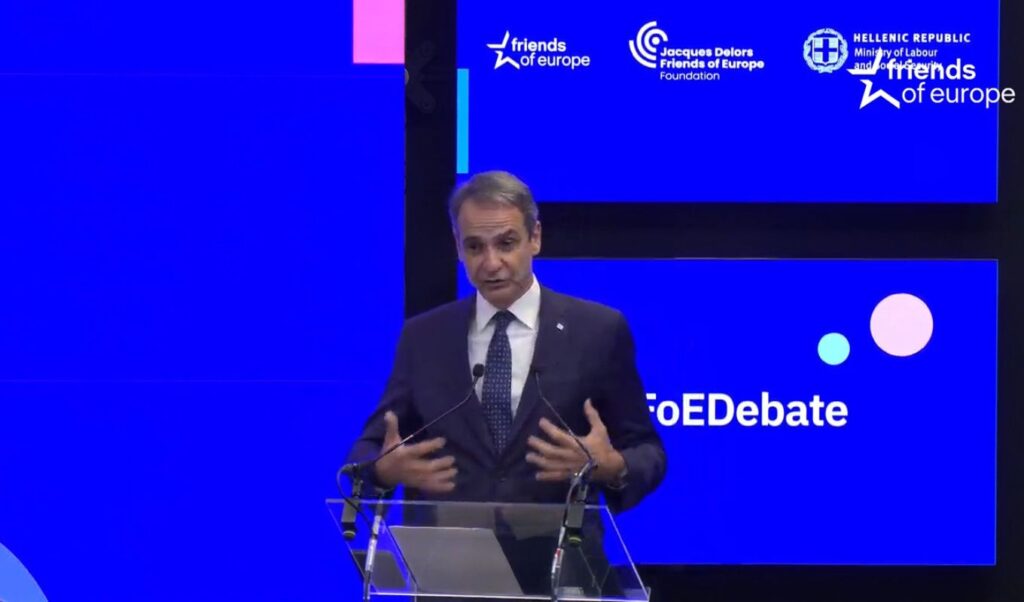
Greek Prime Minister Kyriakos Mitsotakis delivered a keynote address on Thursday (June 18) at an event titled “Greece’s National Social Agreement: A European model for social dialogue,” held during his visit to Brussels for the EU Summit.
The event showcased Greece’s experience as a benchmark and model for social dialogue at the European level. Alongside Prime Minister Mitsotakis, speakers included Minister of Labour and Social Insurance Niki Kerameus, European Commission Executive Vice-President Roxana Minzatu — responsible for Social Rights and Skills, Quality Jobs and Preparedness — and Seamus Boland, President of the European Economic and Social Committee. The event was held to mark the historic milestone Greece achieved in late November 2025, when its National Social Agreement was signed by all national social partners, representing both workers and employers. According to an official announcement, the Agreement paved the way for new Collective Labour Agreements to be signed and existing ones to be extended, delivering wage increases and stronger protections for workers.
Kyriakos Mitsotakis in Brussels: Addressing the event on Greece’s National Social Agreement
Greece’s achievement was met with high praise from the European Commission, which held it up as a powerful example to follow — “a source of inspiration for social dialogue across Europe,” as Executive Vice-President Roxana Minzatu had stated at the December Council of Employment and Social Affairs Ministers. This was followed in March 2026 by Minzatu’s visit to Greece, where, after meetings with Prime Minister Mitsotakis and Minister Kerameus, she commended the country for its labour market reforms and had the opportunity to visit facilities of the Ministry of Labour and Social Insurance and the Public Employment Service (DYPA). It is worth noting that the establishment of the National Social Agreement has already produced tangible results in the labour market, with significant Collective Labour Agreements signed and extended — including in the food service and confectionery sectors — providing wage increases and benefits for nearly 500,000 workers in those industries.
“Trust is built by keeping your commitments and delivering results”
Outlining the reforms introduced in the area of labour, Kyriakos Mitsotakis said: “We wanted better protection of workers’ rights, and one of the key reforms was the digital work card. But there was a gap when it came to collective labour agreements. I was initially cautious. The social partners sat in the same room and reached a landmark agreement that was signed by all of them.” The Prime Minister noted that “the progress we have seen since then is remarkable, because the sectors that have signed such agreements have seen better wages.” He added: “I am glad that employers are realising their success is tied to the wellbeing of their workers.” Mitsotakis also pointed out: “No one would have expected this agreement to be signed by a centre-right government. We managed to reach a deal that benefits employers, but above all workers.” He further emphasised that “trust is built by keeping your commitments and delivering results.”
“I hope Greece’s story will serve as an inspiration”
“Ten years ago, how many people had good things to say about Greece? But now we have achieved significant reforms, with an economy that generates sustainable fiscal surpluses, and we are reducing debt to support the most vulnerable against inflation,” Mitsotakis said. Concluding his remarks, the Prime Minister stressed: “I hope Greece’s story will serve as an inspiration — and if you want advice on how to manage sensitive personalities in a room, feel free to ask us.”
What Niki Kerameus said
Speaking earlier at the same event, Minister of Labour and Social Insurance Niki Kerameus highlighted the major labour market reforms achieved over the past seven years, including a 10% reduction in unemployment and a rise in wages, noting that “we had a gap in ensuring that as many workers as possible were covered by collective labour agreements.” She also recalled a conversation she had with Prime Minister Mitsotakis before negotiations on collective agreements began, during which he asked her: “What are our chances of success?” — to which she replied: “Based on logic, they’re close to 0%, but I had a sense that the right conditions were in place.”
- “We spent seven months in extensive discussions. I insisted that everything be conducted in strict confidence. I believe three elements led to the agreement:
- — there was trust
- — everyone genuinely wanted to find a solution and reach consensus
- — we did not start with preconditions,” Niki Kerameus added
As she noted, the think tank Friends of Europe, which organised the event, stated that “at a time when Europe is seeking to reconcile competitiveness with social justice, Greece has taken a significant and widely recognised historic step forward. In November 2025, the Greek government and all national social partners signed the National Social Agreement — a historic tripartite accord aimed at strengthening Collective Labour Agreements and renewing social dialogue in practice. The Agreement marks a decisive opportunity to enhance labour protections in Greece, where, following the public debt crisis, labour relations had been shaped by the constraints of the crisis era.”