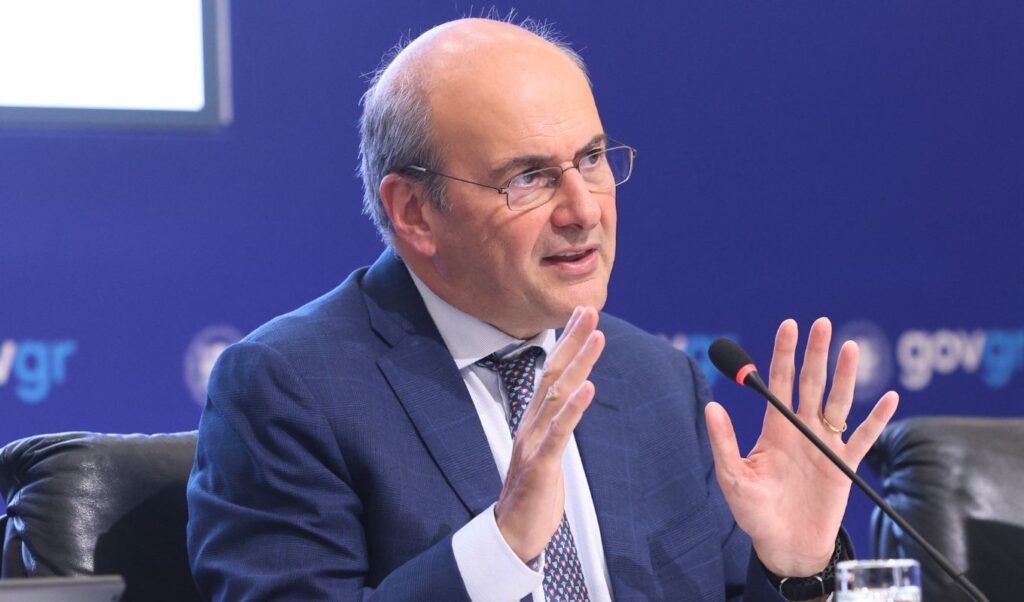
Greece’s Deputy Prime Minister Kostis Hatzidakis outlined the opportunities opening up for Greece through the new European Competitiveness Fund, while also addressing the pivotal role universities must play in driving innovation and growth. He made these remarks during an event titled «The New Era for Higher Education», organized in Athens by the Ministry of Education, Religious Affairs and Sports.
“For the first time in the next programming period, 2028–2034, there will be a European Competitiveness Fund with a total budget of €420 billion. This money will not go toward the traditional actions we’ve known since the 1980s, but toward initiatives that will boost competitiveness through collaboration between businesses, universities, and research centers. Based on population criteria alone, Greece could be allocated between €8 and €10 billion — in other words, half a Recovery Fund.”
Hatzidakis: “Universities to become drivers of local and national development through innovation and action”
Kostis Hatzidakis explained that the Fund will not be distributed through national quotas — though negotiations are still ongoing — but will instead focus on research, technology, and their connection to businesses. As a result, credible, high-scoring proposals will have the competitive edge. “Every academic and every entrepreneur needs to understand this,” he stressed. “Things are changing, and so must our way of thinking. Public and private universities — not just in Europe, but in Greece too — will no longer be places where some people teach classes and others rent out their apartments. They will become drivers of local and national development, through innovation and through initiatives that generate added value. It would be a serious failure if we couldn’t take part in this revolution. And I am confident that, just as we succeeded with digital modernization, we will succeed here as well.”
“The notion that the end of the Recovery Fund will leave a funding gap is simply wrong”
He reiterated that the idea of a funding gap following the expiration of the Recovery Fund is entirely mistaken. Based on the latest proposals — with negotiations still underway — Greece is set to receive €49.5 billion in the next programming period (compared to €57.5 billion in the current one), plus a loan package, plus financing from the Competitiveness Fund.
Turning to the progress made in higher education, Kostis Hatzidakis highlighted two landmark changes introduced in recent years: the evaluation of universities through the national accreditation authority, and the coexistence of public and private universities. “Last year was a beginning. This year, I expect even more private universities to open, and competition will intensify. There are also new approaches emerging within public universities. The institution of industrial doctorates — which brings universities closer to businesses — has been passed into law, and industrial master’s programs could follow,” he noted.
Attracting international students
The Deputy Prime Minister also highlighted progress in attracting international students. “It is very significant that a new mindset is beginning to take hold in universities and that partnerships with foreign institutions are developing. There are collaborations with American universities, and Chinese students are coming to Greece to study ancient Greek philology. This can be expanded even further. Universities — particularly those in island regions and tourist destinations that sit empty every summer — could be used to host summer courses for foreign students and pupils. This would generate additional revenue, make use of underutilized facilities, and move Greece in the direction of becoming an international education hub, much like Cyprus.”
He also criticized the main opposition party for a lack of seriousness, noting that while it agrees with the existence of non-profit universities, it has stated it will vote against the government’s proposal — a proposal that falls within the constitutional framework. “The only reason is that it comes from New Democracy. Is that serious? Is that responsible?” he asked.
Finally, Kostis Hatzidakis announced that a review of the Recovery Fund will take place over the summer — one that will go beyond absorption tables to include photos and videos documenting results on the ground. “I wonder,” he concluded, “what those who tend to dismiss everything will have to say. The first narrative was that we wouldn’t manage to absorb the funds in time. Unfortunately for them, that was proven wrong. The second narrative was that the Fund only benefited large corporations. But it actually reached tens of thousands of small and medium-sized enterprises and touched on very important areas of social policy — such as healthcare, where you can see us inaugurating new health centers and hospital units that affect every citizen, and education. Interactive whiteboards were funded, modernization initiatives were rolled out across primary and secondary education, outreach programs for universities were launched, and new master’s programs were created. All of this is an investment in society and in the future of our country. And we must extend our thanks — not just as a government, but as citizens — to the hundreds of public servants who worked tirelessly for five years and ran a true race against the clock to secure the absorption of these funds. Because the conditions were far more demanding than those of traditional ESPA programs.”