The institutionalization of the 3+1 framework between Greece, Cyprus, Israel and the United States signals a significant geopolitical shift in the Eastern Mediterranean, transforming the region from a field of geopolitical rivalries into an area of strategic cooperation and common interests among the four countries. Through the implementation of the 2019 EastMed Act and the establishment of the Eastern Mediterranean Energy Center in Houston, Greece and Cyprus are being upgraded to critical strategic allies of the US and Israel.
The energy agreements have caused concern in Turkey, with the Turkish press speaking of geopolitical changes in the Eastern Mediterranean that will have implications for Turkey. This is because the emergence of the 3+1 energy alliance is based on the acknowledgment that energy security is inextricably linked to the national security of Greece and Cyprus.
Greece and Cyprus become central hubs in strategic Eastern Mediterranean energy projects – IMEC takes center stage, “paving the way for the Vertical Corridor”
The two countries are no longer considered mere regional players but are transformed into central hubs for the next generation of strategic energy and international connectivity projects, such as the India-Middle East-Europe Economic Corridor (IMEC). Moreover, this cooperation extends beyond traditional energy issues to cybersecurity, critical infrastructure protection, and most importantly, long-term cooperation between Greece, Cyprus, Israel and the US at a regional diplomatic level.
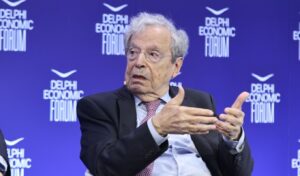
Energy policy professor Charles Ellinas argues to parapolitika.gr that the energy agreements between the four states, which come as a continuation of the P-TEC conference at the Zappeion, have finally been implemented. As he estimates, “from a security perspective in the region, these agreements are very useful because America is engaging more dynamically in the region, strengthening cooperation with Israel, which is truly very significant, and opening the way for Greece to the Vertical Corridor. Additionally, it strengthens the presence of Chevron and ExxonMobil in Greece.”
It is expected, according to Ellinas, that the deepening of strategic ties among the four countries functions as a pole of stability in the region, deterring unilateral actions by third parties. In this way, Greece and Cyprus seal their role as reliable partners during a period of fluid realignments. As he argues, “after the strategic cooperation of the ‘3+1’ and especially the energy agreements, Turkey will hardly take any action against Greece. But if it decides to do something, neither America nor Israel will stop it. Certainly these agreements make it more difficult for Turkey to take any action, because it knows it will lose. It knows there is American support and cannot make moves without seriously considering the consequences,” he maintains.
Nevertheless, according to energy policy professor Charles Ellinas, despite its reactions, Turkey has its own benefits in the region, mainly due to the support it receives from the US, especially now that, for oil transportation due to the closure of the Strait of Hormuz, overland pipelines to the Mediterranean are being sought. As he says, “at this moment America is promoting corridors from Asia through Turkey to Europe. This support exists from America to Turkey and thus maintains a balance between Greece and Turkey. It doesn’t mean America has ‘put all its eggs’ only in Greece’s energy basket, it has also put them in Turkey’s, which is very important, because this balance needs to exist, it is necessary.”
The message for the Western Balkans
At the same time, Greece is promoting cooperation among Western Balkan countries in Europe’s energy security, an issue that emerged as an urgent need after the Russia-Ukraine war and the EU’s energy decoupling from Russian energy. Foreign Minister Giorgos Gerapetritis, in his interview with the Serbian newspaper “Politika,” referred to the need to create a stable foundation for stronger cooperation in the natural gas sector between Greece and Serbia, particularly through natural gas interconnections with Bulgaria and North Macedonia. As he stated in his interview, “Greece constitutes the main southern energy gateway and supply hub for the Western Balkans and the broader Southeastern Europe, contributing to the diversification of energy supply sources for countries in our broader region, including Serbia, and to reducing dependence on individual suppliers. Serbia’s role is equally pivotal in connecting the energy systems of our region with Central and Northern Europe, on the South-North axis.”
Gerapetritis made particular reference to the importance of regional natural gas corridors. As he said, “the Floating Storage and Regasification Unit (FSRU) of Alexandroupolis, where Serbia has already committed natural gas supply quantities, as well as the Revythousa Liquefied Natural Gas Terminal, contribute to diversification in natural gas supply to the Balkans. This happens through the Vertical Corridor, which, through the construction of the Greece-North Macedonia and North Macedonia-Serbia pipelines, will extend to Serbia as well.”