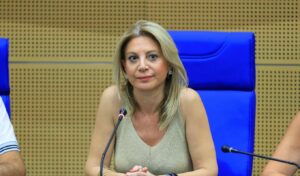
The creation of new parties by former prime minister Alexis Tsipras and former president of the “Tempe 2023” Association Maria Karystianou appears to be thoroughly reshuffling the deck in the country’s political landscape.
First polls and the battle for second place
This became evident from the first measurements taken after the announcements of the new parties – Hope for Democracy and Greek Left Alliance – with analysts estimating that second place is completely open, as the battle will be fought primarily between the Greek Left Alliance and PASOK, while the unknown X factor appears to be Maria Karystianou’s party.
Already, the first polls being published show Alexis Tsipras’s new venture has developed much more momentum than Karystianou’s party, resulting in it being placed in second position. At this stage, PASOK is the loser, though it hopes that when the “dust settles,” it will return to second place again. Taking the polling realignments as an opportunity, “P” sought expert opinions.
Maria Karakliumi: “Second place in the electoral podium remains open”
“Without doubt, since the establishment of the Greek state, the Metapolitefsi was the most peaceful period politically. Institutions were expanded and, generally speaking, functioned better than in other historical periods. I estimate the main reason was strong bipartisanship or, better yet, deeply rooted bipolarity. Political personalities contributed to this and voters followed. After all, ideas had meaning. They provoked political passions, identification, and conditions of competition,” emphasizes Maria Karakliumi, political analyst and CEO of Spin Communications & SpearMind.AI. “With the economic collapse of the country and the party system as we knew it, we moved from weak bipartisanship to today’s fluidity. Citizens, within an environment of realignments, uncertainty, social pressures, and technological changes shaping their future, no longer easily identify with any party or leader. In today’s Greece, this results in political fragmentation of the electorate. Except for New Democracy, which, even with small percentages by its historical standards, continues to lead, mainly thanks to the acquired momentum of governance, second place on the electoral podium appears to remain open,” she adds.
“The battle for second place will be fought on marble threshing floors. The question is which party will prevail. The determining factors are probably more than one. It’s not only the personality of each party’s leader. It’s mainly the ability to give citizens the impression that the specific leader can constitute the other pole opposite Kyriakos Mitsotakis. To become the political reserve, the alternative solution, even out of necessity, for those who desire relief from the current governance. For this reason, the “Left – Right” division may retreat before a new, more direct dilemma: continuation of today’s governance, which for some means stability and for others stagnation, or change of political course?” concludes Maria Karakliumi.
Yiannis Razos: “Today’s polls record intentions, not final results”
For his part, communications expert Yiannis Razos notes that “recent polls show political interest is now shifting to the battle for second place. And this is indicative in itself: The discussion doesn’t yet concern alternation in power, but who can appear as the main pole opposite the government. For now, we have more first impressions than definitive conclusions. This period’s polls record intentions, not final political results. The real picture will emerge in autumn measurements, when it will have been tested who can transform initial resonance into stable political momentum,” he characteristically states.
“Alexis Tsipras seems at this moment to be winning the first ‘bet’: rallying SYRIZA’s hard base. He possesses personal communication ability, experience, and a professional way of political presentation. He knows how to organize narrative and create a sense of political comeback. The question is whether this rallying can open to broader audiences or if it will remain within the limits of the already existing space. PASOK, on the other hand, has history, institutional memory, and organizational base. However, it lost time. It hasn’t managed so far to create dynamic identification with citizens seeking governmental solution with center-left sign. It’s not enough to appear as institutional opposition. It must convince that it can become a carrier of alternative prospect. And this is its basic problem,” adds the communications expert.
“Maria Karystianou is the most unpredictable factor. She appears to have access to larger and more diverse social reservoirs, beyond traditional party limits. Her resonance connects with the need for moral representation and credibility. The crucial bet, however, is whether this resonance can acquire organization, political representation, program, and stable media presence. Therefore, second place isn’t judged only by today’s percentages. It’s judged by who can acquire endurance, identity, and prospect. And this will become clearer in autumn,” concludes Yiannis Razos.
Published in Parapolitika