Greek diplomacy is attempting to “unlock” the delimitation of maritime zones with Libya and close one of the biggest “wounds” in foreign policy. The restart of technical talks between Athens and Tripoli takes on particular significance, as it occurs in a complex environment where Turkey is escalating tensions with Greece and attempting to maintain the agreement for the illegal Turkish-Libyan memorandum.
Antonis Klapsis: The Turkish-Libyan memorandum still lacks legal force
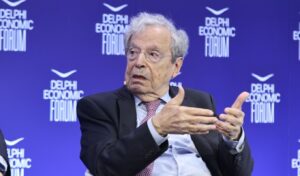
Associate Professor in the Department of Political Science and International Relations at the University of Peloponnese, Antonis Klapsis, argues to parapolitika.gr that there is a critical legal and political framework, as the Libya-Turkey agreement has not yet been ratified by the Libyan Parliament, making it legally inactive domestically. This pending status leaves room for Libya to conclude a new agreement with Greece, which would effectively nullify or replace the previous one.
According to Klapsis, “to the extent that the previous Turkish-Libyan agreement is not ratified, it leaves room for Libya to potentially conclude others. Libya would not violate anything if it proceeds with an agreement with Greece, it simply would not ratify the previous one. So we have room to enter there.”
What Greece can offer Libya – “There are chances the agreement will proceed”
The comparison of “exchanges” that both sides offer to Libya is interesting. While Turkey promises Libya maritime zones that belong to the Greek continental shelf, Greece offers something more tangible: the support of a European Union member state and participation in a stable cooperation axis.
As Klapsis argues, “the question is what the Libyan side weighs as more important right now. To gain something theoretical on the EEZ issue, which however in practice is not certain it can implement, or to take something tangible. The Greek side has something more tangible to give, I think. Under this prism, I believe there are chances for the agreement with Greece to proceed. That it’s not just ‘midsummer night’s dreams’ from our side. But this would simultaneously mean the cancellation of the Turkish-Libyan memorandum. It would mean its replacement by a newer agreement. The previous one, in any case, has no legal force.”
The role of Israel, France and the US – How Turkey is expected to react
This effort is not developing in a vacuum. Greece’s strategic alliance with Israel, France’s presence in the Eastern Mediterranean, and US interest in energy corridors function as catalysts in reshaping regional balances.
In this new framework, a Turkish reaction is expected. According to Klapsis, an agreement between Greece and Libya would put Ankara in a difficult diplomatic position, because as he argues, “for Turkey to intervene, it must send warships between Libya and Crete. That is, it will send ships to a point to intervene in an agreement made by two other states, not itself. From a diplomatic perspective, its position would be rather weakened. It won’t be so easy to support this.”
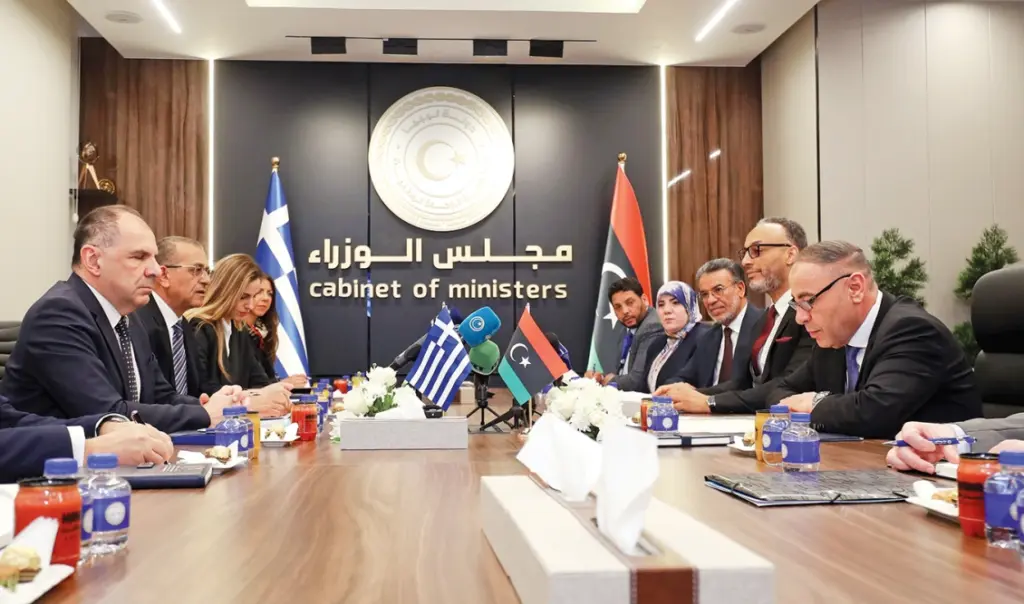
Although the path remains difficult and an agreement is not considered easy in the short term, Athens appears cautiously optimistic, betting on the stability and strategic alliances it has built in the region. As Foreign Minister Giorgos Gerapetritis emphasized, Greece has restored its contacts with Libya and now talks at a high level with both the government in Tripoli and the Benghazi side. In any case, the recent visit of Deputy Foreign Minister Alexandra Papadopoulou to Tripoli signals the transition from theory to practice, aiming to find common ground for EEZ delimitation.