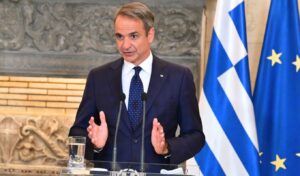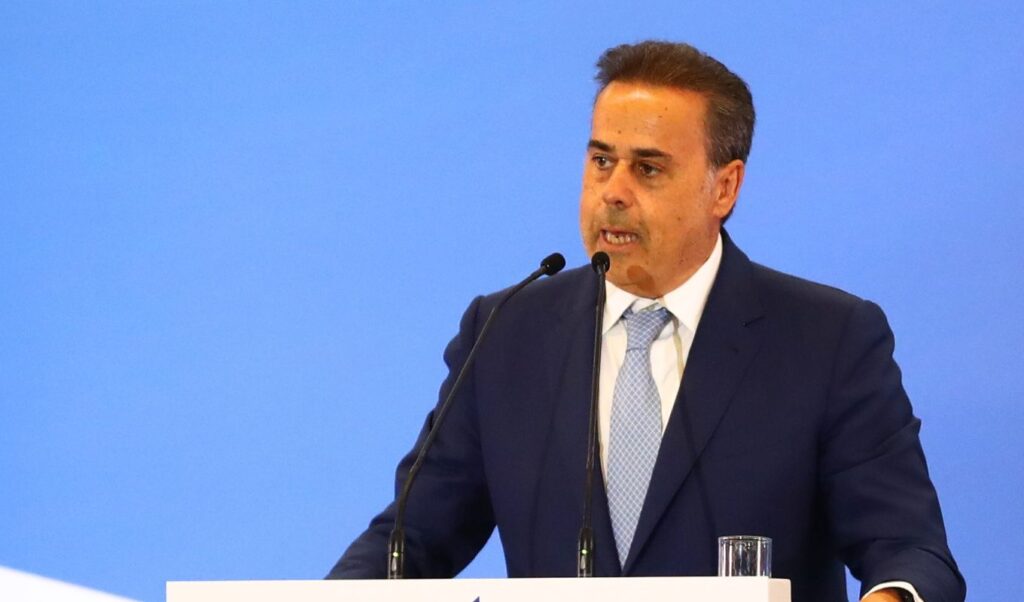
At the Global Energy Forum of the Atlantic Council in Washington, Environment and Energy Minister Stavros Papastavrou spoke about the role of Greece and Cyprus as a strategic hub in the new energy architecture of Europe and the Eastern Mediterranean. Specifically, Mr. Papastavrou connected energy security with national security, emphasizing the need for energy realism, technological neutrality, infrastructure strengthening, and diversification of energy sources and routes. At the center of his intervention were the Vertical Corridor, the 3+1 scheme (Greece, Cyprus, Israel and USA), the East Med Gas Forum, electrical interconnections, hydrocarbons, the Greek EU presidency in 2027, and the increasing electrical energy needs created by artificial intelligence.
Papastavrou: Energy weaponization affects global and regional security
Referring to the challenges created in energy security both by the Russian invasion of Ukraine and by threats connected to the Strait of Hormuz, the minister emphasized: “We learned it the hard way”. As Mr. Papastavrou stressed, these crises highlighted the “systemic risk of energy weaponization,” whether it comes from Russia, Iran, or any other country. He added that Europe must be united against this phenomenon, as energy weaponization affects global and regional security.
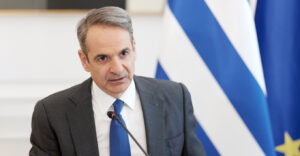
At the same time, the Environment and Energy Minister referred to the concept of energy realism, which, as he said, has been highlighted by Prime Minister Kyriakos Mitsotakis with his article in the Financial Times and with his interventions in the European Council. He noted that Europe set a “noble goal” for clean energy, but to a degree turned it into a moral issue. As he explained, the discussion about hydrocarbons was often treated negatively, while other technologies, such as blue hydrogen, appeared with a much more positive sign.
“We must be technologically neutral”, he emphasized, noting that Europe needs energy and that “energy security is national security”. In this context, he mentioned that Europe must utilize all the domestic resources it has, in order to strengthen its energy independence.
Energy realism & carbon tax on global shipping
Mr. Papastavrou also addressed the discussion that took place in Europe about imposing a carbon tax on global shipping. As he said, global shipping is responsible for less than 3% of global emissions, while transporting more than 90% of global trade. “This is not a good starting point”, he noted characteristically.
According to the minister, “European policy now recognizes that the goals for clean energy did not adequately take into account economic competitiveness and social cohesion. He clarified that this is not about changing direction, but about “adjusting the pace”.
He noted that, compared to the 2022 crisis, when it took about 12 to 14 months for the EU to realize the need for joint action, today European reactions are faster. As he said, the energy realism that started from Prime Minister Mitsotakis has now evolved into a “common sense approach” for the majority of European countries.
Greece and Cyprus strategic hub in new energy geometry
Mr. Papastavrou gave special emphasis to the new energy geography of the Eastern Mediterranean, speaking of a “new geometry of energy”. As he said, Greece and Cyprus are becoming “the epicenter, the strategic hub of this new geometry”.
Describing this new architecture, he referred to the Vertical Corridor, through which American LNG enters Greece and then, through the infrastructure, is directed towards Bulgaria, Romania, Moldova and Ukraine. As he noted, after decades during which natural gas moved from East to West, a vertical axis is now being created that connects Greece with the energy security of Eastern Europe and Ukraine.
The strategic triangle with Israel
In the same logic, Mr. Papastavrou spoke about the strategic triangle with Israel, which, with the participation of the United States, acquires a quadrilateral dimension. He also referred to the “cooperation circle” of the East Med Gas Forum, emphasizing that the importance of this framework should not be underestimated.
Of particular interest was his reference to the fact that, the previous day, representatives from Israel and Palestine sat at the same table. “After three years of war, energy becomes a bridge for the region”, he said, presenting energy not only as a field of competition, but also as a tool for regional cooperation.
The minister integrated into this new geometry the “diagonal line” of the IMEC corridor, as well as major electrical interconnection projects. He specifically referred to the Great Sea Interconnector, the electrical interconnection of Greece, Cyprus and Israel, as well as GREGY, the Egypt-Greece interconnection. As he said, through these projects the region becomes the epicenter of the new European energy architecture.
At the same time, he noted that more and more countries in the region realize that they have more to gain through cooperation than by acting alone. He even mentioned the participation of the Energy Ministers of North Macedonia and Serbia in a recent meeting in Athens, where they expressed interest in an expanded Vertical Corridor. According to Mr. Papastavrou, these new routes are evolving into “arteries of trade and prosperity” for the region.
Papastavrou’s position on the 3+1 scheme
Answering a question about the desired results of the ministerial meeting of the 3+1 scheme in Houston, Mr. Papastavrou said that the goal is for the initiative to acquire substantial content. As he mentioned, until today 3+1 constitutes a very important intergovernmental initiative with energy at its center, but now there is the expectation to create something more permanent. In this context, he referred to the prospect of cooperation with the East Med Energy Center of the Baker Institute at Rice University, so that the four countries acquire a permanent center of geopolitical cooperation. As he said, the Baker Institute is a leading institution in energy geopolitics and this cooperation has broader significance for Greece, Cyprus, Israel and the United States.
Mr. Papastavrou emphasized that both 3+1 and the East Med Gas Forum are not exclusionary initiatives. On the contrary, as he said, “what they exclude is the weaponization of energy”. What they include, he added, is a cooperation framework based on trust, the logic of mutual benefit, respect for common rules and proper business practices, without unilateral actions and threats of violence. According to him, this culture of cooperation can bring the Eastern Mediterranean to the forefront of the global energy scene.
In response to a question about the Greek EU presidency in the second half of 2027, Mr. Papastavrou avoided referring to specific projects, noting that Ireland and Lithuania come first. However, he described the basic guidelines, which, as he said, will be energy realism and pragmatism. The minister pointed out that Europe does not have a real internal energy market, but 27 fragmented markets. Therefore, he said that a basic goal will be to continue the work that Cyprus is doing on the networks issue, as well as to strengthen energy infrastructure. He also emphasized that countries that have energy surplus must be willing to share it, in order to create a real European market.
At the same time, Mr. Papastavrou advocated for a more pragmatic approach to hydrocarbons. He referred to Cyprus’s “Aphrodite” field and Romania’s “Neptune”. For Greece, he noted that after more than half a century there is the prospect of an exploratory drilling by ExxonMobil in the Ionian Sea and seismic surveys by Chevron south of Crete. Mr. Papastavrou emphasized that Europe needs a balanced energy mix, which will not exclude any technology and will be technologically neutral. In this context, he also referred to nuclear energy, noting that there are countries that are very advanced in this field, while Europe must follow the progress made by the United States, including small modular reactors, SMRs.
“For artificial intelligence we need a lot of energy”
He made a special reference to the energy needs created by artificial intelligence. As he said, Europe is following what the United States is putting in the discussion, while he referred to the opinion of American Interior Secretary Doug Bergum that the race for artificial intelligence resembles the arms race of the 1980s and that whichever side prevails will determine and control developments. Mr. Papastavrou warned that Europe must not find itself in the position of countries that did not participate in the industrial revolution. “For artificial intelligence we need a lot of energy”, he said characteristically.
In closing, the Environment and Energy Minister summarized the role of the US in three points, saying that “more energy, more interconnections and closer cooperation with the United States” is needed. As he said, energy constitutes a bridge for transatlantic cooperation, something that is evident both in the gradual independence from Russian natural gas and in the challenges created by artificial intelligence.