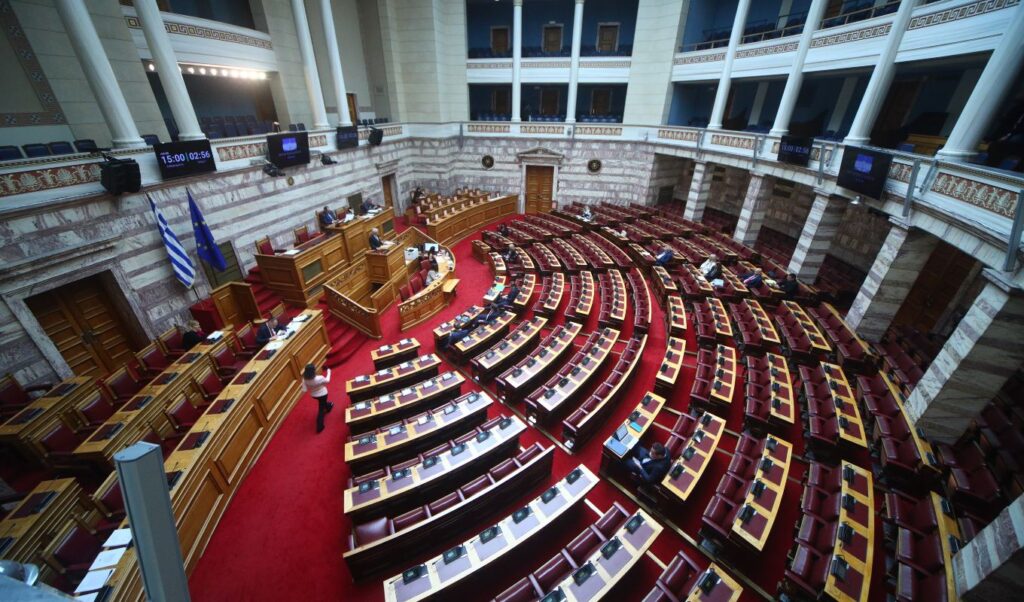
Twelve major changes are being brought forward by the constitutional revision being voted on this Monday by the Greek Parliament — however, it is the next parliament that will make the final decisions. The legislature that emerges from the 2027 national elections will, in its first session, decide by a majority of at least 180 MPs on the provisions to be revised (since none of the proposed articles are expected to secure that majority in the current parliament). This, of course, gives New Democracy the opportunity to incorporate its proposed institutional reforms into its pre-election campaign, as the Greek people will ultimately decide at the ballot box whether these changes move forward or not.
“The elections will be held in 2027, and our pre-election campaign will be built, in part, on our constitutional revision proposals, as we believe popular legitimacy is required — in the sense of putting these issues before the electorate ahead of the next elections,” Prime Minister Kyriakos Mitsotakis recently stated.
At the same time, this gives New Democracy an opening to attack PASOK, which the ruling party accuses of political deception, having voted “present” on 15 articles during the constitutional revision process — articles it had agreed with in principle. “In a process like this, voting ‘present’ means nothing. PASOK kicked away an opportunity for consensus, even on articles it had itself proposed to change,” government sources at Maximos Mansion stated pointedly.
Constitutional revision: The 12 proposed changes put to a vote
The twelve key changes that will come into effect — provided 180 votes are secured in the next parliament — are as follows:
1) Artificial Intelligence is enshrined in the country’s constitution for the first time, with the following wording: “Artificial Intelligence must serve individual freedom and societal well-being, so that its risks are mitigated and its benefits are harnessed.”
2) The state’s monopoly on higher education is broken, opening the door to “the provision of higher education by university-level legal entities, which may be of public or private character, with full self-governance, under state supervision and subject to the guarantee of a high standard of studies provided.”
3) In the areas of urban planning and spatial development, protections are expanded to include not only property rights and compensation for use restrictions short of expropriation, but also the ability to transfer building coefficients — introducing a framework of dynamic urban planning.
4) The President of the Republic will be elected for a single term of six years, rather than the current five-year term, with no possibility of re-election.
5) The ability to dissolve parliament over a national issue of exceptional importance is abolished. Dissolution will instead occur upon a government proposal and a parliamentary vote for the renewal of the popular mandate — effectively a self-dissolution mechanism.
6) With an eye toward the controversial 2015 referendum, rules for the proper conduct of referendums are introduced: questions must be formulated in a clear and comprehensible way for citizens, and a minimum of 20 days must elapse between the announcement and the holding of any referendum.
7) Greeks living abroad will gain the right to exercise their voting rights via postal vote.
8) Looking back to the pre-bailout era, a constitutional provision on fiscal responsibility is introduced, stipulating that “the Budget must ensure sustainable fiscal operation.”
9) Under the much-debated Article 86 on the criminal prosecution of ministers, the procedure is reformed as follows: investigations and preliminary examinations will be conducted by an appeals court prosecutor, with a prosecution recommendation issued by a supreme judicial body. The requirement to transmit case files to parliament “without delay” is abolished, as is parliament’s power to conduct its own preliminary examination. The decision to prosecute government ministers or deputy ministers for criminal offences committed in the exercise of their duties will be made by the full parliament, by an absolute majority of all MPs, via a roll-call vote.
10) Two major changes are introduced regarding the judiciary: First, judges will be prohibited from serving in any capacity in government or being appointed to independent authorities for at least three years after their retirement. Second, addressing the long-standing demand regarding the heavily debated Article 90, promotions to the leadership positions of the three supreme courts will be decided by a special parliamentary committee — without government intervention — from a shortlist of three judges per vacancy, proposed by the respective plenary bodies of those courts.
11) The constitutionality of legislation is clarified through the introduction of preventive constitutional review by the Supreme Special Court for already-passed bills. Any ruling by the Supreme Special Court on the constitutionality of a passed bill will be binding on all courts in subsequent constitutional review proceedings.
12) For the first time, the constitution will enshrine a mandatory evaluation system for civil servants, based on the principles of impartiality, neutrality, professional competence, and efficiency, with the possibility of the Supreme Council for Civil Personnel Selection (ASEP) also participating in the process.
Published in Parapolitika